Table of Contents
There are two problems with acid reflux: the burn that’s happening right now, and the frequency that keeps bringing it back. The fix for one doesn’t help the other. Antacids work in minutes but are useless for prevention. PPIs take days to kick in but suppress 90-95% of acid production once they do. Most people pick the wrong tool because nobody explains the ladder. Here’s what each option does, when to use it, and the lifestyle changes that reduce how often you’re reaching for any of it.
1. Antacids
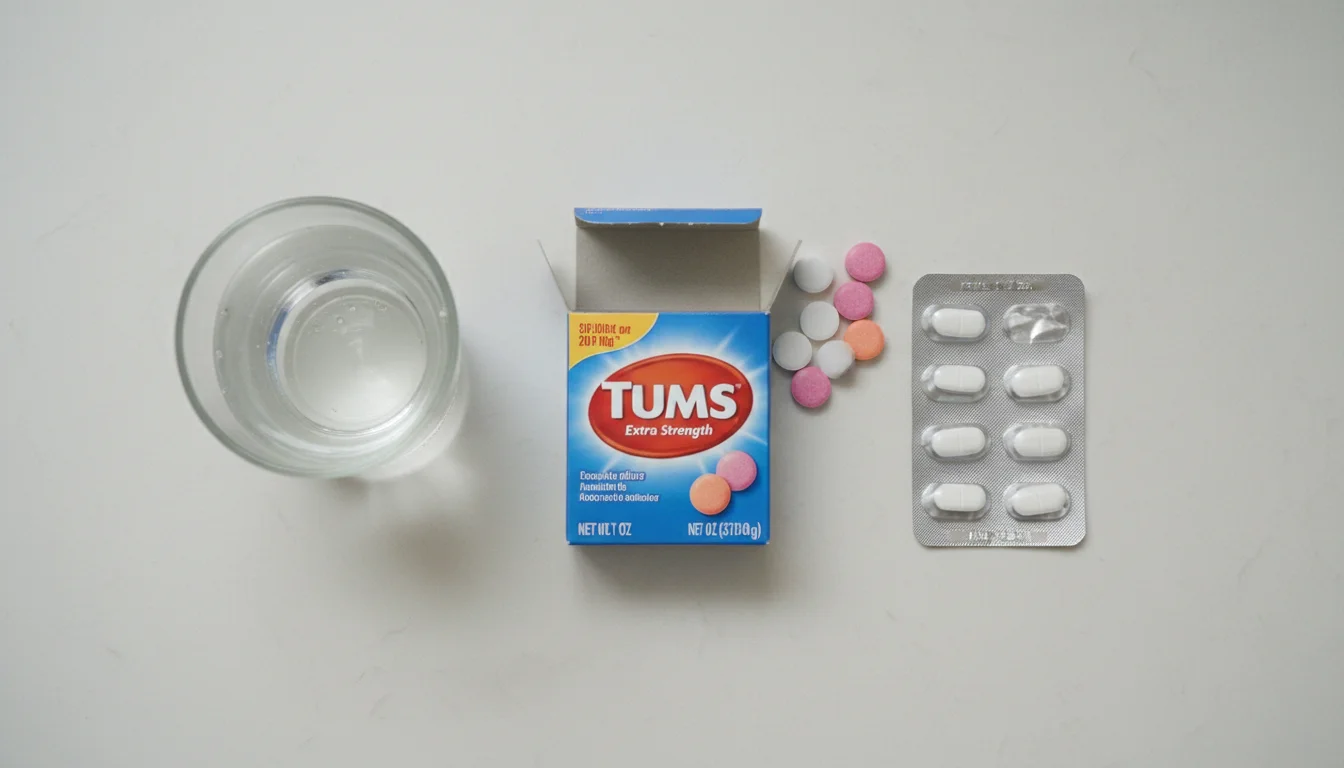
The fastest option. Antacids (Tums, Rolaids, Maalox, Mylanta) neutralize stomach acid on contact – calcium carbonate versions like Tums work in 5-10 minutes. Liquid antacids coat the esophagus more thoroughly than tablets, which is why they’re better when the burn is high in your chest. Tablets are easier to carry.
They don’t prevent anything. They put out a fire that’s already burning. If you’re reaching for them more than twice a week, that’s telling you something – you need a longer-acting option, not more Tums.
Don’t take antacids within 2 hours of other medications. They interfere with absorption of antibiotics, thyroid drugs, and a handful of others. This catches people out.
2. H2 Blockers
The most underused option in the OTC arsenal. H2 blockers (famotidine/Pepcid, cimetidine/Tagamet) reduce stomach acid production rather than neutralizing acid that’s already there. They take 1-2 hours to work, but once they kick in they last 8-12 hours. That time profile makes them useful in ways antacids aren’t – and most people skip straight from Tums to PPIs without ever trying them.
The smart use is proactive: take one 30-60 minutes before a meal you know will trigger symptoms. Pizza night, a work dinner with wine, anything with tomato sauce. By the time the food hits your stomach, acid production is already suppressed rather than firing at full capacity. For nighttime symptoms specifically, a dose before dinner keeps acid down through the 8-12 hours when you’re lying flat and most vulnerable.
Famotidine (generic or Pepcid) is the one to buy. Ranitidine (Zantac) was pulled from the market due to contamination concerns, so don’t bother looking for it. Generic famotidine at 20mg OTC is identical in effect to brand Pepcid at roughly a quarter of the price.
Tolerance does develop with daily use over several weeks – the acid-suppressing effect gradually diminishes as your body compensates. H2 blockers are better suited to intermittent or situational use than as a daily maintenance drug. If you’re finding you need them every single day, PPIs maintain their effectiveness much better over time and are the appropriate next step.
3. Proton Pump Inhibitors
The heavy artillery, and the slowest to act. PPIs (Prilosec, Nexium, Prevacid) block the enzyme that pumps acid into your stomach, cutting production by 90-95%. They’re the right choice for people with frequent or chronic symptoms who’ve already tried antacids and H2 blockers without getting adequate control.
The catch: they take 1-4 days to reach full effect. They do nothing for a current episode. For the first few days while you’re waiting for the PPI to build up, keep taking antacids for immediate relief alongside it.
Timing is non-negotiable: one pill in the morning, 30 minutes before breakfast. This isn’t arbitrary. PPIs activate when acid pumps in your stomach are actively secreting – which happens in response to eating. Taking a PPI after you’ve already eaten misses the window when the most pumps are available to be blocked. Some people take it and wonder why it doesn’t seem to be working – they’re taking it with food or after meals.
OTC versions are designed for 14-day courses. Generic store brands (omeprazole 20mg at most pharmacies) contain the same active ingredients as Prilosec and Nexium for significantly less. If symptoms come back after finishing the 14-day course, see a doctor rather than running another solo cycle – that pattern indicates something that needs a proper diagnosis, not indefinite self-medication.
4. Don’t Lie Down After Eating
No pills, no cost. Just timing. Stay upright for at least 3 hours after eating. Gravity keeps acid in your stomach; lie down and it pools against the lower esophageal sphincter (LES) and works its way up.
Dinner at 7 means no bed before 10. That’s it. But it applies beyond bedtime – post-lunch couch naps and reclining on the sofa after dinner count too. The LES doesn’t know whether it’s 2pm or midnight. This single habit eliminates nighttime heartburn for a lot of people who try it consistently. Before buying a foam wedge or taking any medication for nighttime symptoms, just try this for a week and see how much it helps.
5. Elevate Your Head While Sleeping
For when the 3-hour rule isn’t enough on its own, or when you have reflux that wakes you up mid-sleep. Raise the head of your bed 6-8 inches (15-20 cm) using a foam wedge pillow. A proper wedge is significantly better than stacking regular pillows – pillows compress and shift during the night, and by 3am you’ve likely migrated back to flat, which negates the whole thing.
Left-side sleeping compounds the effect. The stomach’s position in the abdomen means that when you’re on your left side, the gastroesophageal junction sits above the stomach’s acid pool. On your right side, it sits below it. The practical difference is real – people with reflux consistently report worse symptoms when they sleep on their right side. If you’re waking up with a burning throat, check which side you’re sleeping on.
Combine the wedge with left-side positioning and you’ve covered the mechanical side of nighttime reflux without medication.
6. Track and Eliminate Trigger Foods
This is the method that addresses root cause rather than symptoms. The usual suspects – tomatoes, citrus, chocolate, coffee, alcohol, fried foods, onions, mint – are well-documented, but individual triggers vary enough that the list is only a starting point. Some people can drink coffee every day without issue but can’t touch anything with tomato. Others can eat a whole pizza and only have problems if they have wine with it.
The only reliable way to map your specific triggers is to track them. Write down what you eat and when symptoms start. Keep it simple – a notes app entry after each meal with what you had and whether you noticed anything within 2 hours is enough. The pattern usually becomes visible within a week or two.
Once you’ve identified the culprits, cut them fully and see if the reflux stops. Not "reduce slightly." Cut them. Then, once symptoms are under control, reintroduce one food at a time to find your actual threshold. This is how you end up with a concrete list of your personal triggers rather than avoiding everything on every generic list indefinitely.
7. Eat Smaller Meals
A full stomach creates pressure against the LES. More volume means more upward force against the valve that’s supposed to keep acid down. This is basic physics – the stomach is a pressurized container and the LES is the seal. Overfill the container and the seal fails.
Aim for 4-5 meals of roughly 300-500 calories each instead of three large ones. The total daily intake stays the same; you’re just distributing it so your stomach is never at capacity.
Eating speed matters as much as eating size. Your brain takes about 20 minutes to register fullness via hormonal signals from the gut. Eat quickly and you overshoot your comfortable capacity before the feedback loop catches up. Slow down, stop before you feel full (not when you feel full), and you’ll consistently eat less without consciously restricting.
This is a long-game method. It won’t help during a current episode and the benefit builds over weeks rather than days. But combined with the posture habits above, it reduces the baseline conditions that allow reflux to happen in the first place.
When to See a Doctor
Home treatment is appropriate for occasional or mild acid reflux. See a doctor if:
- Symptoms occur more than twice a week for 3+ weeks despite OTC treatment
- You have difficulty swallowing or feel like food is getting stuck
- You’re experiencing unintentional weight loss
- You have chest pain (this needs to be distinguished from cardiac symptoms – don’t assume it’s reflux)
- You’re vomiting blood or have blood in your stools
Frequent untreated reflux can lead to esophageal damage, Barrett’s esophagus, and in rare cases esophageal cancer. The OTC options above are appropriate for management of mild to moderate symptoms. Persistent symptoms warrant a proper diagnosis.
FAQ
How do you get rid of acid reflux fast?
Antacids – Tums, Rolaids, Maalox – work within minutes. Chew a calcium carbonate tablet (Tums) with water and you’ll feel relief in 5-10 minutes. Liquid antacids coat the esophagus more thoroughly and work slightly faster if the burn is high in your chest rather than in your stomach. H2 blockers take 1-2 hours, PPIs take days; neither helps with immediate symptoms. For acute relief right now, it’s antacids. Everything else is for preventing the next one.
Does drinking water help acid reflux?
A little, briefly. Water dilutes stomach acid and can help wash acid back down the esophagus. It won’t neutralize the acid the way antacids do, but it’s a reasonable first response if you don’t have anything else available. Alkaline water (pH 8+) shows modest benefit in some studies, more than plain water. One constraint: don’t gulp large amounts at once – a very full stomach increases upward pressure on the LES, which is exactly what you’re trying to avoid.
What drink clears acid reflux?
Water is the safest option and a reasonable starting point. Ginger tea has modest anti-nausea and anti-inflammatory properties and is one of the better-studied herbal options. Aloe vera juice (unflavored, food-grade – not the topical gel) can soothe an irritated esophagus. What to avoid: coffee, carbonated drinks, citrus juices, alcohol, and notably peppermint tea. Peppermint relaxes the lower esophageal sphincter, which makes reflux mechanically worse despite the momentary soothing sensation. Milk is the classic home remedy that doesn’t really work – it gives temporary relief by coating the esophagus but stimulates more acid production within an hour or two.
How do you stop acid reflux at night?
Two things work consistently: don’t eat within 3 hours of bed, and elevate your head 6-8 inches (15-20 cm) with a foam wedge pillow. Left-side sleeping also reduces symptoms – stomach anatomy means the gastroesophageal junction is above the acid pool when you’re on your left, below it when you’re on your right. If those mechanical adjustments aren’t enough, famotidine (an H2 blocker) taken before dinner suppresses acid production for 8-12 hours, covering the overnight window when you’re lying flat and most vulnerable to aspiration.