
Table of Contents
When over-the-counter skincare isn’t producing results, the professional tier offers treatments that work at a different depth. These four options range from a simple prescription to invasive procedures – listed roughly in order of intensity and commitment.
1. Prescription Retinoids
Tretinoin (Retin-A) is the version of retinol that actually has decades of clinical data behind it. Over-the-counter retinol converts to retinoic acid in your skin over several steps, losing potency along the way. Prescription tretinoin is already retinoic acid. It works faster, more completely, and at lower concentrations.
Start with 0.025% applied every third night after cleansing. The first 4-8 weeks will involve peeling, redness, and sensitivity. That’s the adaptation period – push through it by moisturizing well and cutting back frequency if the irritation becomes severe. Most people can work up to nightly use within 3 months.
Noticeable pore reduction typically shows up at 3-4 months. The mechanism is collagen synthesis and increased cell turnover: the walls around pores firm up, and dead skin cells that would clog and stretch pores are shed faster. Higher concentrations (0.05%, 0.1%) are available for people who’ve built tolerance, with stronger results and more irritation.
Adapalene (0.3%) and tazarotene are alternatives with slightly different irritation profiles. Your dermatologist will guide the choice. All require sunscreen every single morning – prescription retinoids make your skin significantly more photosensitive.
2. Professional Microneedling
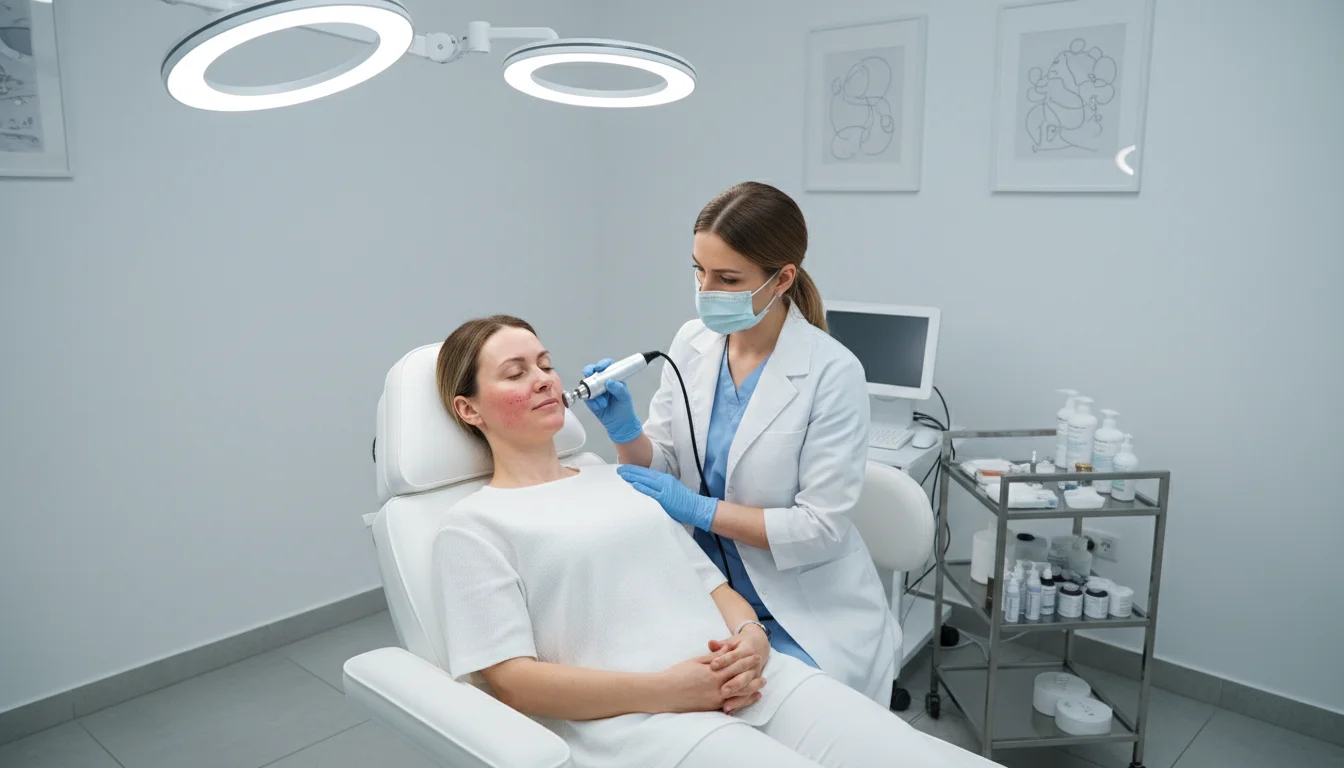
A dermatologist or trained esthetician uses a device with fine needles to create controlled micro-injuries in the dermis. Your skin’s healing response produces new collagen, which tightens the tissue around pores and improves overall texture.
Professional treatment uses needle depths of 0.5-2.5 mm depending on the area and goal. At-home rollers are shallower and significantly less effective. After a session, skin is red for 24-48 hours – plan around it.
Most protocols call for 3-6 sessions spaced 4-6 weeks apart. Results appear gradually as collagen forms over several months. Each session runs $200-700 depending on location and provider. This isn’t casual maintenance – it’s a treatment course with a timeline and a cost. But the pore reduction is visible and durable.
Some providers combine microneedling with radiofrequency (RF) energy, which adds heat to stimulate deeper collagen remodeling. More effective, more expensive, more downtime.
3. Laser Therapy
Fractional lasers deliver controlled thermal energy to columns of skin, leaving surrounding tissue intact. The heating triggers collagen remodeling in the treated zones – skin tightens, pores shrink, texture improves. Different lasers work at different depths and with different tradeoffs between results and recovery.
Ablative lasers (CO2, Er:YAG) produce the most significant results by essentially resurfacing the skin surface. Recovery takes 5-10 days of significant redness and peeling. Non-ablative lasers (Fraxel, Clear + Brilliant) are gentler with 1-3 days of redness but require more sessions (typically 4-5 versus 2-3 for ablative) to achieve comparable improvement.
Sessions cost $500-2,500 depending on the laser type and treatment area. Results last several years but aren’t permanent – most people do one maintenance session per year after the initial series.
If oil production rather than collagen loss is your primary issue, ask your provider about IPL (intense pulsed light), which targets sebaceous glands directly rather than stimulating collagen.
4. Oral Medications
For cases where excess sebum production is the underlying driver – not just general pore appearance, but oily skin that keeps clogging and stretching pores despite topical treatment – dermatologists have two oral options.
Spironolactone is prescribed primarily to women. It blocks androgen receptors that drive sebaceous gland activity, reducing oil production over several months. Common side effects include irregular periods and potassium changes that require monitoring. It’s not for pore cosmetics as a first-line treatment; it’s for hormonally driven oily skin with acne that happens to improve pore appearance as a side effect.
Isotretinoin (Accutane) is the heavy option. It shrinks sebaceous glands, dramatically reduces oil production, and for many people produces lasting changes in skin texture. It also carries serious risks: severe birth defects requiring strict contraception protocols, liver effects requiring regular blood work, and psychological side effects in some patients. It requires a supervised treatment program through iPLEDGE in the US.
Neither medication is appropriate as a standalone treatment for cosmetic pore reduction. Both are appropriate for severe acne that happens to also address pore size – the pore improvement is a welcome side effect, not the primary indication. If you’ve exhausted topical options and professional procedures, these conversations belong with a dermatologist, not a general practitioner.

Comments