Table of Contents
Knowing how to get rid of a side stitch comes down to two distinct goals: stopping one mid-run, and preventing the next one. The first three methods below handle the acute case. The last two are for runners who get them regularly.
A side stitch is almost always diaphragm-related – specifically, stress on the ligaments connecting the diaphragm to internal organs. Right-side stitches (the more common type) usually involve the liver. Left-side stitches involve the spleen. The repetitive up-down force of running tugs on these ligaments with every stride. That’s why stitches hit during runs but not while sitting.
1. Slow Your Pace
Drop to a jog or brisk walk the moment the stitch starts. Don’t push through it – running hard through a stitch tightens the diaphragm further and usually makes it worse. At reduced pace, the tugging force on the diaphragm ligaments drops enough for the cramp to release.
Most stitches ease within 1-2 minutes of slowing. Once it clears, build back gradually – jumping straight to full pace often brings it back.
2. Press on the Painful Spot
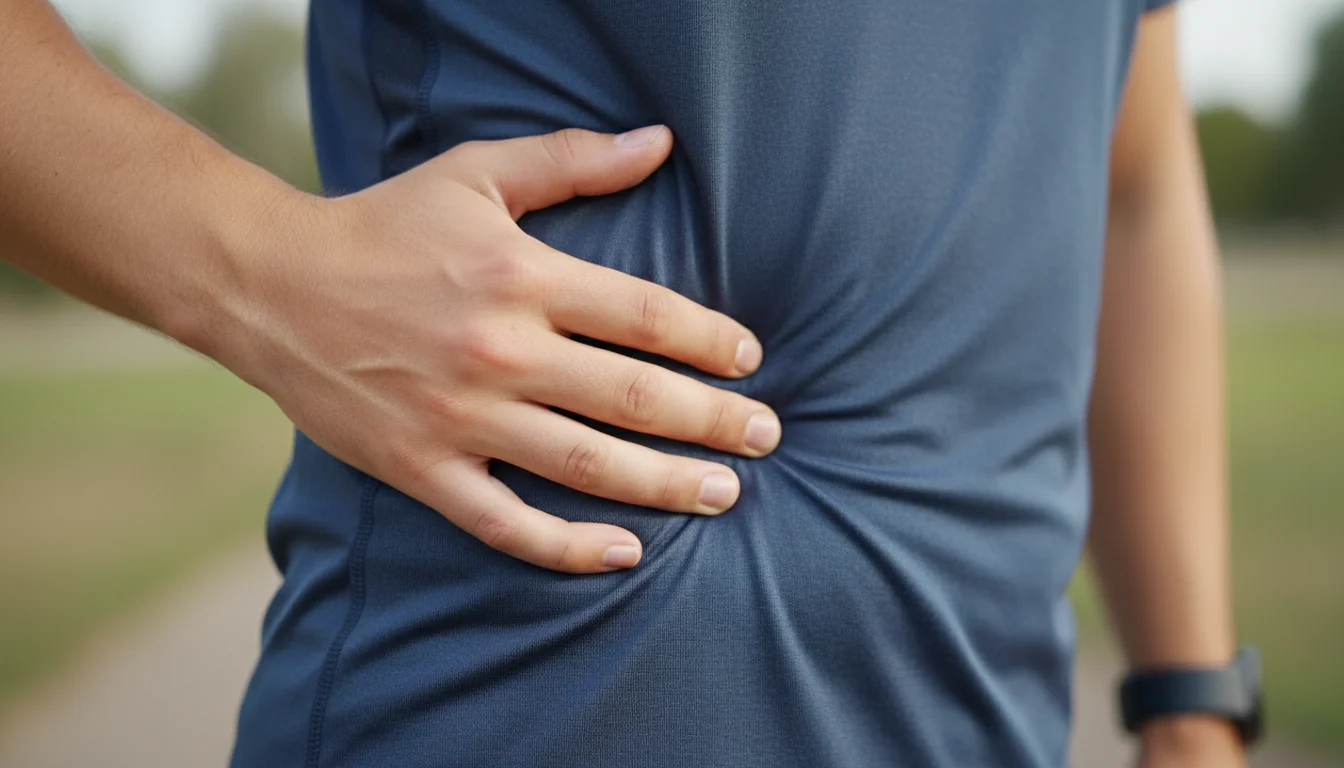
While slowing down, push two or three fingers firmly into the stitch. For right-side stitches, press upward and slightly inward toward the ribcage. Hold firm, constant pressure for 30-60 seconds – not a poke, but a sustained push.
Some runners find pressing while exhaling makes it more effective. The exact mechanism isn’t certain, but the pressure appears to interrupt the pain signal and reduce tension in the diaphragm ligaments. Don’t press a left-side stitch on the right side and vice versa – the pressure needs to be directly on the source.
3. Belly Breathing
Take a deep breath, pushing your belly out rather than lifting your chest. Hold briefly. Then exhale forcefully and completely – push all the air out, don’t just let it drift. Repeat 3-5 times.
This activates the diaphragm more fully and can break the spasm. The combination of slow pace, direct pressure, and forced belly breathing works faster than any one technique alone.
One technique most guides skip: exhale on the footstrike of the leg opposite the stitch side. If the stitch is on the right, exhale as your left foot hits. This reduces peak diaphragm stress at the moment of maximum ground impact. It takes a few runs to build the coordination, but regular runners report it cuts stitch frequency noticeably.
4. Avoid Eating Before Exercise
Eat your last full meal at least 2-3 hours before running. For a small snack, allow 1.5-2 hours. A loaded stomach is heavier and pulls down more forcefully on the diaphragm ligaments with each stride.
What you eat matters too. Fat and fiber slow gastric emptying – avoid high-fat or high-fiber foods in the 2-3 hours before a run. Protein and simple carbs clear faster. Skip carbonated drinks for at least 30-60 minutes pre-run; gas volume adds to the diaphragm stress.
5. Strengthen Core Muscles
A weak core pushes more stabilization work onto the diaphragm during running, which accelerates fatigue and increases susceptibility to stitches. Core strength doesn’t eliminate stitches overnight, but regular runners who add core work consistently report fewer of them after 6-8 weeks.
Three times a week is enough: planks held 30-60 seconds, dead bugs, bird dogs, side planks. None of these require a gym. This is a prevention strategy, not a fix for a stitch you’re having right now – but it’s the closest thing to a permanent solution for runners who get them regularly.
Frequently Asked Questions
What causes a stitch in the side?
Most likely: stress on the ligaments connecting the diaphragm to internal organs. The liver on the right side is most commonly involved, which is why right-side stitches are more common. Every running stride produces an up-down force that tugs on these ligaments. The exact cause is still debated, but ligament stress and diaphragm fatigue are the leading explanations.
How long does a side stitch last?
Typically 1-2 minutes once you slow down. If it hasn’t cleared after 2-3 minutes at reduced pace, add the pressing and belly-breathing techniques. A stitch that doesn’t clear after several minutes of intervention, or that persists after you stop entirely, is unusual – that’s worth medical attention, because at that point it may not be a stitch.
What can be mistaken for a side stitch?
Poor posture, gas buildup, and digestive issues can all produce side pain without exercise. The distinguishing feature of a true stitch is that it appears during exercise, usually in the upper-right or upper-left abdomen, and clears within minutes of slowing down. Pain that appears without exercise, persists after stopping, or comes with nausea, shortness of breath, or shoulder pain should be checked by a doctor.
Why does my stitch keep coming back?
Recurring stitches despite using the immediate fixes usually come down to: starting runs too hard without a warmup, eating too close to exercise, carbonated drinks pre-run, or an underconditioned diaphragm and core. Work backward through those causes. For most regular runners, consistent core work is what finally breaks the pattern.