Table of Contents
Weeds don’t care about your plans. They colonize bare ground, choke out what you actually want growing, and bounce back faster than most people expect. The right approach depends almost entirely on scale. A dandelion in a garden bed is a five-second job. An acre of blackberry and thistle is a months-long project requiring a completely different toolkit.
Here’s how to match the method to the actual problem.
Grazing and Animal Methods
For large-scale infestations, particularly on terrain where machinery won’t go, goats are the most effective tool available. They eat the weeds most people avoid – poison ivy, blackberry brambles, thistles, stinging nettle, kudzu – and they reach steep hillsides, rocky ground, and overgrown fence lines where nothing else can.
Selective grazing works when you concentrate the animals using portable electric fencing and rotate them through problem zones. Casual browsing won’t dent established infestations. High-density stocking (30-40 goats per hectare for 3-4 days at a time) is what actually shocks tough weed populations. Timing matters too – spring grazing in March-April catches weeds when they’re young and prevents early seed set. Follow-up rounds in June-July and August-September exhaust root reserves.
The trampling effect matters independently of what they eat. Hooves break up compacted soil and disrupt shallow roots, creating conditions where you can seed competitive plants immediately after the goats leave. The combination method – goats clear, you seed aggressively within a week – is how you actually hold reclaimed ground long-term.
Goat rental services handle the logistics. They drop off animals, rotate them, pick them up when done.
Smothering and Physical Suppression
When animals aren’t practical, blocking light is the next most reliable option. Tarping (black plastic or heavy landscape fabric staked over problem zones for 8-12 weeks during growing season) kills everything underneath without chemicals or labor beyond the initial setup. It’s slow. It’s ugly. It works.
Deep mulch follows the same principle but for maintenance rather than active clearing. A 4-6 in (10-15 cm) layer of wood chips, straw, or shredded bark prevents weed seeds from germinating and smothers shallow growth. This is a layer you put down after you’ve knocked back an infestation, not a first response to established weeds.
In lawn and garden transition zones, mulch around edges cuts off the main invasion route. Creeping weeds like creeping Charlie spread through the gap between beds and grass. Keep that zone mulched and edge it clean twice a season.
Manual and Spot Removal
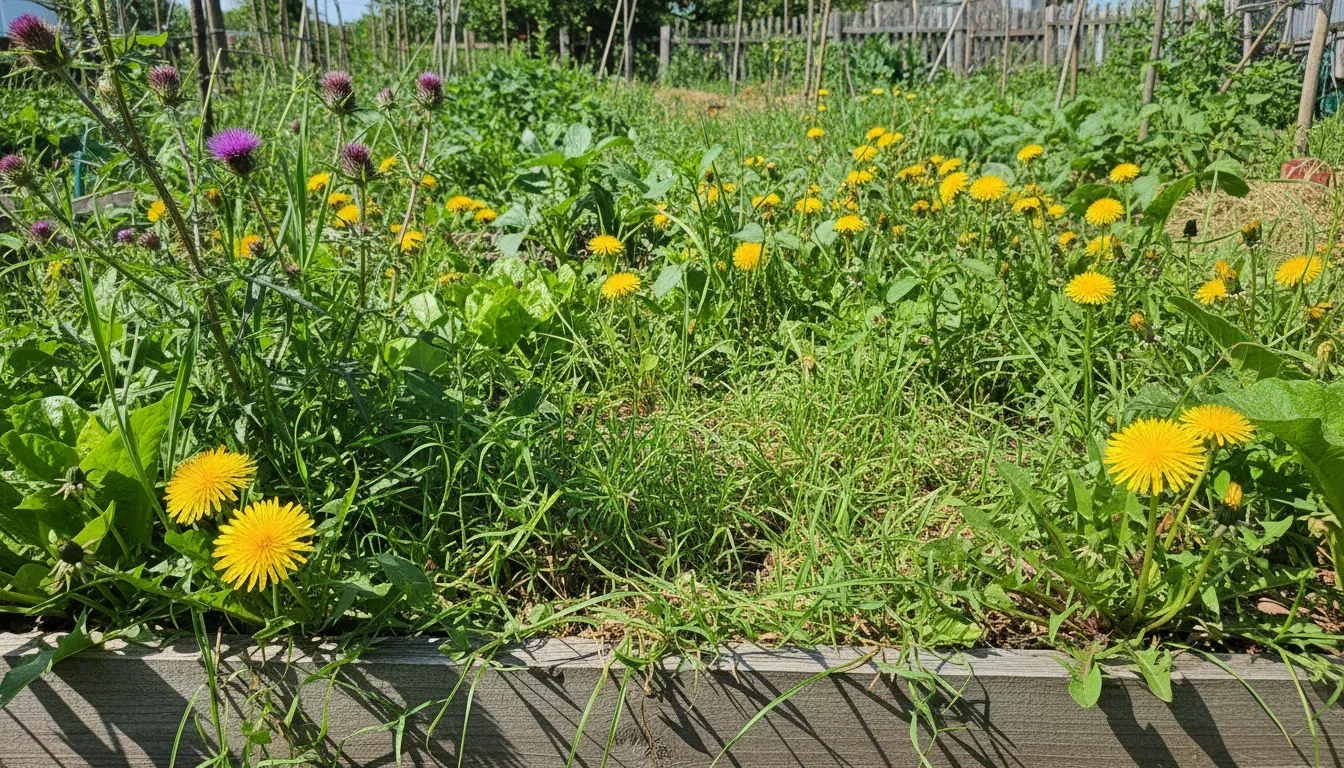
At smaller scales, pulling works fine if you do it right. The two rules: pull when soil is moist, and get the full root. Yanking the top off a dandelion leaves a 10 in (25 cm) taproot that’ll resprout in days. Use a weeding knife or fishtail weeder and go down at least 4 in (10 cm). Annual weeds (chickweed, crabgrass, purslane) are easier – get them before they flower and you’ve stopped the next generation entirely.
For hardscaping – driveways, patios, gravel paths – horticultural vinegar (20% acetic acid, not kitchen strength) kills top growth on contact. Boiling water does the same. Neither kills deep roots, but on paved surfaces where roots can’t establish deeply anyway, repeated applications are all you need. Don’t use these in garden beds or lawns – they’re non-selective and will burn anything green.
Lawn Health and Competitive Suppression
Weeds don’t invade thick, healthy turf. They invade gaps. Most lawn weed problems are really lawn health problems in disguise.
Mow high (3-4 in / 7-10 cm) – taller grass shades the soil and prevents weed seed germination while developing deeper roots that outcompete weeds for water. Aerate compacted soil in spring or fall so grass roots can actually grow. Overseed bare patches in early fall (cool-season) or late spring (warm-season) – a dense lawn is its own herbicide. Water deeply once or twice a week instead of shallow daily watering, which encourages shallow-rooted weeds.
Corn gluten meal works as a pre-emergent: apply 20 lb per 1,000 sq ft (1 kg per 5 sq m) in early spring before weed seeds germinate, water in lightly, then let it dry to form a barrier. Takes 2-3 years of consistent use to see full results, but it does work.
Where It Shows Up
Weeds adapt to whatever conditions you give them. The specific weed and the specific location changes what works best:
- Weeds in Lawn – competitive lawn care methods that stop weeds without chemicals
- Weeds in Large Areas – goat grazing, tarping, and deep mulch for acreage, pastures, and overgrown land
Scale the approach to the actual infestation. Goats and tarps for large areas. Mulch and mowing for maintenance. Manual removal for small gardens. Match the tool to the job and follow through – one round rarely finishes it.