Table of Contents
You can write. You’ve done it before and you’ll do it again. The problem isn’t ability – it’s that your brain has decided this particular writing session is a threat, and it’s responding accordingly. Avoidance, dread, the sudden urge to reorganize your sock drawer instead of opening that document. All normal. And all fixable. Here’s how to get rid of writers block for real.
The fix isn’t complicated, but it does require you to stop waiting for inspiration and start doing things that create it. Here are 13 methods, ordered by how reliably they work.
1. Freewrite without editing
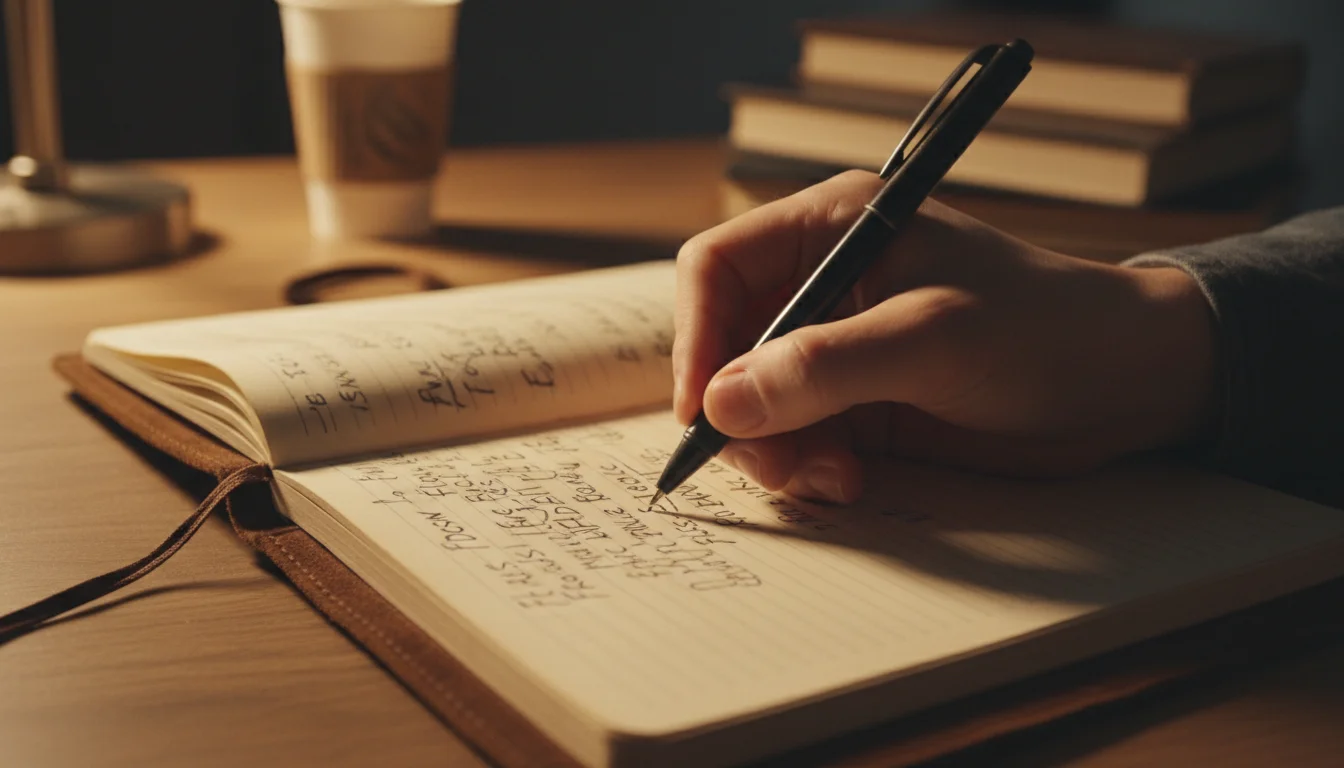
Set a target – 500 words, 1,000 words, whatever – and write without stopping. Don’t edit. Don’t reread. Don’t delete the sentence you just wrote because it sounds stupid. The goal is quantity, not quality. Ugly paragraphs are fine. Nonsensical tangents are fine. A blank page is the only failure.
This is the single most effective cure for writer’s block because it attacks the root cause: the gap between what you want to produce and what comes out. Remove the quality expectation and that gap disappears. You’ll have raw material on the page, and editing bad work into good work is a solvable problem. Staring at nothing isn’t.
Some writers set a deliberate goal of writing 1,000 words of garbage. Sounds counterproductive. But you end up with something to edit, which is infinitely better than a blank document and a growing sense of doom.
2. Take a mindful break
Step away and do something that occupies your body but leaves your mind alone. Walk outside for 20-30 minutes. Take a shower. Cook something from scratch. Garden. The key: physical engagement with low cognitive demand.
Your subconscious keeps working on the problem while your attention is elsewhere. This isn’t wishful thinking – the "default mode network" (the brain regions active during unfocused states) plays a documented role in creative insight. When you stop forcing a solution, this network makes connections that focused staring never will.
But here’s the critical distinction: scrolling social media doesn’t count. Neither does watching videos or reading news. Those demand attention and block exactly the process you’re trying to activate. The break has to be low-stimulus and physical.

3. Reframe the block
Stop calling it a block. "Block" sounds permanent and immovable. Call it resistance, a rough patch, whatever. Then name the actual problem. "I’m afraid this chapter will be bad" is useful because it gives you something specific to address. "I have writer’s block" is a diagnosis masquerading as an explanation.
When you catch yourself opening social media for the fourth time, say it out loud: "I’m avoiding writing." Naming the behavior breaks the automatic loop. You don’t have to fix the avoidance right away. Just notice it. That alone shifts something.
4. Use the Pomodoro Technique
Twenty-five minutes of writing, five-minute break, repeat. After four rounds, take a 15-30 minute break. That’s it.
The trick is that 25 minutes is short enough to disarm resistance. You can endure almost anything for 25 minutes. And most people find they produce more in four focused sessions than in an unfocused full day. If 25 minutes feels impossible, start with 10. Build up.
During breaks, stand and move. Don’t check your phone.
5. Build a writing routine
Pick a time, a place, and a minimum duration. Show up consistently. Write even when the output is terrible. Especially when the output is terrible.
The routine works because it eliminates the daily decision of whether to write. You write today because it’s Tuesday at 6 a.m. and that’s what you do on Tuesday at 6 a.m. Stephen King writes 2,000 words every morning. Maya Angelou rented a hotel room and wrote from 6:30 a.m. to 2 p.m. Your version can be smaller. "I write when the toddler naps" counts. "Fifteen minutes before bed" counts.
Habit formation research puts the median at about 66 days before a behavior becomes automatic. You’ll feel it clicking before then.
6. Set up a distraction-free workspace
Close the door. Put your phone in another room (not silenced on the desk – in another room). Use full-screen mode in your writing app so nothing else is visible. If music helps, instrumental only. If silence helps, earplugs.
Then figure out your peak hours. When are you most alert and creative? Protect that window. No calls, no email, no "quick" tasks. The workspace isn’t just a physical space. It’s the combination of place, time, and reduced stimulation. Environmental cues prime your brain for specific activities – the same principle behind sleep hygiene. Write in the same spot consistently and your brain learns to shift into creative mode when you sit down there.

7. Skip to the exciting part
Stop grinding through the scene that bores you. Jump ahead to the climactic battle, the confrontation, the moment you’ve been anticipating since you started. Write it now.
Two things happen. First, you reconnect with the enthusiasm that started the project. Second, writing that later scene often reveals exactly what the boring earlier section needs to accomplish. You can go back and write the transition when you have a clear destination instead of groping forward in the dark.
Linear writing is a convention, not a requirement. Build the peaks first, then construct the valleys to connect them. Nobody will know what order you wrote it in.
8. Switch to a different creative outlet
Paint. Draw. Play an instrument. Write terrible poetry. Dance. Pick anything creative where you have zero quality expectations. If you write fiction, poetry works precisely because you know nothing about writing it well. The absence of standards lets you create freely.
The block is usually specific to one form of output, not to creativity itself. A blocked novelist can often sketch with no difficulty. Route creative energy through a different channel for an hour, and the momentum often carries back to the original work. But time-box it. An hour is productive. A week of avoidance painting is procrastination with a nicer name.
9. Try writing prompts and exercises
Step away from your main project and work through something structured. Interview your characters. Rewrite a scene from the villain’s perspective. Grab a random prompt and write 500 words.
This differs from freewriting. Freewriting removes all constraints. Exercises provide specific constraints that channel creative energy into a narrow focus. Both bypass the block, but through opposite mechanisms. Character interviews are particularly effective for fiction writers stuck on plot – writing answers in the character’s voice forces you to think from inside the character rather than about them.
10. Keep a distraction notebook
Paper. Next to your workspace. When an intrusive thought hits – that bill, the text you forgot, an idea for a completely different project – write it down in one line. Return to work immediately.
Intrusive thoughts persist because your brain fears you’ll forget them. Externalizing the thought reassures it that the information is stored. Working memory frees up. The notebook is a parking lot, not a destination. One line per thought, maximum. If you’re writing paragraphs in it, you’ve turned it into another procrastination tool.
11. Journal about what’s bothering you
When life stress is the cause, writing about the stress is sometimes more productive than fighting through the block. Dump whatever’s in your head onto a page. Don’t edit, don’t structure, don’t worry about it being coherent. Ten to fifteen minutes of unfiltered writing reduces emotional intensity by forcing your brain to organize chaotic thoughts into linear sentences.
You’re not trying to solve the problem. You’re trying to offload it enough that your creative brain has room to operate.
12. Read other writers on the craft
Stephen King’s "On Writing." Anne Lamott’s "Bird by Bird." Natalie Goldberg’s "Writing Down the Bones." Every established author has described producing enormous quantities of bad writing. Reading their accounts normalizes your experience and dismantles the myth that real writers produce polished prose on the first pass.
Join a writing community too – online or local. Isolation amplifies the block. In a group of writers, bad sentences are just Tuesday. But set a limit: one chapter, one essay, then write. Reading about writing can become its own form of avoidance.
13. Switch to a different project
If the block is specific to your current project, set it down temporarily and work on something else. A short story. An outline for the next thing. An essay on a topic that interests you. The goal is to keep writing while giving the stuck project space.
This is not abandonment. You’re creating distance, and distance often resolves whatever specific problem caused the block. Before you switch, set a return date – "I’ll come back to this March 1" – otherwise temporary distance becomes permanent avoidance. When you return, you’ll frequently spot the solution you couldn’t see when you were staring directly at it.
If you find yourself cycling through projects repeatedly without finishing anything, the problem isn’t project-specific. Try a different method.
What Causes Writer’s Block
Four things, usually:
Perfectionism. Fear that the writing won’t be good enough, which morphs into fear that you’re not good enough. The blank page becomes a test you might fail.
Overthinking. You started stuck on one scene. Two weeks later, you’ve spiraled into questioning your entire career. The specific problem ("this dialogue doesn’t work") became a general one ("I’ll never be a real writer").
Lost enthusiasm. The honeymoon phase with your project ended. What was exciting three months ago now feels like a chore. This happens in every long project. It’s the writer’s equivalent of mile 18 in a marathon.
Life stress. Bills, relationships, career changes, loss. Your brain is at capacity and refuses to set down the big thing to play with sentences. You’re not broken. You’re human.
Prevention
Three things keep the block from settling in:
Write regularly, even in small amounts. Consistency matters more than volume. Fifteen minutes of writing on a tough day beats zero minutes followed by guilt.
Separate drafting from editing. Write first, improve later. Never in the same session. The moment you start evaluating while creating, you invite the block.
Keep an idea file. When inspiration hits outside of writing time, capture it. A notes app, a pocket notebook, a voice memo. Having a bank of ideas to draw from means you never face a truly blank page.
Frequently Asked Questions
Is writer’s block real?
The experience is real. The paralysis, the dread, the blank page. But it’s not a permanent condition or a medical diagnosis. It’s a solvable problem with specific causes, each of which has specific fixes. Treating it as a mysterious affliction gives it more power than it deserves.
How long does writer’s block last?
Anywhere from an afternoon to months. Duration usually correlates with the underlying cause. Perfectionism-driven blocks tend to be shorter once you recognize what’s happening. Stress-driven blocks last as long as the stress lasts. Most people who actively use the methods above break through within a week or two.
Can writer’s block be permanent?
No. If you can form sentences – and you can, because you do it every day in texts and emails and conversations – then you can write. The block isn’t about ability. It’s about the relationship between your expectations and your output in a specific context. Change the context, change the expectations, and the words come back.
What is the main cause of writer’s block?
Perfectionism, by a wide margin. The fear that what you write won’t be good enough keeps you from writing anything at all. Which, ironically, guarantees that nothing good gets written.
Why do I keep getting writer’s block?
Recurring blocks usually point to a structural issue rather than a one-off problem. You might lack a writing routine, which means every session starts with a decision ("should I write today?") that gives resistance an opening. Or your internal quality bar is set at "publishable" for first drafts, which is like expecting to run a marathon at sprint pace.
Go write something. It doesn’t matter what.