Table of Contents
Fruit flies don’t need much. A piece of overripe fruit, a splash of wine left in a glass, a damp drain. They find it before you even notice it’s there. The good news: the same things that attract them are the same things that kill them. Trapping fruit flies isn’t complicated. You’re exploiting their one weakness, which is that they can’t resist fermented anything and they’re bad at escaping containers. Set something up today and you’ll have results by tomorrow morning.
1. Apple Cider Vinegar Traps
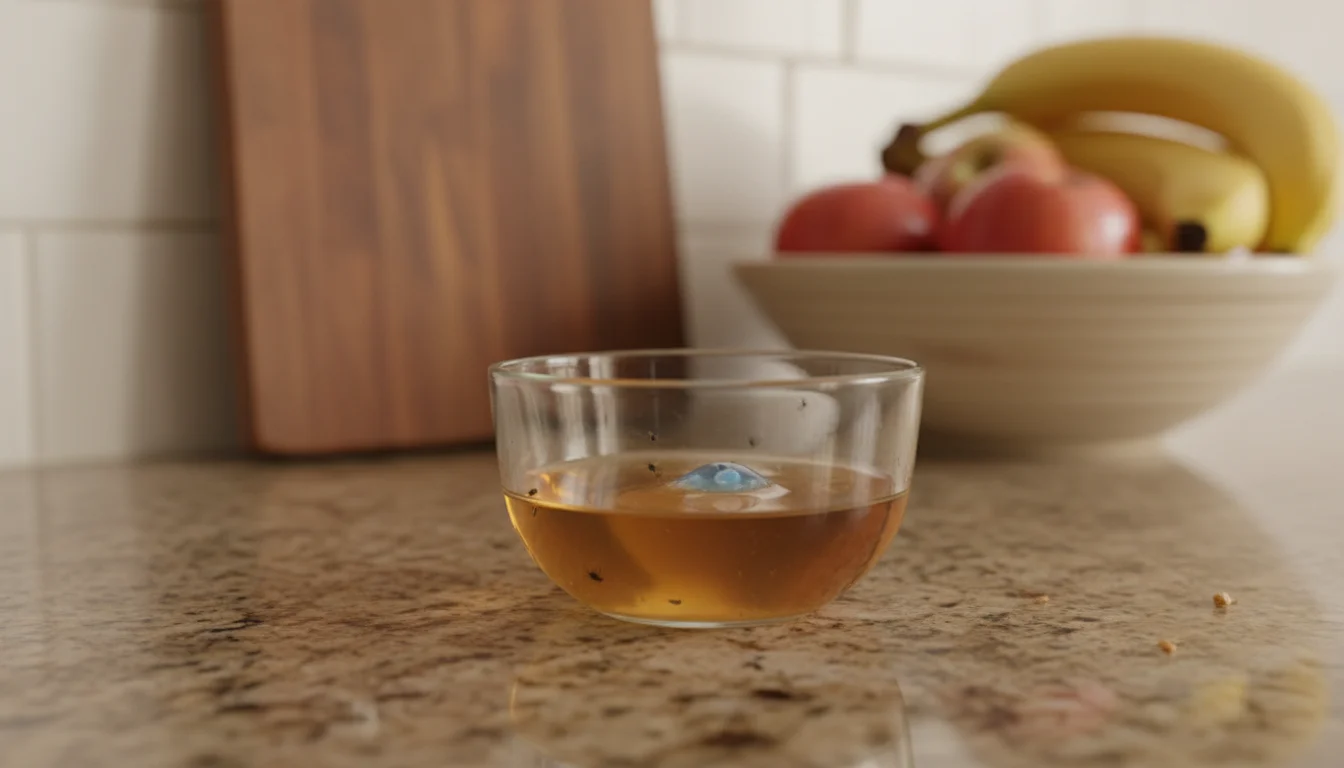
The classic, and the one that earns that title. Pour about 1/4 cup (60 ml) of apple cider vinegar into a small bowl or cup. Add a few drops of dish soap and stir gently. The vinegar pulls them in, the soap kills the surface tension, and they drown instead of touching down and flying off.
Set several of these around your kitchen, right where you’ve seen the most action. Refresh them daily. Don’t sub in white vinegar – fruit flies go for the sweeter, fermented smell of apple cider vinegar, and white vinegar doesn’t have it.
This is the method to start with. If it’s not catching anything, something else is feeding them and you need to find it.
2. Apple Cider Vinegar Jar Trap with Plastic Wrap
Same bait, different container design. Pour about 1 inch (2.5 cm) of apple cider vinegar into a mason jar. Cover the top with plastic wrap pulled tight, then poke five or six small holes with a toothpick.
Flies smell the vinegar, crawl in through the holes, and then can’t figure out how to get back out. They’re not smart. This catches them alive rather than drowning them, which matters to some people and not at all to others. Empty the jar outside every couple of days and reset it.
The advantage over the open bowl: it keeps working longer without evaporating and it’s less grim to look at on the counter.
3. Make a Jar Trap with Holes
The reusable, permanent-installation version. Take a small jar with a metal lid and punch several tiny holes through the lid with a nail and a hammer (or a drill). Fill with 1/4 cup (60 ml) of apple cider vinegar and a few drops of dish soap. Screw the lid on.
Flies enter through the holes, can’t navigate back out. When it fills up, rinse and refill. This is the one worth keeping on the counter year-round, not just during infestations. It catches the odd stray before it turns into a full infestation, which is a much better use of your time.
The lid-with-holes design also survives longer between refreshes than an open bowl – less surface area means less evaporation. A jar you prepared on Monday is still working Friday, which you can’t say for a bowl of vinegar left out in a warm kitchen.
4. Overripe Fruit Trap
Got a banana that’s crossed the line? A peach nobody’s going to eat? Put it in a jar and cover the top with plastic wrap, poked with holes just like the vinegar trap. Fruit flies evolved specifically to find rotting fruit. You’re giving them exactly what they want, then closing the door behind them.
Works faster than vinegar if your bait is genuinely rotten. The downside is obvious: you’re housing rotting fruit in your kitchen. Seal the jar tight, and get it outside to dump it before the smell becomes its own problem. Don’t let it sit more than two or three days.
5. Use Red Wine as Bait
No vinegar on hand? Open bottle of cheap red wine on the counter? You’re set. Pour a small amount (a few tablespoons) into a glass, cover it with plastic wrap, and poke several small holes. Fruit flies are drawn to fermentation and wine qualifies.
This actually works better when the wine’s been sitting out for a day and has had time to develop further. Replace every few days. And yes, the cheap stuff works exactly as well as the good stuff here. Don’t waste it.
6. Wine Trap
Simpler than the wine-in-a-glass setup. Leave about 1/2 inch (1.5 cm) of red wine in the bottom of the bottle it came in. The narrow neck acts as a natural funnel: flies go in through the opening, can’t find their way back through it.
Leave the bottle out overnight near your problem area. By morning you’ll have results. Doesn’t require any plastic wrap or holes. Just an empty (mostly) bottle and patience.
One note: both wine methods work best with red. White wine and rosé don’t attract them as reliably, probably because the fermented, acidic smell of red is closer to the rotting fruit they’re actually after.
Six traps. Most of them use things you’ve already got. Set up two or three at once, see what catches, and pull the bait from whatever’s feeding them in the first place. The trap kills the adults; removing the food source ends the cycle.