Table of Contents
There’s a difference between methods that actually reduce the stray cat population around your property and methods that just redirect stray cats somewhere else. Most deterrents are in the second category – useful for protecting specific areas, but the cats are still there. If you want them gone, that requires a different approach.
This guide separates the two. Population-reduction methods first. Physical deterrents second. Low-confidence options last.
1. Trap-Neuter-Return
The only method that actually shrinks a feral colony over time. You trap the cats using humane box traps, transport them to a participating vet for spay or neuter surgery, then return them to their territory. Neutered cats can’t reproduce, and they hold their territory – keeping new unaltered cats out. The population declines through attrition rather than expanding each breeding season.
This takes 18 to 24 months of consistent effort before you see measurable population decline. It’s not fast, and it’s not nothing-to-do. But it’s the only approach that addresses the root problem. Studies at managed colonies show 70 to 90% population reduction over 5 to 10 years when the whole colony is TNR’d consistently.
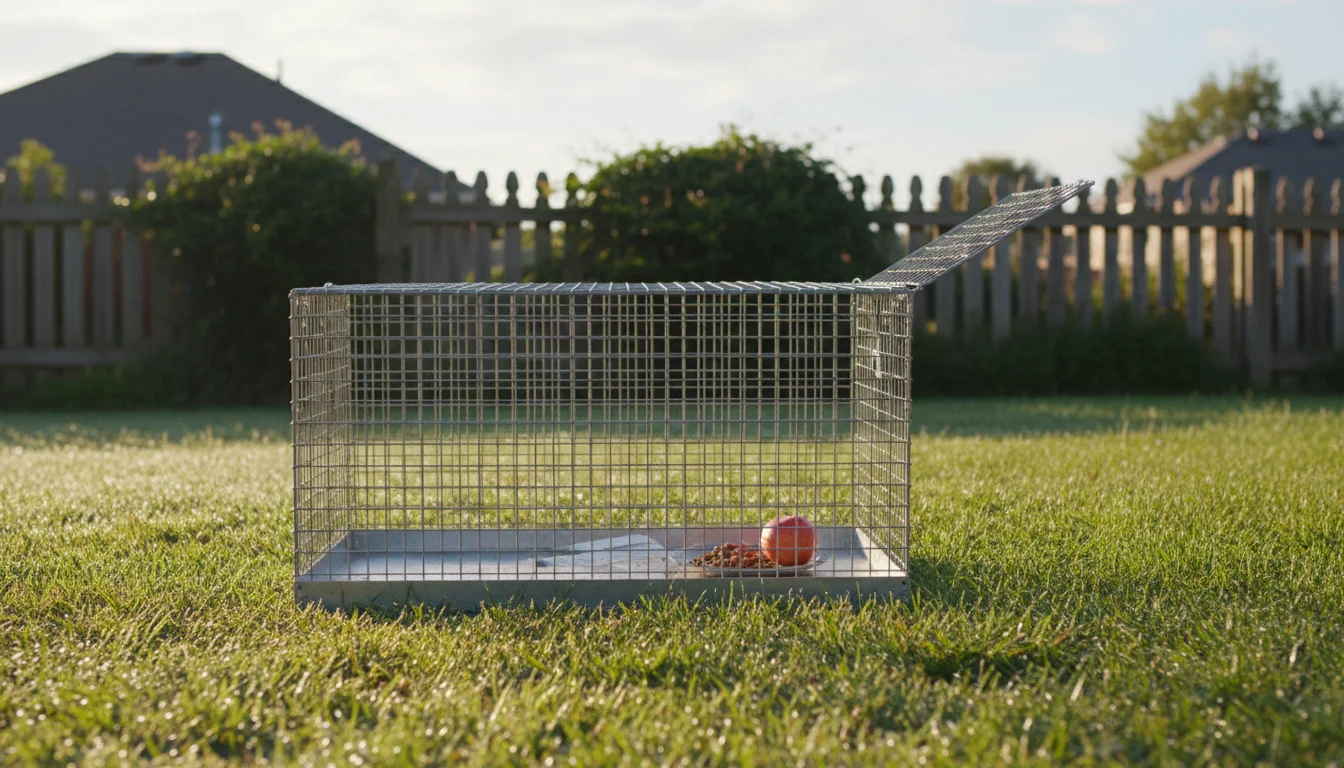
How to do it: bait a 12x12x36 in (30x30x90 cm) box trap with tuna, sardines, or wet food placed at the very back. Set it in the evening when cats are active. Check every few hours – never leave a cat trapped overnight in heat or cold. Transport same-day for surgery. After 24 to 48 hours recovery, return to the original territory. Ear-tipping (removing 1/4 in (6 mm) from the left ear tip) marks each cat as neutered so you can track who’s been done.
Many municipalities have TNR programs that supply loaner traps and subsidize surgery costs. Check with local rescue groups before buying equipment.
2. Remove Food Sources
Cats keep coming back because there’s a reason to. Removing what attracts them to your property makes your yard less worth their while – and reduces the number of newcomers.
Outdoor pet food is the biggest attractor. Bring bowls inside after each meal or switch to timed feeders that close automatically. Secure compost bins with a locking lid – compost smells like food to a cat even when it doesn’t look like it. Clean under bird feeders where scattered seed attracts rodents that in turn attract cats. Don’t leave dog food out overnight.
Removing food doesn’t move the existing colony. It just makes your property slightly less preferred. Pair it with TNR or trapping to address both the existing population and future draw.
3. Live Trap and Relocate
For a single stray or a small number of cats where TNR isn’t practical, live trapping works. Bait a cage trap with wet food, tuna, or sardines at the very back of the trap. Set it along a fence line or wall – cats travel edges, not open ground, so placement matters. Check every few hours; never leave an occupied trap in extreme heat or cold.
Before assuming a trapped cat is feral, scan for a microchip. A lot of "strays" are lost owned cats. Cover the trap with a towel during transport to reduce stress and prevent injury from the animal throwing itself against the sides.
Relocate at least 5 miles (8 km) away – cats have strong homing instincts and will return from shorter distances. Contact local animal rescue if you’re unsure how to proceed with a specific animal.
The limitation: relocation doesn’t reduce the population. New cats move into the vacated territory within weeks. It works for individual nuisance animals but not for a persistent colony.
4. Motion-Activated Sprinklers
The most effective physical deterrent. A motion-activated sprinkler covers roughly 35 ft (10 m) of detection area, fires a burst of water when a cat enters the zone, and eventually convinces most cats that your garden isn’t worth the ambush. Products like the Orbit Yard Enforcer and Contech ScareCrow are the standard for this – both work at dusk and dawn when cats are most active and can be set to night-only mode to avoid triggering on daytime foot traffic.
Reposition the unit weekly. Cats map fixed deterrents and learn the edges of the detection zone faster than you’d expect. A unit that stays in the same spot stops working within two weeks.
Most effective as a deterrent for newcomers. An established cat that’s been using your garden for years will need consistent repositioning to dislodge.
5. Install Cat Deterrent Spikes
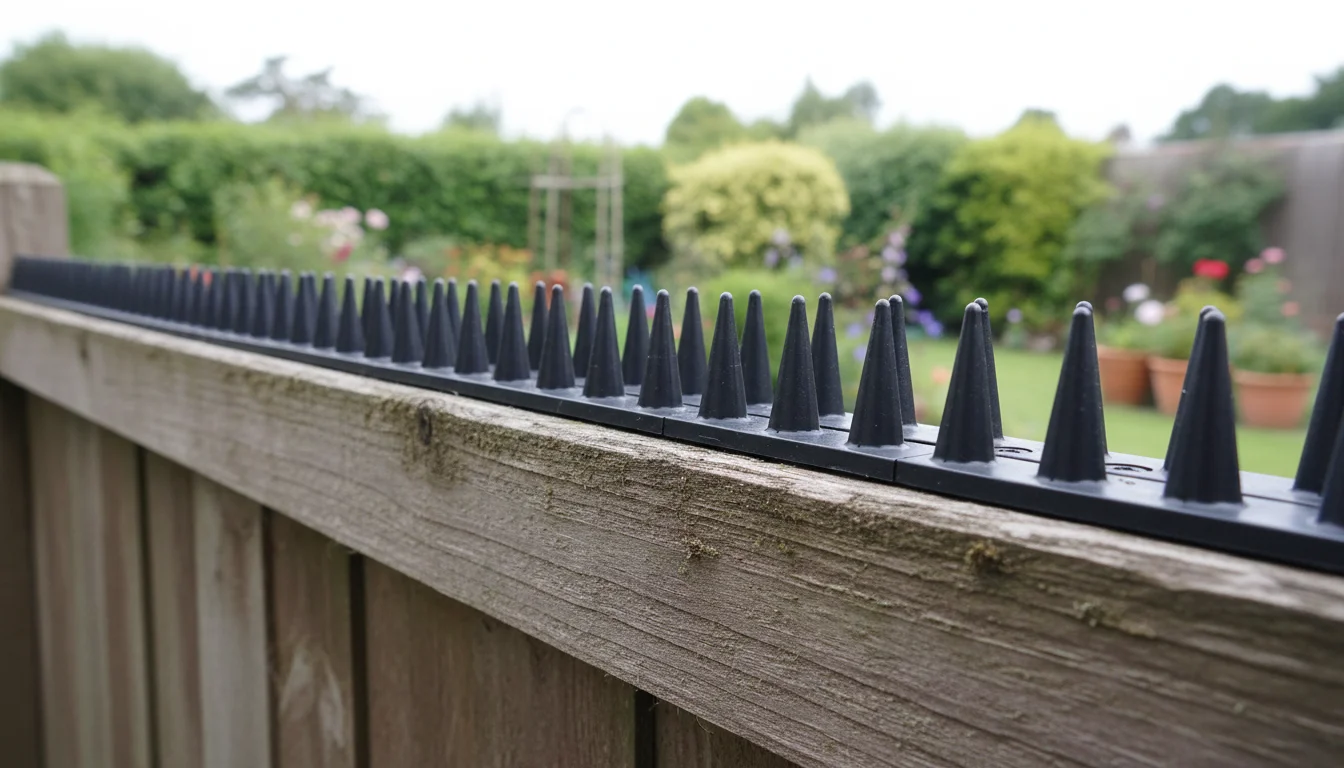
Spike strips on fence tops, wall caps, and garden bed edges make elevated transit routes uncomfortable. Cats that normally hop your fence to enter the garden find the landing surface unpleasant and go elsewhere. These are blunt plastic or stainless steel strips – they cause discomfort that makes cats hop off immediately, not injury.
Cover the full width of any surface without gaps. A single gap will be used repeatedly. For fence tops, measure the full run and buy enough to close it completely. For garden beds, line the outer perimeter and any internal paths you’ve noticed cats using.
UV-stabilized plastic strips last 3 to 5 years outdoors. Stainless versions last indefinitely. Screw-down mounting holds better than adhesive in wet climates.
Combine with motion-activated sprinklers to cover both elevated entry points (spikes) and ground-level access (sprinklers) at the same time.
6. Scatter Hot Pepper Deterrent
Cayenne pepper or chili flakes scattered in garden beds irritates cats’ paws and nose on contact, which they dislike enough to avoid. Scatter generously around the perimeter of beds or directly on soil. Or mix 2 tablespoons of cayenne per 1 qt (1 L) of water as a spray that holds longer on non-porous surfaces like fence tops.
The main limitation is persistence. Rain washes it out completely. In a wet climate you may need to reapply every 2 to 3 days; in dry conditions once a week holds. It’s a low-commitment option that’s worth using in conjunction with other methods, but too inconsistent to rely on alone.
Keep away from children’s play areas – capsaicin transfers from paws to eyes if a child touches treated soil then rubs their face.
7. Plant Deterrent Plants
A long-game approach for gardens where physical barriers aren’t practical. Some plants produce scents that cats actively avoid. Coleus canina (sold as "Scaredy Cat plant") is specifically bred as a cat deterrent and plants along bed borders work reliably. Rue (Ruta graveolens) is another strong option – cats avoid it consistently, it grows as a low border shrub, and it’s undemanding to maintain. Lavender and pennyroyal have some deterrent effect and are useful as a secondary layer alongside stronger options.
Note: the common recommendation to plant lavender as a standalone cat deterrent is optimistic. It’s not reliable enough by itself. Plant it as part of a layered approach alongside spikes or sprinklers.
8. Ultrasonic Devices (Mixed Results)
Ultrasonic repellers emit high-frequency sound intended to drive cats away. Use outdoor-rated units only – indoor units fail outside within a season. Place near areas of active use rather than at a distance.
The honest assessment: some cats ignore them completely after a few days of exposure. Habituation is the main failure mode. This is the lowest-confidence option on this list – worth trying as a passive supplement if you’ve already addressed the other entry points, but not the thing that’s going to solve your problem on its own.
FAQ
How do I get rid of stray cats permanently?
Trap-neuter-return is the only method that permanently reduces a feral colony. It takes 18 to 24 months of consistent effort to see measurable decline, but neutered cats hold territory and stop breeding, so the population shrinks through attrition. Deterrents like sprinklers and spikes keep cats out of specific areas but don’t reduce the population – new cats replace relocated or deterred ones.
What is the 3-3-3 rule for stray cats?
The 3-3-3 rule is an adoption guideline: 3 days to decompress in a new home, 3 weeks to learn the household routine, 3 months to feel fully settled. It has nothing to do with getting cats out of your yard – it’s guidance for bringing a stray inside, not for deterring outdoor cats.
How do I get a stray cat to leave my property?
Remove what’s attracting it: outdoor food sources, accessible shelter under porches or sheds, and unsecured compost or garbage. Then add deterrents – motion-activated sprinklers cover the most ground fastest. If it’s a single stray rather than a feral colony, live trapping and contacting a local rescue is the cleanest resolution.