Table of Contents
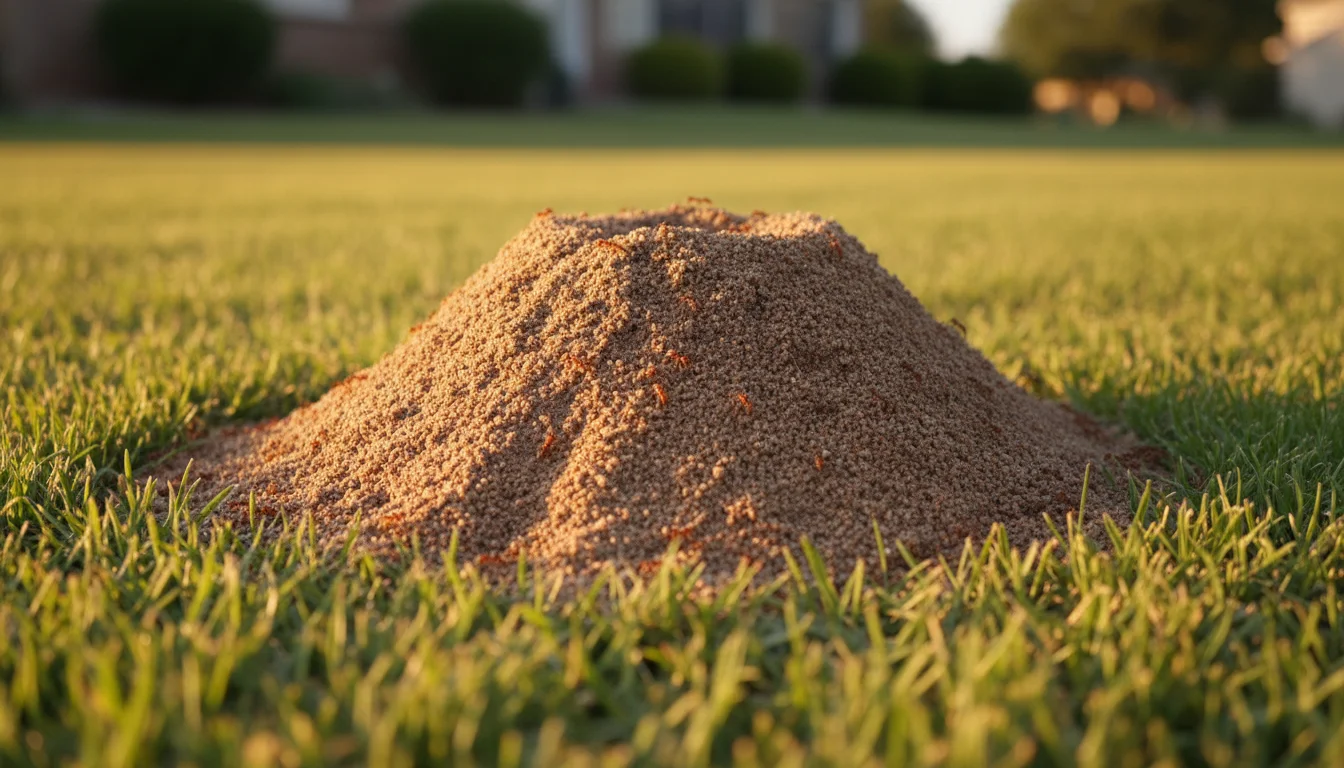
Ant hills are a red herring. The mound is just excavated dirt from tunneling – the colony lives 1-2 feet (30-60 cm) underground. Knocking it flat, hosing it down, or scattering it with a rake doesn’t touch the queen. The mound rebuilds within 24-72 hours because nothing changed underground. To actually solve this, you need to kill the queen. Here’s how.
1. Commercial Fire Ant Baits
The best long-term solution. Baits like Amdro or Advion use a slow-acting toxin that workers carry back to feed the queen. She dies, the colony dies. Spread the granules in a circle around the mound – not directly on it. Ants don’t forage on recently disturbed soil, so piling bait on top of the mound is wasted product.
Results take 1-2 weeks. That’s not a flaw – it’s how the mechanism works. The delay is what allows workers to transport the poison deep into the colony before they die. Rush it with a fast-acting contact killer and you get surface kill; bait it correctly and you get close to 100% colony elimination.
Apply in the morning or evening when ants are actively foraging. Heat kills the active ingredient, so don’t apply in direct midday sun. Dry conditions matter too – wet granules go inert. Check the mound 2 weeks after treatment: if there’s still visible activity, reapply. A single successful treatment should leave the mound abandoned and collapsing.
New queens fly in constantly during warm months. Reapply monthly if you’re seeing new mounds pop up.
One honest trade-off: baits are formulated for fire ants specifically, which makes them safer around pets than broadcast insecticides, but they’re not harmless. Keep kids and dogs away from treated areas until the granules are gone.
2. Liquid Insecticide Drenches
When you need results today. Products with bifenthrin or permethrin (Ortho Fire Ant Killer is a common option) pour directly into the mound. Mix per label directions – typically 1-2 gallons (3.8-7.6 L) per mound. More is better here; the liquid needs to soak deep enough to reach the queen’s chambers.
Before pouring, scatter the top of the mound with a rake to expose the tunnel entrances. That gives the liquid a faster path into the colony instead of having to soak through compacted surface soil. Do this quickly – fire ants attack immediately when their mound is disturbed. Wear closed-toe shoes and long trousers.
You’ll see dead ants at the surface within an hour. With enough product, the queen dies within 24 hours.
The downside is concentration. You’re applying a significant amount of pesticide in one spot. Don’t use near vegetable gardens or water wells. Baits spread the impact thin over a wide area; drenches do the opposite.
3. Pour Boiling Water on Outdoor Mounds
Free, chemical-free, and satisfying to execute. Bring a full kettle (roughly 1.5-2 quarts / 1.4-1.9 L) to a rolling boil and pour slowly into the mound entrance. The heat kills workers, eggs, and pupae in the upper chambers.
The limitation is depth. One pour rarely reaches the queen. Consider it reliable colony damage, not reliable colony elimination. Combine with bait stations for the best outcome – the boiling water thins the population, the bait finishes the job.
Repeat applications over 3-4 days help. Each pour reaches a bit deeper as the upper tunnels collapse. But if you’re dealing with fire ants, the safety calculus is worse here than with drenches: you’re bending over a mound with a kettle while the colony is actively disturbed. Long sleeves, closed-toe shoes, and don’t linger.
This works best on small mounds or species less prone to swarming aggression. For large fire ant mounds, drenches are safer to apply. And if you want to cover your bases: boil the water, pour it in, then follow up with bait granules around the perimeter the next morning. The physical damage plus slow-acting poison is a more reliable combination than either alone.
4. Apply Diatomaceous Earth Barriers
Food-grade diatomaceous earth (DE) is fossilized algae ground fine enough that the particles shred insect exoskeletons on contact, causing dehydration. It kills by physical damage, not chemistry, which means ants can’t develop resistance to it.
It’s not a mound treatment. DE kills individual ants that walk through it – it won’t reach the queen underground. Use it as a perimeter barrier after you’ve treated the mound, or around entry points to the house while you wait for bait to work. It’s particularly useful along the edge of a patio, driveway crack, or doorframe where ants get into the house repeatedly. If the problem is mounds in beds and borders rather than the building, see also getting ants out of the garden.
Sprinkle a thin, even line where you want the barrier. Thin works better than piled – ants detect and avoid thick accumulations. DE stops working when wet, so reapply after rain or irrigation.
Wear a dust mask when applying. DE is harmless to swallow but the fine particles irritate lung tissue if you inhale a cloud of it during application.
FAQ
Should you destroy ant mounds?
Depends on the species. Native harmless ants are genuinely beneficial – they aerate soil and break down organic matter. If you’ve got a mound in an out-of-the-way corner, leaving it alone is a reasonable call. Fire ants are a different matter. They’re aggressive, their sting hurts, and they spread. Any mound in a high-traffic area, near children, or clearly a fire ant colony is worth treating.
Are ant hills good or bad for your yard?
Both, depending on what’s building them. Native ant colonies improve soil drainage, turn over nutrients, and eat pest insects. Some gardeners actively encourage them. Fire ants spread aggressively and sting in swarms, which makes them genuinely harmful. The honest answer: look up what species you’re dealing with before reaching for the chemicals. If it’s native ants in a low-traffic area, you may not have a problem at all.
Why am I seeing so many ant hills in my yard?
Warm weather after rain triggers colony expansion and new mound building. You’re probably also seeing multiple separate colonies rather than one large one – ant hills look clustered but are often independent. If you treated previously and mounds keep reappearing, new queens are flying in from elsewhere. Monthly bait application during summer is the only way to stay ahead of it.
What happens when you destroy an ant hill?
The mound rebuilds within 24-72 hours because the colony is underground and intact. The workers just excavate new exit tunnels. Physical disruption only matters if you’ve also killed the queen – otherwise you’re doing landscaping, not pest control.