Table of Contents
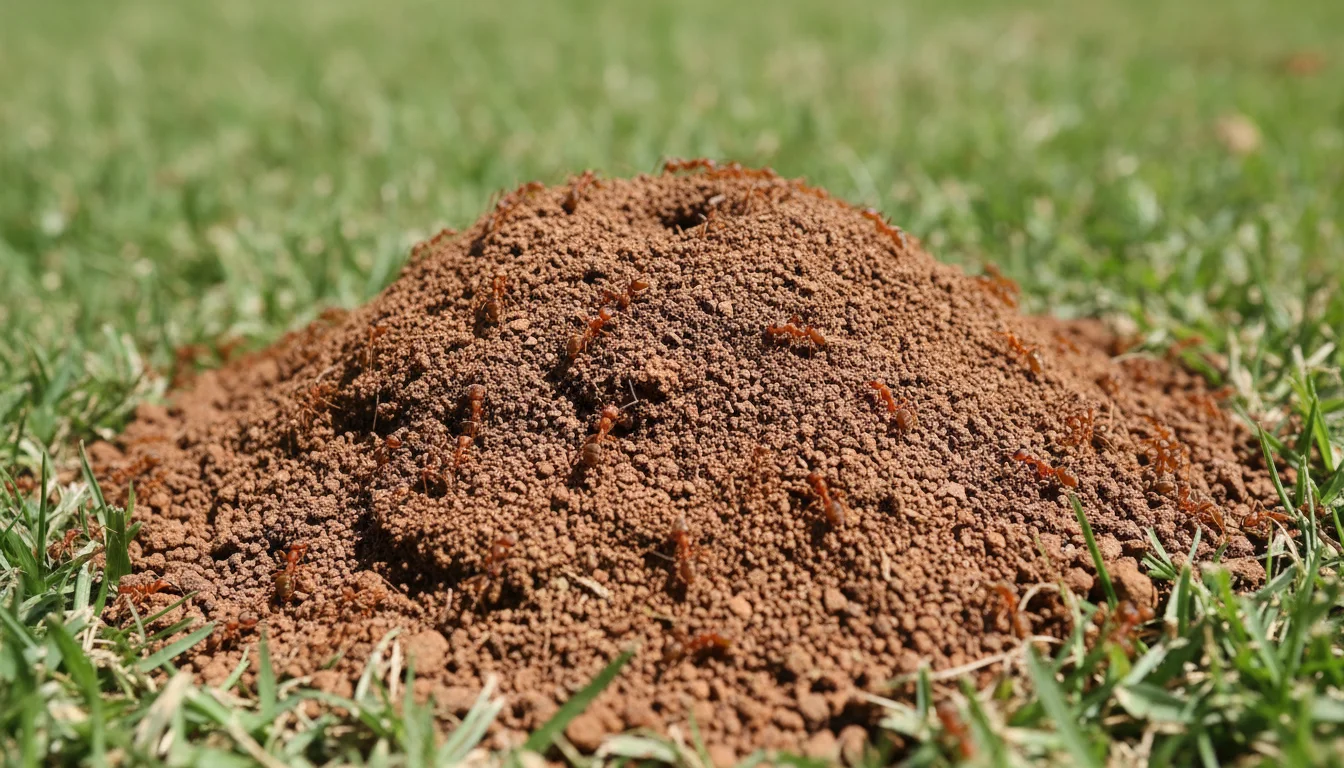
Fire ant mounds appear overnight and the colonies underneath can hold hundreds of thousands of workers. Stomp one mound and the survivors relocate and rebuild within days. Pour straight insecticide on top and you’ll kill the foragers you can see while the queen keeps reproducing twenty feet away, unbothered.
If you want to know how to get rid of fire ants for good – not just knock back the visible mound – you need to kill the queen. That’s what every method below is designed to do: either by delivering poison she’ll eat, or by flooding the nest with something that reaches her chamber. Surface sprays are not on this list because they don’t work. They produce a satisfying pile of dead ants and a live queen who spends the next two weeks making more.
Fire ants are also persistent re-colonizers. Even after you kill a colony, new queens can fly in from neighboring properties and establish fresh mounds. Long-term control means treating actively and monitoring your yard throughout warm months – not a one-and-done treatment.
1. Commercial Fire Ant Baits
The most effective method for most yards, and the one that actually solves the problem rather than managing it. Baits like Amdro or Advion use slow-acting insecticide (typically hydramethylnon or indoxacarb) suspended in a carrier that smells like food. Workers pick it up during foraging, carry it back into the nest, and feed it to the colony. Including the queen. She eats it, stops laying, and the colony collapses within 1-2 weeks.
That timeline is why people abandon this method. They put the bait down, see ants still moving the next day, get frustrated, and switch to a contact spray. Which kills a lot of workers and leaves the queen alive. Stick with the bait. The delayed kill is the mechanism, not a bug.
How to apply it correctly:
Spread granules in a wide circle around the mound at a distance of about 12-18 inches. Not on top of the mound, not on the disturbed soil immediately adjacent to the entrance. Fire ants won’t forage on recently disturbed ground. Give them undisturbed soil and they’ll find the bait on their own.
Apply when the ground is dry – wet bait degrades fast and smells wrong to foragers. Apply in morning or late afternoon when soil temperature is between 70-90°F (21-32°C) and workers are actively foraging near the surface. Midday heat during summer pushes colonies deeper and you’ll see less foraging activity.
Maintaining control after the first treatment:
A single bait application is not a permanent solution. Fire ant queens can live for 6-7 years. New queens also fly in from outside – winged reproductives disperse in warm months and establish new colonies wherever they land. A yard that looks clean after one treatment can have three new mounds four weeks later.
Reapply monthly during warm months (roughly April through October in most affected states). Some people do a broadcast application across the whole yard twice a year and spot-treat new mounds as they appear. Either approach works. The goal is keeping the bait available before mounds get established.
The fire ant bait toxin is slow-acting by design and specifically formulated for ant metabolism – it’s significantly safer around pets and wildlife than broadcast pyrethroids or carbamates. Hydramethylnon has a very low toxicity to mammals, which makes Amdro and similar products appropriate for households with dogs that like to investigate mounds.
2. Spinosad-Based Organic Insecticides
If you’re treating within 10 feet of a vegetable garden or need something with organic certification, spinosad is the right call. Products like Conserve SC use spinosad – a compound derived from the soil bacterium Saccharopolyspora spinosa – that’s approved for organic gardening and kills fire ants effectively.
The mechanism is different from chemical insecticides. Spinosad activates nicotinic acetylcholine receptors and GABA receptors in insects, causing involuntary muscle activation and paralysis. It’s highly toxic to fire ants and most other insects, but breaks down rapidly in sunlight (typically 1-3 days on soil surfaces) and doesn’t bioaccumulate in the food chain.
Two ways to apply it:
As a drench: mix Conserve SC per label directions (typically 3-6 fl.oz per gallon of water / 90-180 ml per 3.8 L) and pour directly into the mound entrance. Use enough volume to penetrate – you want the solution to reach the queen’s chamber, which can be several feet down in mature colonies. A full gallon (3.8 L) per large mound is not too much.
As a bait additive: spinosad can be mixed with an attractant bait carrier and spread around the mound the same way you’d apply granular bait. This approach uses less product and lets workers distribute it through the colony more thoroughly. It’s slower than the drench – expect 5-7 days rather than 3-5 – but requires less total product and reaches more of the colony through normal foraging.
Timing and limitations:
Colony kill time runs 3-5 days for the drench approach, longer for bait application. That’s faster than slow-acting granular baits (1-2 weeks) but slower than synthetic contact insecticides (hours, with shallow penetration). For most people treating a vegetable garden or an area where organic certification matters, 3-5 days is acceptable.
Because spinosad degrades quickly in sunlight, it provides minimal residual protection. Treat, confirm the mound is dead in a week, and plan to retreat if new mounds appear. It’s a treatment, not a barrier.
One genuine limitation: spinosad is also toxic to bees if they contact it while it’s wet. Apply in the evening after bee foraging activity has stopped, or early morning before it starts. Once dried, the residue has minimal impact on bees. If fire ant mounds are located near flowering plants that bees are actively visiting, evening application is the safer window regardless of season.
3. Boiling Water
Zero cost, zero chemicals, and works consistently on shallow ground nests. Boil a full kettle (about 1 gallon / 3.8 L) and pour it directly into the mound entrance in a slow, controlled stream. Slow is the key word. A fast pour creates runoff that spreads across the surface without penetrating. You want the water to follow the tunnel structure down, not sheet off the top of the mound.
Tilt the kettle so the water runs in a narrow stream and give each pour 30-40 seconds. The water needs time to work its way in.
When to do it:
Early morning is significantly more effective than any other time of day. Fire ant colonies move vertically – up toward the surface in cool morning hours, down away from heat in the afternoon. Hitting a mound at 6 or 7 in the morning catches the colony clustered near the entrance, maximizing kill rate. The same treatment at 2pm, when the colony has retreated several feet deeper, will kill far fewer ants and almost certainly miss the queen.
How many treatments:
Two or three pours on consecutive mornings gives the best results. The first treatment kills the upper chambers and whatever portion of the colony was accessible. If the queen survived deeper down, she’ll still be producing eggs but the reduced worker population makes the colony vulnerable. The second morning pour, when the survivors have moved back toward the surface overnight, reaches the next layer. By the third morning you’ve usually addressed the whole accessible colony.
Honest success rate:
Boiling water kills the colony roughly 20-60% of the time, depending on mound depth, colony size, and pour technique. Commercial baits run 90%+. That gap is real. If you have a large infestation or a yard full of mounds, boiling water is not your primary tool. But for a single accessible ground nest where you don’t want to use chemicals – maybe it’s right next to a raised bed, or you have young kids, or you just don’t want to buy anything – it’s worth three mornings of effort before escalating.
Two hard limits: boiling water kills surrounding grass and plants in a 6-12 inch (15-30 cm) radius. Accept that before you pour. And it only works on nests with a clear ground entrance you can pour into – aerial nests, wall-void nests, or nests under concrete slabs are not candidates.
A word on scalding hazards: you’re carrying a full kettle of boiling water across the yard, likely bent over a mound near the ground. Pour slowly, wear closed-toe shoes, and pour from a standing position to avoid splash-back. It sounds obvious until you’re doing it on an uneven lawn at 6am.
Frequently Asked Questions
What kills fire ants immediately?
Contact insecticides like bifenthrin, permethrin, or deltamethrin kill workers on contact within minutes. Fast and visually satisfying. But they don’t penetrate deep enough to reach the queen, and they don’t persist long enough to prevent reinfestation from surviving colony members. You’ll see the mound go quiet within hours, then watch it rebuilt over the following 1-2 weeks. Use a contact spray if you need a specific area clear for an outdoor event happening today. For actual elimination, you need bait or a drench that reaches the queen.
Why do fire ants keep coming back?
Two separate problems with two separate solutions. First: if the queen survived your treatment, she’s still laying and the colony rebuilds from scratch in 3-4 weeks. Better treatment method needed – granular bait or spinosad drench that penetrates to queen depth. Second: even if you killed a colony completely, winged fire ant queens can travel up to several miles on dispersal flights during warm months. Your yard can be re-colonized from outside regardless of how thorough your treatment was. Monthly monitoring and spot treatment of new mounds as they appear is the only long-term management strategy.
Are fire ants dangerous?
For most people, painful but not medically serious. The sting injects venom (solenopsin alkaloids) that causes immediate burning, followed by raised white pustules at each sting site. Fire ants swarm when disturbed, so a single disturbance can result in dozens of stings. The pustules itch for 3-10 days and carry infection risk if popped.
For people with insect venom allergies, fire ant stings can trigger anaphylaxis. If you’ve had systemic reactions to bee or wasp stings, treat fire ant stings as a potential emergency. Carry an epinephrine auto-injector if you spend time in infested areas. The venom chemistry is different from hymenopteran stings but cross-reactivity occurs in a meaningful percentage of people with existing venom allergies.
When should I call a professional?
When the infestation is extensive (dozens of mounds across a large area), when treatments have failed twice, or when you find nests inside a structure. Large-scale infestations benefit from broadcast granule treatment across the whole property rather than mound-by-mound spot treatment – professionals have access to product quantities and formulations that aren’t practical for consumer use. If you’re also seeing ants inside the house, that’s a separate problem requiring a different approach than yard mound treatment.