Table of Contents
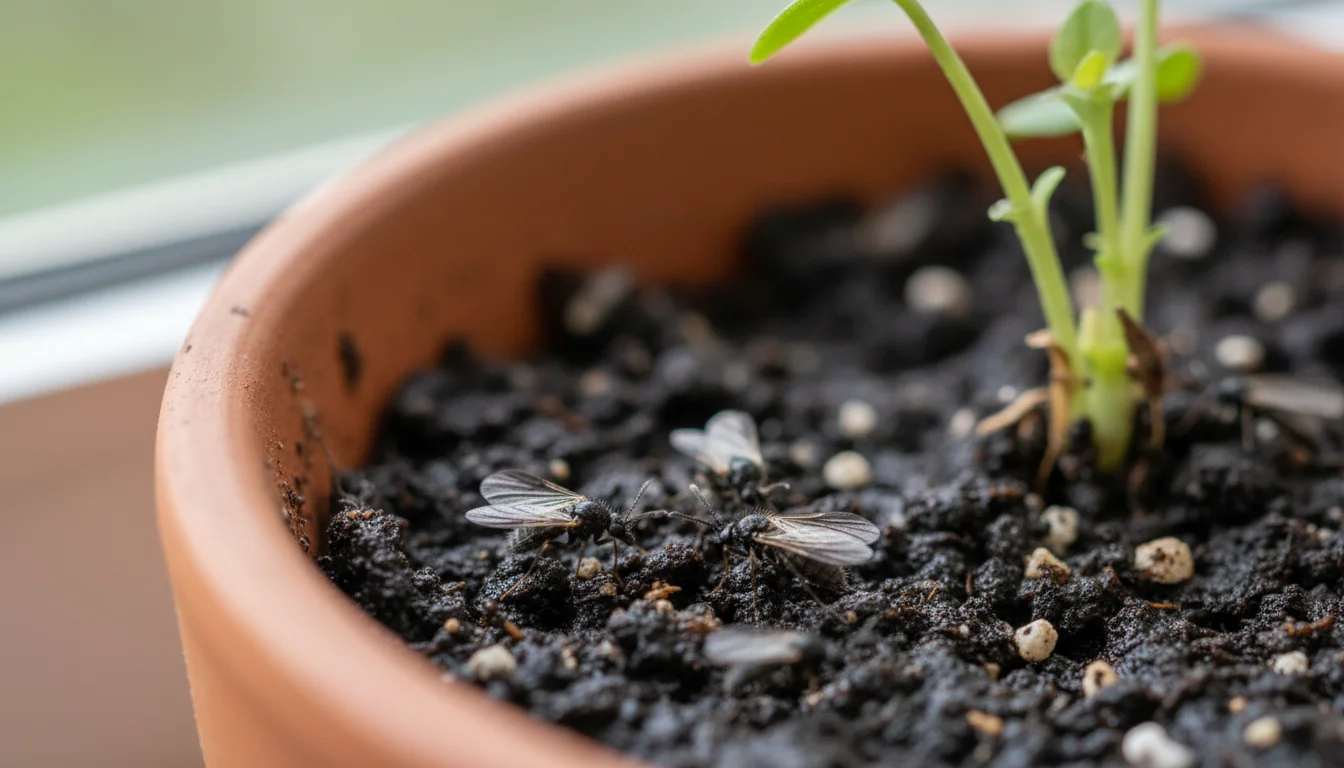
Fungus gnats are a soil problem that presents as a flying insect problem – and that’s why most advice on how to get rid of fungus gnats misses the point. The tiny adults hovering around your plant are annoying but largely harmless. The real damage is underground, where larvae feed on roots and organic matter in consistently moist soil. Spray the adults all you want. If you don’t fix the conditions in the pot, the next generation hatches in 17-28 days and you’re back where you started.
The fixes that actually work target the larvae. Drying out the soil, adding biological controls, and removing organic debris disrupts the cycle at the source. Yellow sticky traps handle the adults and tell you how bad the infestation is. Do both together and a persistent problem usually resolves within 3-4 weeks.
1. Let Soil Dry Between Waterings
Fungus gnat larvae need consistently moist soil to survive. They can’t complete development in dry conditions – eggs and young larvae desiccate before maturing. So the single most effective thing you can do is stop overwatering.
Stick your finger at least 1-2 inches into the soil before watering. If it still feels damp, wait another day. Most houseplants tolerate this far better than they tolerate the soggy conditions that invite gnats. Bottom watering helps – set the pot in water and let the roots absorb from below. It hydrates the plant while keeping the top inch of soil much drier, which is exactly where larvae live.
This alone won’t end an active infestation overnight, but it stops the cycle from continuing. Every generation of larvae that can’t find moist soil to develop in is one less generation of adults you’ll be swatting.
2. Remove Decaying Organic Matter
Dead leaves sitting on the soil surface, decomposing bark in potting mix, and old roots are fungus gnat food. They’re not just incidental – they’re what sustains the fungal growth the larvae eat.
Remove dead plant material from the soil surface and around the pot. Repot into fresh, well-draining potting mix if the current soil has been in use for several years and is breaking down into peat-like mush. For top dressing, a layer of coarse sand or fine gravel over the top inch of potting soil makes it harder for adults to lay eggs and dries out faster than organic media.
Outdoors, clear thick layers of decomposing mulch from around plant bases. This is a less common source of fungus gnats than houseplant soil, but it happens.
3. Use Yellow Sticky Traps
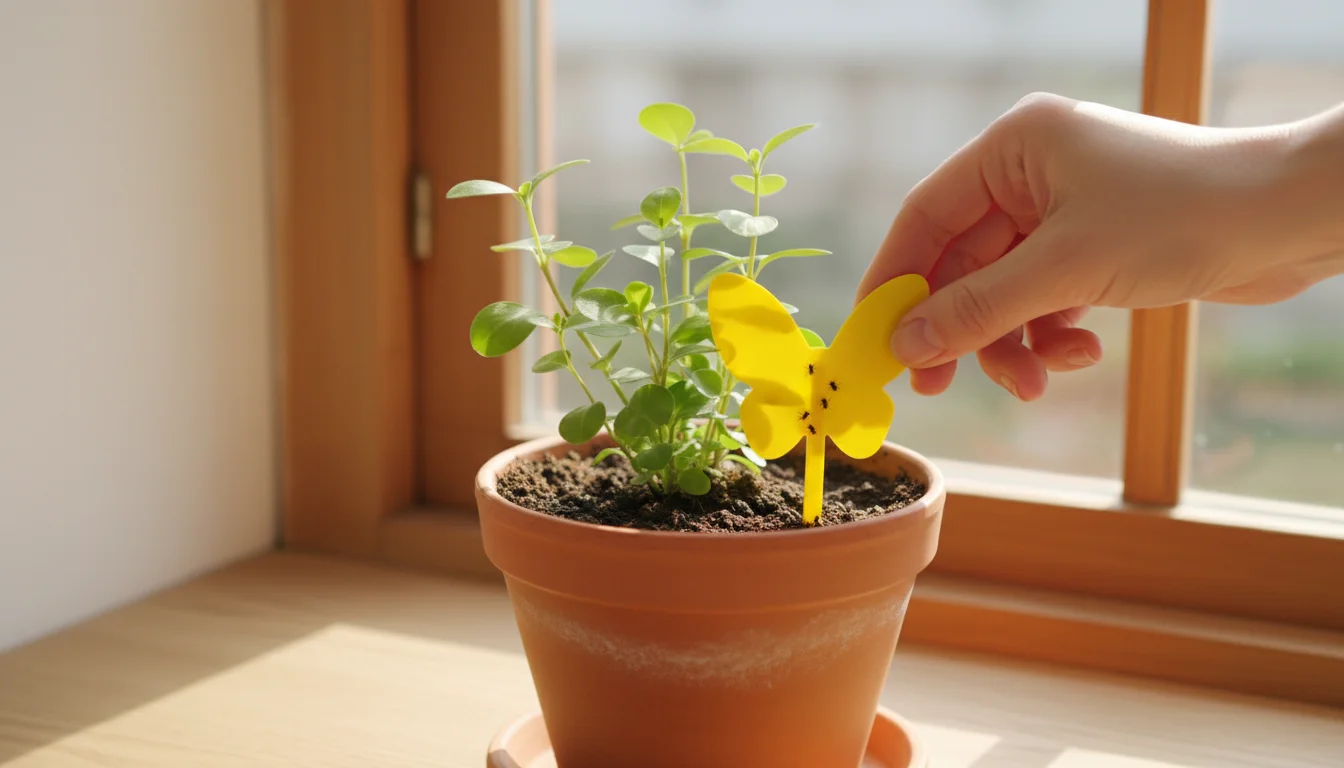
Yellow sticky traps do two things: reduce the adult population, and show you how bad the infestation actually is. Fungus gnat adults are strongly attracted to yellow. A trap placed at soil level (not elevated – these aren’t fruit flies) will catch significant numbers within a day or two of placement.
Place traps at soil surface level, one per pot for heavily infested plants. If you’re catching dozens per day, the infestation is established and you need the biological controls below. If you’re catching a few, soil drying alone may be enough. Replace traps when they’re full or after two weeks.
Sticky traps won’t eliminate the infestation. The larvae in soil are what keep it going. Think of traps as population reduction plus a diagnostic tool.
4. Bacillus Thuringiensis Israelensis (Bti)
Bti is the most effective solution for fungus gnat larvae and the one most people find after trying everything else. It’s a naturally occurring soil bacterium (sold as Mosquito Bits, Gnatrol, or other products) that produces proteins toxic to fungus gnat larvae but harmless to humans, pets, earthworms, and beneficial insects.
Two application methods work. The drench method: soak 1-2 tablespoons of Mosquito Bits granules in a gallon (3.8 L) of water for 30 minutes, strain out the granules, and water your plant with the infused water. The soil-top method: sprinkle granules directly on the soil surface and water them in. Either works – the drench gets deeper into the root zone faster.
Repeat weekly for 3-4 weeks. Fungus gnats have a multi-week lifecycle, so you need to kill each wave as it hatches. One treatment won’t end it. Three or four will.
5. Beneficial Nematodes
For larger plant collections or persistent infestations that haven’t responded to Bti, beneficial nematodes are the next escalation. Steinernema feltiae specifically targets fungus gnat larvae in soil – it’s parasitic to them and leaves everything else alone.
Apply to moist soil in early morning or evening, when temperatures are between 50-85°F (10-30°C). Water the area before and after application. Nematodes need moisture to move through soil and reach larvae, so don’t apply to dry pots and don’t let the soil dry out for 2-3 days after treatment.
They’re available online and at some garden centers. Buy from a reputable supplier and check the expiry date – live nematodes have a short shelf life.
6. Hydrogen Peroxide Drench
Quick kill for an active infestation while you wait for Bti to work. Mix 1 part 3% hydrogen peroxide (standard pharmacy H2O2) with 4 parts water. Pour it onto the soil until it drains from the bottom of the pot.
The peroxide fizzes on contact with organic matter and kills larvae immediately. It also adds oxygen to compacted soil and helps prevent the root rot that often accompanies the overwatering that caused the gnats in the first place. It breaks down to water and oxygen within hours and leaves no residue.
Wait 2-3 days before normal watering. Repeat weekly for 3 weeks. Don’t use higher concentration peroxide – 3% is effective and plant-safe. Above that, you risk damaging roots.
What kills fungus gnats fast? Hydrogen peroxide drench kills larvae on contact. Yellow sticky traps catch adults immediately. Bti takes a few days to start working but is the most thorough larval kill. Fast and lasting require different tools.
How long does a fungus gnat infestation last? The lifecycle is 17-28 days depending on temperature. With consistent treatment – Bti weekly, soil kept drier, sticky traps in place – most infestations resolve in 3-4 weeks. They’ll return if you go back to overwatering.
Does Dawn dish soap kill fungus gnats? As a trap mixed with apple cider vinegar (a few drops of soap in a shallow dish with 1/4 inch of ACV), yes – it breaks surface tension and drowns adults. As a soil drench for larvae, no. Stick with H2O2 or Bti for the larvae.
Does hydrogen peroxide kill fungus gnats? Yes. The 1:4 dilution with water kills larvae on contact when poured into soil. Safe for plants at that dilution. Ineffective against adults – use yellow sticky traps for those.