Table of Contents
Before anything else: what are you actually dealing with? "Ground hornet" is a catch-all people use for anything that stings and lives in a hole. Most ground hornets people panic about are yellow jackets – and the species matters a lot.
Yellow jackets are the ones that send people to the hospital. Aggressive defenders, especially in late summer and fall when the colony is at peak size – a mature colony can hold 4,000 to 5,000 workers by September. The rest of this guide is written for them. Cicada killers, on the other hand, are enormous and terrifying-looking but almost entirely docile – solitary insects that will not sting unless you physically grab one. If you’ve got those buzzing around your lawn, you can largely ignore them. Baldfaced hornets build paper nests in trees or eaves, not typically in the ground.
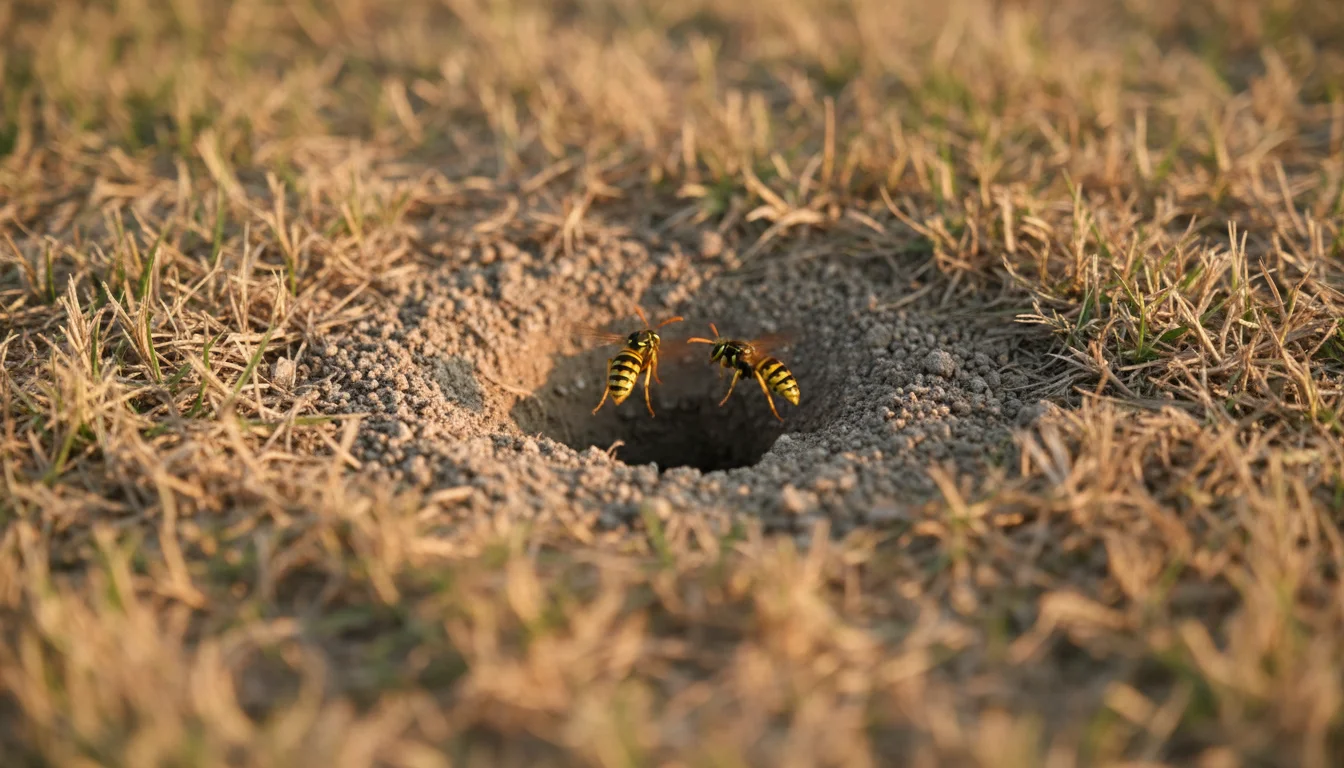
If you’re watching steady traffic of yellow-banded insects flying in and out of a hole in your lawn or a gap near the foundation, you’ve got yellow jackets. Fall is when they’re most dangerous – workers are defensive, the colony is at maximum size, and they’re protecting larvae. Treat them at dusk when the full colony is inside and slower-moving.
1. Spray Ground Hornets Directly in the Nest
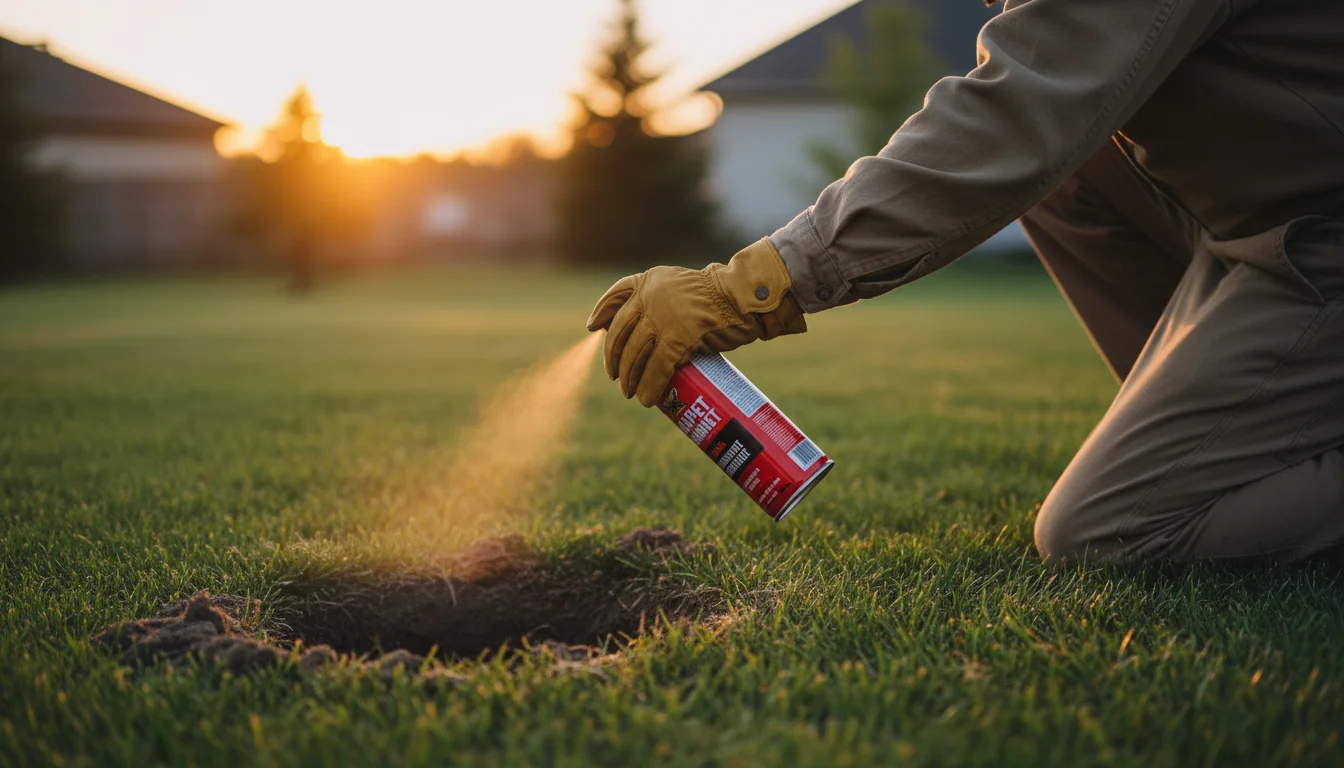
The standard approach, and the right one to start with. Get a can of wasp-and-hornet spray (anything with permethrin or pyrethrin), stand upwind, and aim the nozzle directly into the entrance hole. Give it a solid 5 to 10 second burst – the spray needs to penetrate the nest, not just coat the entrance.
Back away immediately. Don’t hang around to see if it worked. Workers can and do emerge even after treatment, and fall colonies can have several thousand of them.
Check the entrance hole the following morning. If you still see activity, repeat the treatment the next dusk. Two treatments clear most nests.
2. Gasoline (Old School, Fast)
Old-school, effective, and faster than spray for a confirmed ground nest. Pour about a cup (240 ml) of gasoline down the entrance at dusk, then immediately cover it with a shovelful of dirt and a heavy rock. The fumes kill the colony overnight without you having to hover nearby.
Keep it well away from plants you care about – gasoline kills vegetation. And don’t smoke while doing it, or use a lighter afterward to "check if they’re gone." People have genuinely done both of those things.
Not glamorous advice, but it works.
3. Diatomaceous Earth
Slower, safer at a distance. Sprinkle a ring of food-grade diatomaceous earth (DE) around the entrance in the evening. Workers picking up the powder on their way in and out will be dehydrated over the next few days as the microscopic particles damage the waxy coating on their exoskeletons.
This won’t kill the colony overnight – expect three to five days before you see a meaningful drop in activity. Worth it if the nest is in a low-traffic area and you’d rather not stand close enough to spray into the hole. For a high-traffic location or a large fall colony, DE is too slow – go with spray or gasoline first.
Use food-grade DE, not the kind sold for pool filtration. The pool version is processed differently and far more hazardous to breathe.
4. Boiling Water
Chemical-free, free, and works if you can safely get close with a full kettle. Pour directly into the nest entrance, slowly, so the water penetrates rather than splashing off the surface.
One pour rarely finishes the job because the deeper chambers survive. Do it twice a day for three days. Not the ideal method for an aggressive fall colony when the hole is in your main footpath, but useful when the nest is tucked somewhere accessible.
5. Wait and Seal (Free, Slow)
If the nest isn’t in a high-traffic spot and it’s already late in the season, do nothing. Yellow jacket colonies die naturally when temperatures fall consistently below 50°F (10°C). Only mated queens survive winter; every worker is dead by December in most temperate climates.
Wait until you see zero flight activity for at least 14 consecutive days before sealing the entrance. Don’t rush it – a mild spell in November can briefly revive stragglers. Once you’re confident the colony is dead, fill the hole with caulk or expanding foam and tamp soil over it.
The sealing step matters. Old nest pheromones act as a chemical signal that draws new scouts to the same location the following spring. Skip the seal and you’re likely to find a new colony in the same spot next year. Takes five minutes and costs almost nothing.
6. Call a Pro
If the nest is near a doorway, a children’s play area, or anywhere you can’t approach safely, call a professional. Same if you’ve treated twice and it’s still active, or if anyone in the household has a sting allergy.
About 100 people die from bee and wasp stings in the US each year, almost all from allergic reactions. It’s not worth the hospital trip to save $150 on a pest control visit.
FAQ
Are ground hornets aggressive?
Depends on the species. Yellow jackets are genuinely aggressive, especially in fall when the colony is at its largest and most defensive. Cicada killers, despite looking alarming, are solitary and rarely sting unless handled. If you’re not sure what you have, watch from a safe distance: yellow jackets will be visibly reactive if you get within a few feet of the entrance.
How bad is a ground hornet sting?
Yellow jacket stings are painful and – unlike bees – they can sting multiple times. For most people it’s a localized reaction. The serious risk is anaphylaxis in people who are sensitized. If you’re stung multiple times, or if you notice swelling spreading beyond the sting site, shortness of breath, or dizziness, get to an emergency room.
What do ground hornet nests look like?
A hole roughly 1-2 inches across, often in bare or thin-grass areas, with traffic of yellow-banded insects flying in and out. There may be a small mound of loose dirt around the entrance from excavation. These are easy to mow over – that’s the most common way people get stung without intending to disturb anything.
How to get rid of ground hornets permanently?
Kill the colony and seal the entrance. The seal matters because old nest pheromones will draw new scouts to the same location next season. Even if the original colony is fully dead, an unsealed entrance is an open invitation.