Table of Contents
Sprays, traps, and yard treatments help with the overall population. But when you’re outside right now and mosquitoes are landing on you every thirty seconds, you need personal protection – the stuff that keeps them off your body regardless of what’s happening in the yard. These five methods work on that level.
1. Wear Light and Loose (and Long) Clothing
Cover up. The more skin you show, the easier their job gets. Long sleeves and pants beat shorts and a tank top every time. Skip the jeans though – mosquitoes bite right through tight fabric. Loose-fitting clothes create a gap between fabric and skin that makes it much harder for their proboscis to reach you.
Light colors help too. Mosquitoes home in on dark clothing, so save the black outfit for indoor events. Khaki, white, and pastels make you less of a heat-and-color target.
Don’t forget your feet and ankles. They love that zone, especially if you’re wearing sandals. Closed-toe shoes with socks eliminate it entirely.
2. Apply Effective Repellents
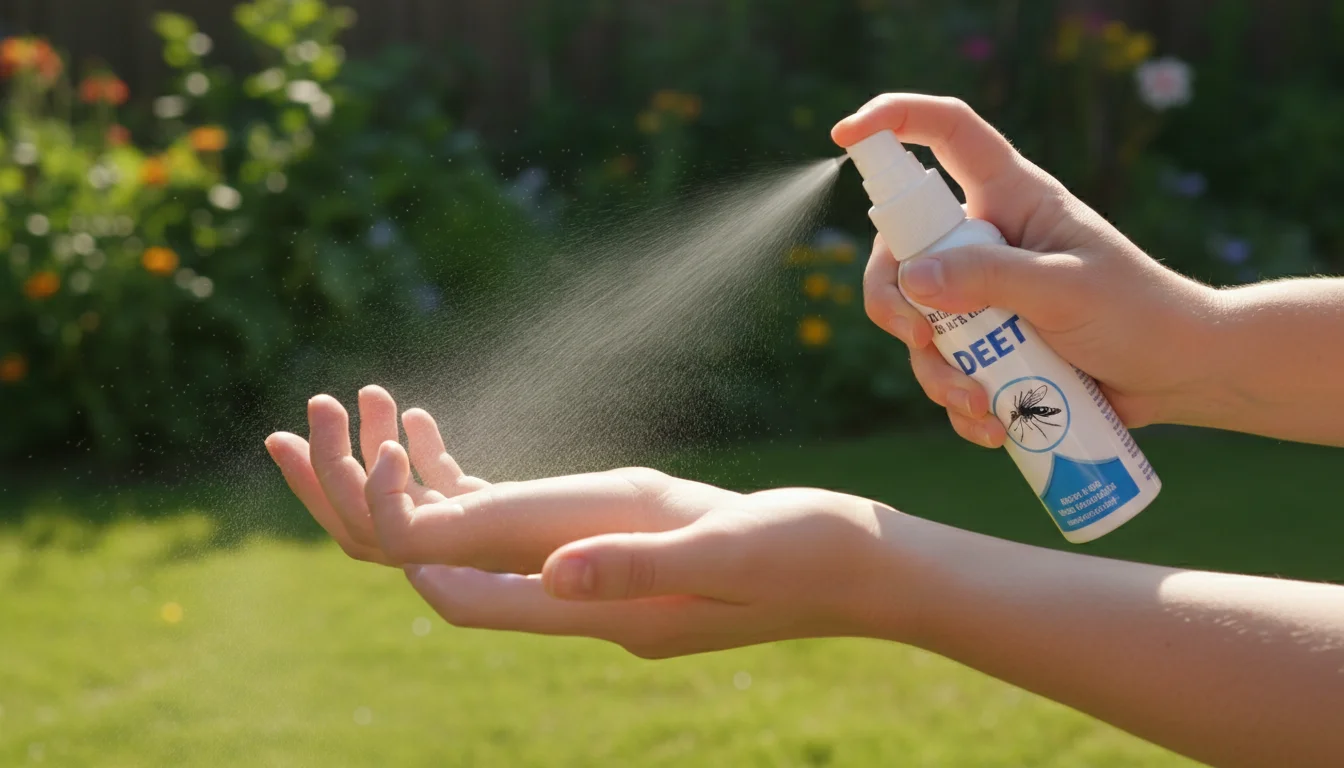
DEET works. It’s the gold standard and has been since the 1940s. Concentrations of 20-30% give you several hours of protection. Apply to exposed skin and clothing, skip hands, eyes, and mouth, and check the label for the rated duration.
If you’d rather skip DEET, picaridin and IR3535 perform nearly as well without the harsh smell. Oil of lemon eucalyptus (OLE) is the only plant-based option the CDC actually endorses for disease-carrying mosquitoes. The essential-oil sprays at the farmers market are not in that category.
Skip the bracelets, stickers, and ultrasonic clips. None of them work. Topical repellents on skin and clothing do.
3. Repair Damaged Screens
A single small hole in a window screen turns your home into an open invitation. Check every screen for tears, gaps along the frame, or mesh pushed out of its track. Insects fit through openings smaller than you’d think – a hole the size of a nickel is more than enough.
Patch small holes with screen repair tape or swap the whole screen – they’re cheap, and replacement screens for standard window frames cost a few dollars at any hardware store. Add foam weatherstripping to frames that don’t seal tightly against the window. Don’t forget attic vents, crawl space openings, and any gaps around pipe penetrations in the foundation. One repair session in spring closes off a problem that’d otherwise follow you through the whole season.
If you have a door that doesn’t close tightly or stays propped open frequently, consider adding a magnetic screen door – the kind with a split down the middle that snaps back together after you walk through. They’re not elegant, but they’re effective for back doors that get heavy traffic during summer.
4. Use Mosquito Nets for Sleeping Areas
In areas with heavy mosquito pressure or disease risk, nets are the move for sleep. Choose ones treated with permethrin for a second layer of protection, and tuck the edges firmly under the mattress so nothing gets in through the bottom. Permethrin-treated nets remain effective through dozens of washes.
For outdoor spaces – porches, decks, camping setups – hang netting around the seating area. It blocks them without cutting off the breeze. Use mesh with at least 18 strands per inch; coarser weave lets smaller mosquitoes straight through.
If you’re camping, look for a freestanding pop-up canopy with integrated mosquito netting – the kind that covers a whole sleeping area. They’re significantly faster to set up than hanging netting from trees in the dark and work much better in rain. For fixed porch structures, outdoor curtain rod systems with fine mesh panels are a more permanent solution that can be drawn open during non-mosquito hours.
5. Use Fans to Create Air Barriers
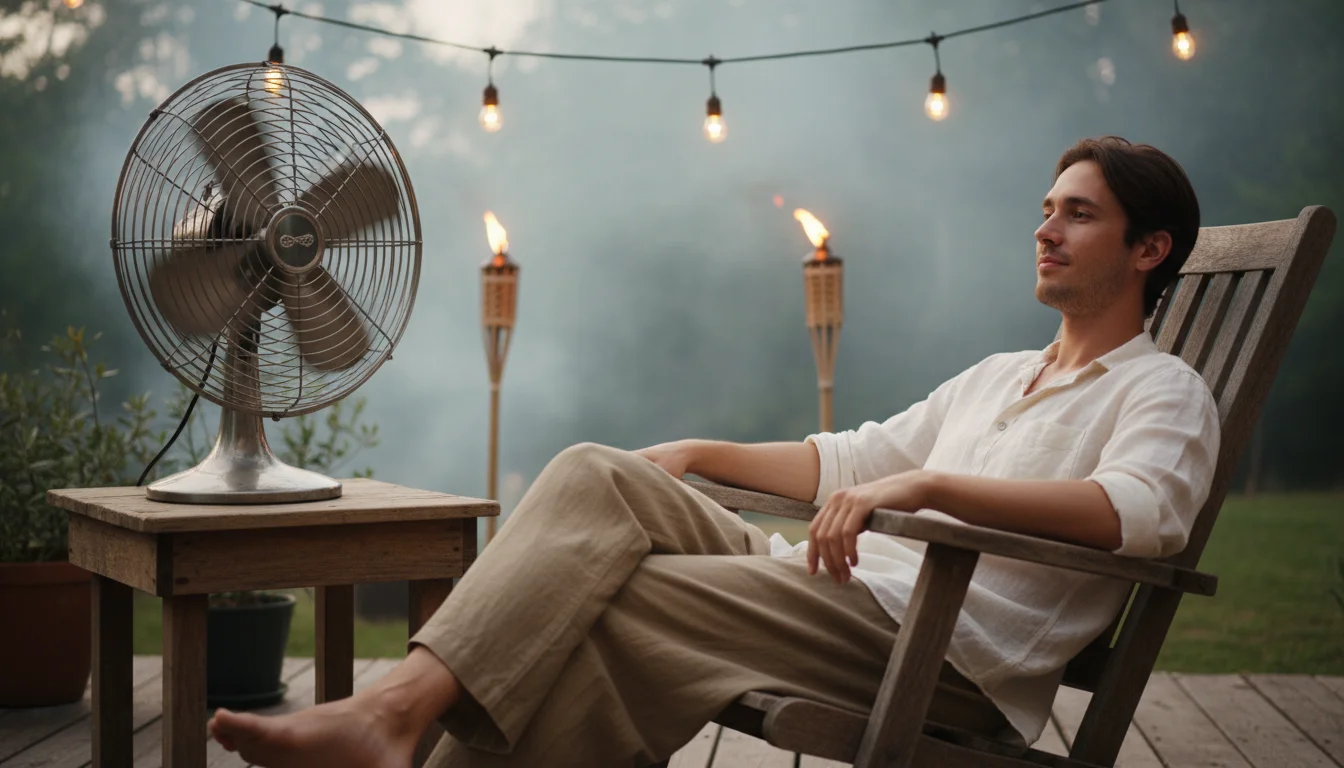
Mosquitoes are weak fliers. A steady breeze of 2-3 mph makes it nearly impossible for them to land on you. Set up fans on a patio or deck aimed at your seating area and they’ll stay clear. Ceiling fans work on covered porches; oscillating fans cover more ground for open areas.
There’s a secondary benefit too: fans disperse the carbon dioxide and body heat that attract mosquitoes. You become harder to find, not just harder to land on.
For maximum effect, position fans so the airflow moves away from where you’re sitting and toward the perimeter of the space. You want mosquitoes pushed outward, not just disrupted while they’re already on top of you. A box fan on a table at the edge of a deck works better than a fan aimed directly at your chair from two feet away.