Table of Contents
Moisture control and prevention address why silverfish are in your home. Traps and treatments address the silverfish that are already there. Use both in combination – treating without fixing the underlying conditions just means you’ll be treating indefinitely.
Diatomaceous Earth
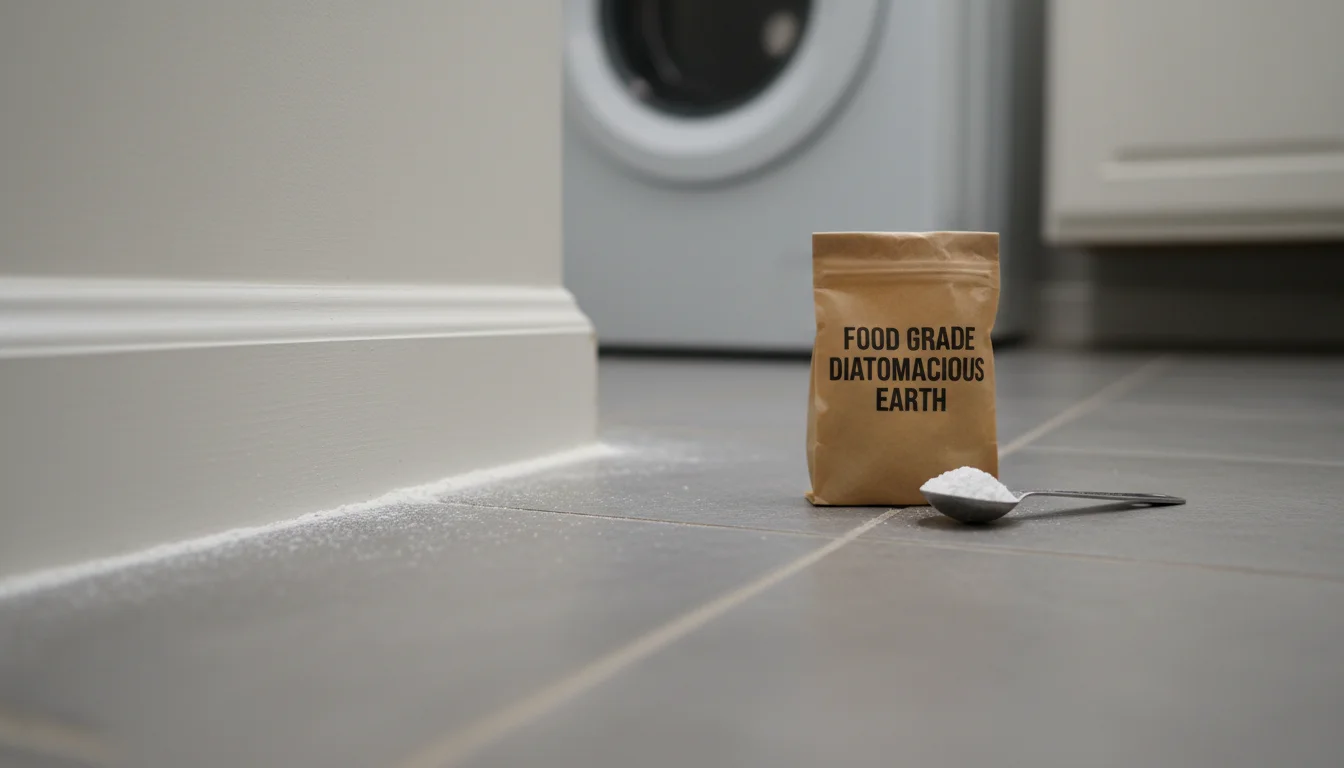
Food-grade DE is a fine powder made from fossilized algae shells. Under a microscope, the particles are jagged enough to shred the waxy coating on silverfish exoskeletons, causing them to dehydrate and die. For humans and pets it’s inert.
Spread a thin line along baseboards, under appliances, in closet corners, and anywhere you’ve seen activity. The layer should be thin – silverfish won’t cross a heavy pile, they’ll go around it. Reapply after any moisture exposure, since wet DE clumps and stops working. It’s slow (days to weeks for results), but it’s genuinely effective in locations you can’t spray and needs no reapplication once dry conditions are maintained.
Use Boric Acid Bait
Mix 1 tablespoon of boric acid with 3 tablespoons of sugar and enough water to form a paste. The sugar is the lure; boric acid disrupts the insects’ digestive systems. They absorb a lethal dose over 1-2 days rather than instantly, which means they carry contaminated material back to their hiding spots before dying.
Place small amounts on cardboard or plastic lids in areas of activity – along baseboards, under sinks, behind appliances. Keep away from pets and children, both because boric acid is toxic in quantity and because the sugar attracts them too. For a liquid version: 1 teaspoon boric acid dissolved in 1 cup warm water with 8 teaspoons sugar, applied to cotton balls. Replace every few days.
Homemade Jar Traps
Wrap the outside of a glass jar with masking tape – rough enough texture for silverfish to climb. Put a piece of bread or a spoonful of flour inside as bait. They’ll climb up the tape on the outside, drop in for the food, and can’t climb back out on the smooth glass interior.
Check every morning, tip the contents into soapy water, reset with fresh bait. This won’t resolve a heavy infestation on its own, but it’s a useful monitoring tool: where you’re catching them tells you where activity is concentrated. It also catches stragglers after other treatments have brought numbers down.
Use Sticky Traps
Flat glue traps placed along baseboards, in corners, and under furniture catch silverfish during their nocturnal runs. No attractant needed for crawling pests – placement along travel paths does the work. Replace traps when they’re full or when the adhesive dries out.
Sticky traps serve two functions: active population reduction and monitoring. What you’re catching (and how many) tells you whether your other methods are working. Spike in catches after adding moisture control usually means you’re flushing them out of damp hiding spots – a good sign.
Peppermint Oil Spray
Mix 15-20 drops of peppermint essential oil with 2 cups of water and 1 teaspoon of dish soap (to help it emulsify). Shake well, spray along baseboards, in closet corners, around pipe penetrations and entry points.
Peppermint oil overwhelms the chemoreceptors silverfish use to navigate, making treated areas register as hostile. Reapply every 3-5 days or after cleaning. It’s a broad-spectrum repellent, so you’ll push back multiple species at once. One note: peppermint oil is toxic to cats. If you have cats in the house, use citrus peel extract or bay leaf sprays instead.