Table of Contents
Your plants are getting eaten overnight and you’re finding nothing but slime trails by morning. That’s slugs. They feed at night, hide during the day, and can strip seedlings to stubs in a single week. Traps and baits let you fight back without blanketing your garden in chemicals – some of these methods cost nothing, and the best one (iron phosphate) is completely safe around pets and kids. Here’s what works.
Slug Balls
Perlite stops them cold. Add a half-inch (1-2 cm) layer above your substrate surface as backup defense around prized plants or seedlings.
I tested this by watching a slug try to cross a strip of perlite. Within seconds it was coated in the white volcanic granules and couldn’t move – looked like a snowball with a slug center. Their defensive response is to secrete mucus and curl into a ball. On perlite, that sticky mucus glues them to the rocks. They’re stuck. Not the most lethal method in this list, but as a barrier around individual containers or raised beds, it’s genuinely effective.
Cardboard Traps
Free. Zero effort. Surprisingly good.
Wet a sheet of corrugated cardboard and lay it flat on the soil where you’ve seen slug activity, ideally after watering in the evening. Slugs need moisture and shelter, and wet cardboard delivers both. By morning you’ll find slugs hiding underneath. Lift it, scrape them into a bucket of soapy water, and reset.
You can scale this up – lay several pieces across a larger bed and you’re running a full trap line. Works best when soil is already damp, because dry conditions mean fewer slugs moving around to catch. Reuse the cardboard until it falls apart; the wetter and more degraded it gets, the more attractive it becomes.
A Slug Trap
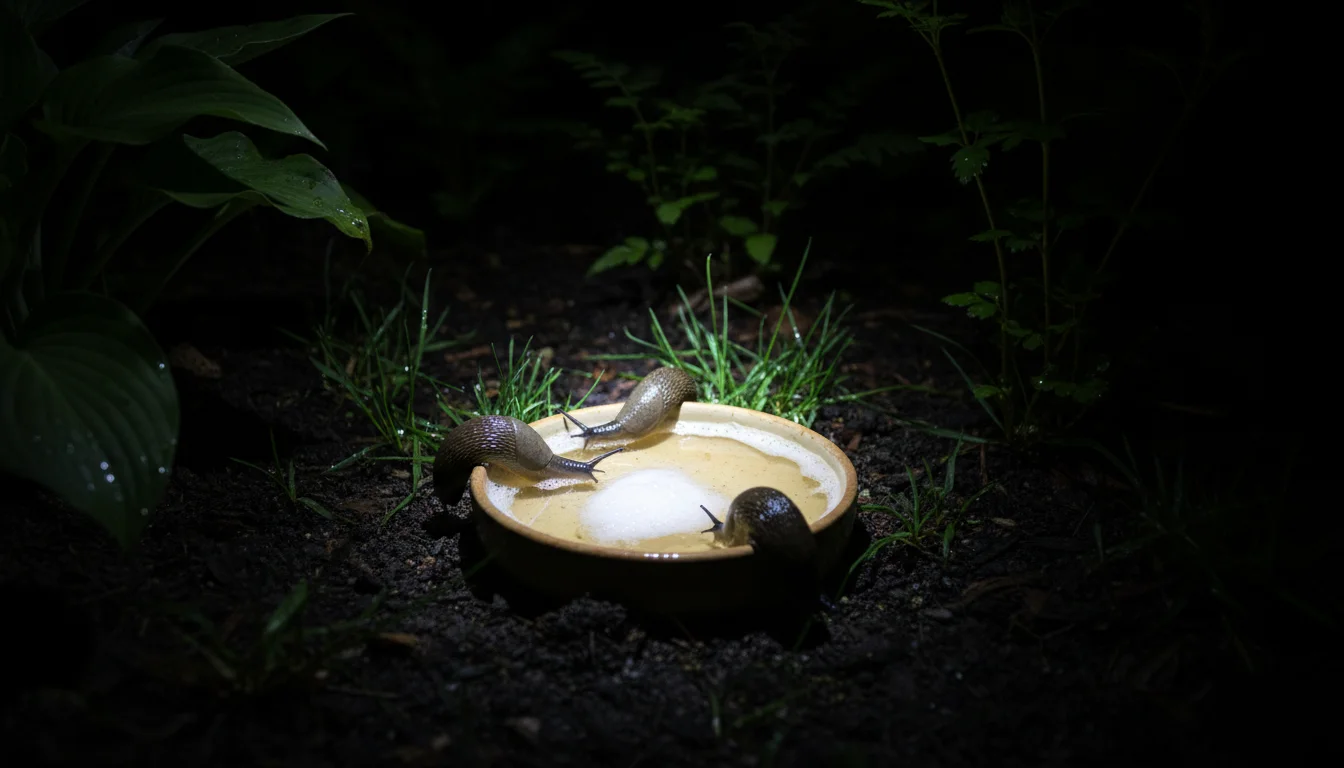
Put a shallow dish into the soil so the rim sits flush with the surface. An old tuna can, a container lid, anything low-sided will work. Fill it with beer. Any beer.
Slugs are attracted to the yeast and sugar, crawl in, and drown. They can’t resist it. Check it every morning, dump the contents, and refill. During a bad infestation you’ll be amazed at how many you catch in a single night.
Use the cheapest beer you can find. They genuinely don’t care. And yes, there’s something faintly poetic about the most destructive thing in your garden meeting its end face-down in a dish of lager.
Iron Phosphate Bait
This is the best option if you’re dealing with a real infestation. Iron phosphate pellets (sold as Sluggo, Escar-Go, and similar brands) are the only slug bait that’s genuinely safe around pets, kids, and wildlife – including birds and hedgehogs that might eat a poisoned slug. Scatter them thinly around affected plants. Slugs eat the pellets, stop feeding immediately, and die within a few days.
Dead slugs decompose in the soil rather than sitting on the surface, so you won’t find piles of carcasses. After use, the iron phosphate breaks down into fertilizer. Reapply every 2-3 weeks during slug season, more often after heavy rain. It outperforms beer traps in heavy infestations because it covers a wide area rather than waiting for slugs to find a single dish.
Night Watch
The low-tech option that’s more satisfying than it sounds. Go out at dusk or after dark with a flashlight and pick slugs off your plants by hand. Drop them into a bucket of soapy water.
You’ll catch far more in one evening than most traps catch in a week, especially right after rain or in humid conditions. The first time you do it you’ll probably be surprised by the numbers – many gardeners don’t realize how dense the population actually is until they see it. That’s fine. It means you’re actually solving the problem rather than just making a dent in it.
Wear gloves if the texture bothers you. Salt works too as an instant kill if you’d rather not handle a bucket, though it leaves residue on your soil. Combine night watch with iron phosphate bait for the most effective approach – you’re removing the adults while the bait catches what you missed and anything that arrives after you’ve gone inside.
The best time is 1-2 hours after dark on a mild, damp night. That’s peak slug activity. A dry night in summer will yield almost nothing; a wet night in spring or fall can yield dozens per plant.