Table of Contents
Knowing how to get rid of tree stumps comes down to one decision: how fast, and at what cost? If you need it gone in a day, you’re renting or hiring. If you’re willing to wait months and spend nothing, you have options. The methods below are ordered fastest to slowest, with costs and honest timelines for each.
1. Rent a Stump Grinder
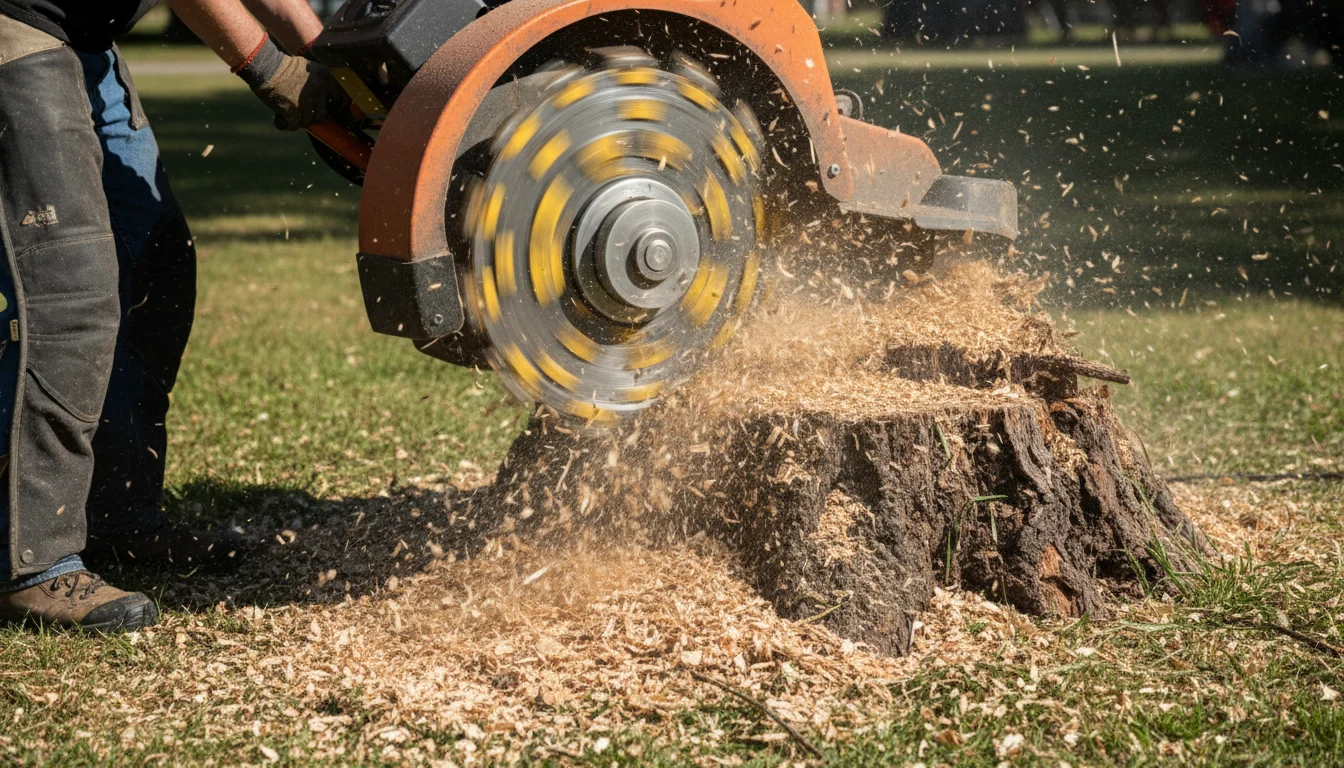
Fastest DIY option. A stump grinder is a self-propelled machine with a spinning carbide-tipped wheel that shreds wood into chips 6-12 inches (15-30 cm) below grade. Rental runs $150-300 per day from equipment hire shops. Any stump under 24 inches (60 cm) diameter is practical with a rental machine; above that size, a contractor’s truck-mounted unit is faster and the price gap shrinks.
Position the wheel slightly above the stump, engage the cutter, and work in sweeping passes from front to back. Move in 2-3 inch (5-8 cm) increments per pass. If the stump has major surface roots, grind those first – unground roots will jam the machine.
The resulting wood chips fill the hole. They’ll compress 30-40% volume as they decay over the next two years, so mound them slightly above grade before seeding or planting to account for settling.
Approximate time to clear: same day.
2. Hire Professional Stump Removal
The right move for stumps over 24 inches (60 cm) diameter, stumps near underground utilities, or when you have multiple stumps to clear in one visit.
Contractor stump grinding costs $150-400 per stump for standard residential work. Bundle multiple stumps in a single visit – one stump at $250 might become three for $500. End-of-season (late fall) and weekday pricing is lower than spring and weekends. Some tree removal companies include stump grinding in the tree removal price; ask before signing.
Professionals handle stumps that rental equipment can’t efficiently address, work around buried cables and irrigation systems, and clean up afterward.
Approximate time to clear: same day.
3. Dig Out Stump by Hand
Practical only for small stumps. Under 8 inches (20 cm) diameter: 1-2 hours. 8-14 inches (20-35 cm): 2-4 hours. Over 14 inches (35 cm): a full day, at which point renting a grinder becomes more cost-effective.
Dig a trench 12-18 inches (30-45 cm) deep around the perimeter with a mattock and spade. Expose lateral roots and cut each one as close to the stump as possible with a pruning saw or reciprocating saw. Once lateral roots are severed, lever the stump free with a pry bar or mattock handle. Most small stumps come out with significant leverage once the roots are cut.
Anything with a deep tap root or dense root ball gets exponentially harder above 12 inches (30 cm) diameter. Don’t start the hand dig on a stump you’re not sure about.
Approximate time to clear: 1 day (small stumps only).
4. Apply Chemical Stump Remover
The fastest chemical option that actually works. Products like Spectracide Stump Remover and Bonide Stump Out contain potassium nitrate, which feeds the bacteria and fungi that break wood down – actively accelerating decomposition rather than just desiccating.
Drill 1-inch (2.5 cm) holes 8-10 inches (20-25 cm) deep across the stump’s top surface in a grid, spaced 3-4 inches (8-10 cm) apart. Pour the granules into the holes and fill with water. Cover with a tarp to retain moisture.
Timeline: 4-6 weeks before wood softens enough to axe apart. Full decomposition takes 3-12 months depending on stump size and wood species. This isn’t immediate removal – it’s progressive breakdown that makes the stump easier to chip away over several months.
Important distinction: potassium nitrate (chemical stump remover) and salt are not equivalent options despite appearing together in most competitor content. Potassium nitrate accelerates decomposition by feeding the organisms doing the work. Salt just kills the stump by desiccation – the dead wood still takes years to break down, and salt sterilizes the surrounding soil. If you’re using a chemical approach, potassium nitrate gets you to a removable stump far faster.
Approximate time to clear: 3-12 months.
5. Cover Stump to Accelerate Rotting
The chemical-free slow route. Drill multiple holes in the stump top, pack with nitrogen-rich material (grass clippings, coffee grounds, or diluted high-nitrogen fertiliser), then cover with 6-8 inches (15-20 cm) of compost or wood chip mulch. Cover the pile with a black plastic tarp weighted at the edges. The warm, moist, high-nitrogen environment accelerates decay fungi and bacteria naturally.
One tip that no competitor mentions: inoculate the drilled holes with oyster mushroom plug spawn ($15-25 at garden centres). Mushroom mycelium accelerates a medium stump from a 3-5 year unaided timeline down to 12-18 months – and produces edible mushrooms while it works.
Check monthly, add more nitrogen material and water as needed.
Approximate time to clear: 6-24 months (12-18 months with mushroom inoculation).
6. Apply Salt to Desiccate Stump
The slow chemical-free option. Rock salt or Epsom salt packed into drilled holes draws moisture out of the wood, eventually killing the stump and preventing resprouting.
Same drilling pattern as chemical remover: 1-inch (2.5 cm) holes, 8-10 inches (20-25 cm) deep, 3-4 inches (8-10 cm) apart. Pack with salt, water to dissolve, cover with tarp.
Honest limitations: desiccation kills the stump but doesn’t accelerate decomposition. The dead wood still takes years to break down – you end up with a dead stump rather than no stump, just faster than unaided rotting. Salt also sterilises surrounding soil, so don’t use this near gardens, lawn edges, or anywhere you plan to plant. For stumps in open, isolated areas where you don’t care about the soil around them, it’s free and hands-off.
Approximate time to clear: 1-3 years.
7. Cut Stump Flush to Ground
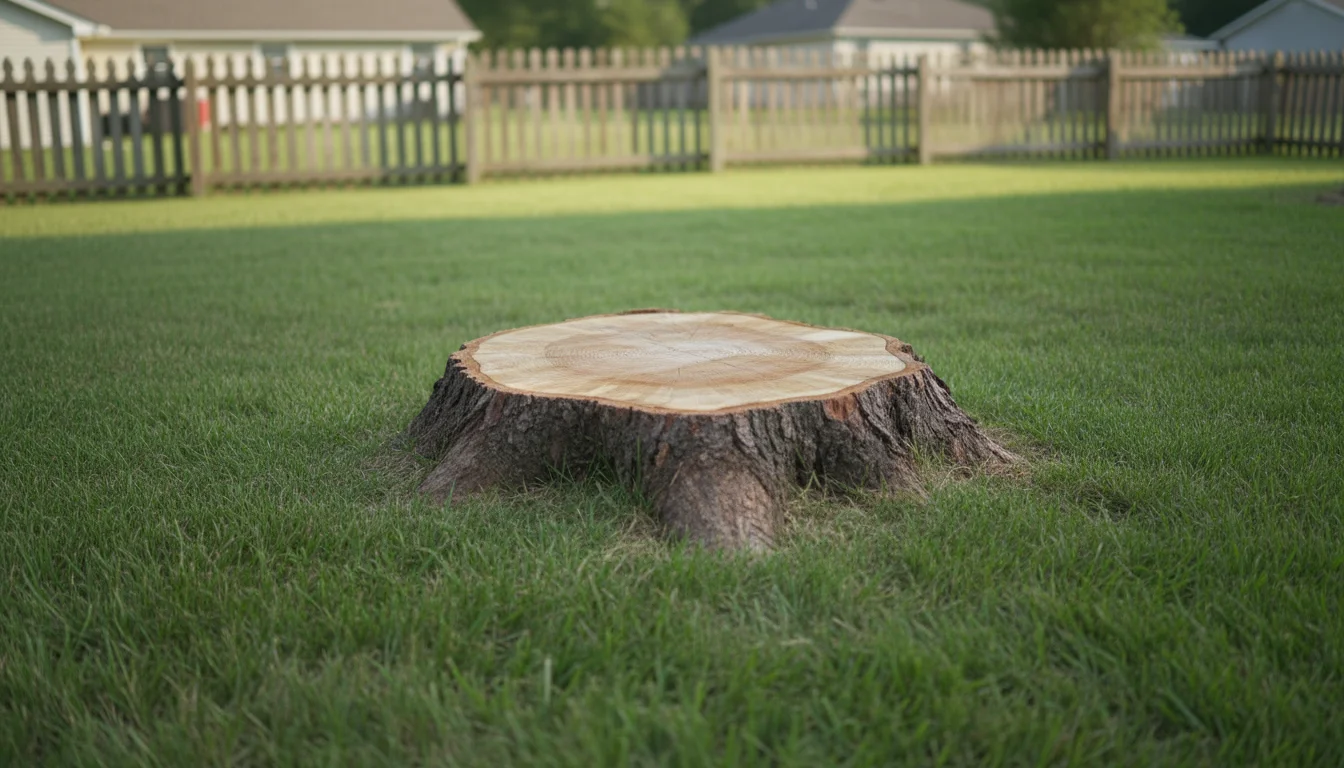
This doesn’t remove the stump – it removes the hazard and prevents trunk regrowth. Use a chainsaw to cut the stump as close to ground level as possible, ideally just below grade. For a lawn area, anything above 2-3 inches (5-8 cm) will catch mower blades.
One critical timing note: if regrowth is a concern (elm, cherry, poplar, and most oaks resprout vigorously from cut stumps), apply concentrated glyphosate or triclopyr to the freshly cut surface within 30 minutes. After 30 minutes, the cut wood oxidises and seals, and herbicide absorbs much less effectively.
Use this as a prep step for other methods, or as a permanent solution if you’re OK with the root system eventually decaying on its own timeline.
Approximate time to clear: hours (stump remains underground).
FAQ
How do you get rid of a stump in 2-3 days naturally?
Nothing natural works in 2-3 days. That’s not how wood decomposition works. The fastest natural method – covering with nitrogen-rich material and a tarp – takes 6-24 months. If you need it gone in days, rent a stump grinder ($150-300/day) or hire a contractor. That’s the honest answer.
What will rot a tree stump quickly?
Potassium nitrate (Spectracide Stump Remover, Bonide Stump Out) is the fastest option – it feeds the decomposers, softening most stumps enough to axe apart within 4-6 weeks, with full breakdown in 3-12 months. Nothing chemical-free works quickly. For "quickly" in natural terms, mushroom plug spawn inoculation brings 12-18 months vs 3-5 years unaided.
What’s the fastest way to get rid of tree stumps?
Stump grinding – either renting a machine ($150-300/day) or hiring a contractor ($150-400 per stump). A grinder turns any stump into wood chips in under an hour, ground 6-12 inches below grade. It’s the only method that completely removes a stump the same day.
How much does it cost to have a stump ground down?
$150-400 per stump for a contractor, depending on size and access. Bundling multiple stumps in one visit gets you a significant discount. DIY rental is $150-300 for the day. For stumps under 24 inches (60 cm) in open areas, rental usually makes financial sense. Above that size, the contractor’s equipment is faster and the price gap shrinks.