Table of Contents
You came out to the garden and half your tomato plant was stripped overnight. Leaves gone, stems gnawed to stubs, and somewhere on what’s left: a large green caterpillar so well-camouflaged you almost missed it. That’s a tomato hornworm. If you’re searching for how to get rid of tomato hornworms, the short answer is: hand-pick them first, spray Bt if they keep appearing. The damage looks catastrophic but it’s fixable once you know how to find them.
How to get rid of tomato hornworms comes down to one question: how bad is it? Light infestation – pick them off by hand. Heavier problem or you keep missing them – add Bt spray. Want to stop it happening next year – companion planting and fall tilling. This guide covers all of it.
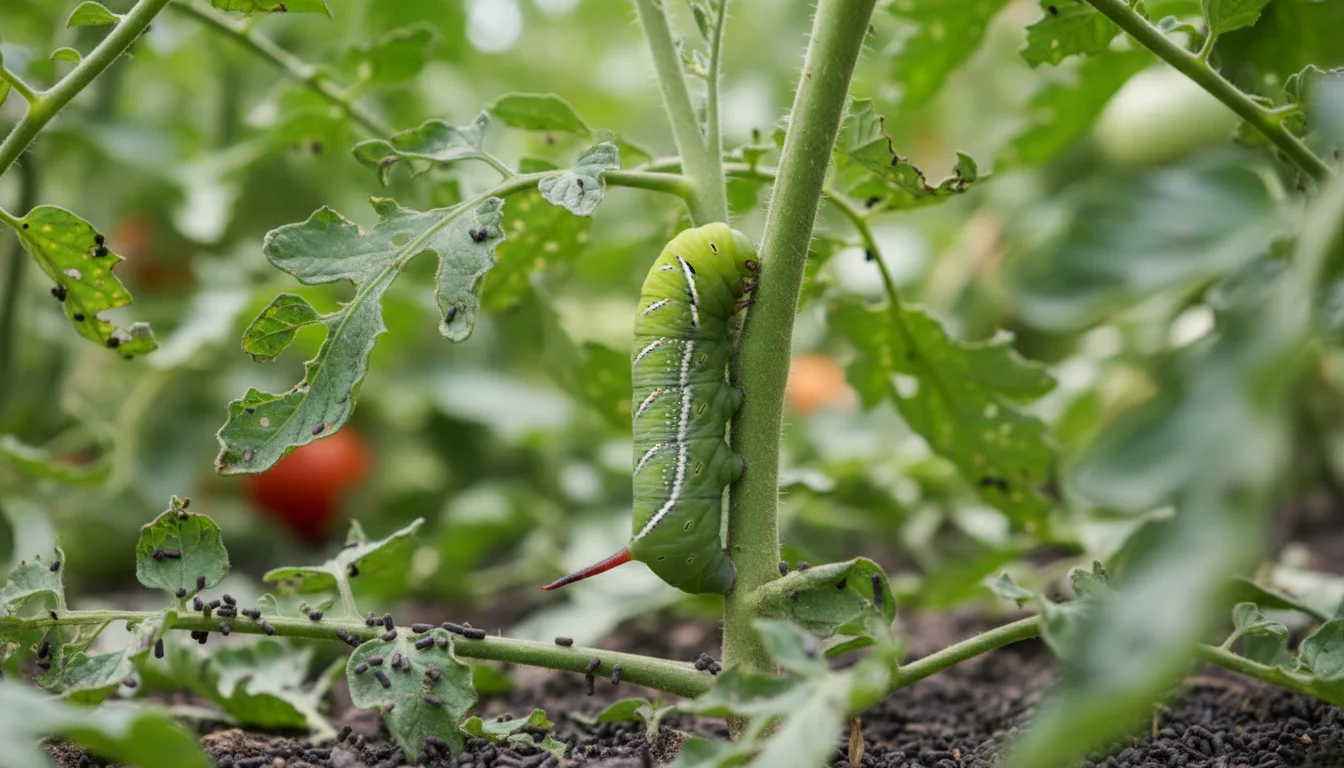
How to find them: Start with the frass. Look for dark green-black pellets about the size of a small pea scattered on leaves or on the soil beneath the plant. That’s hornworm droppings, and they’re usually directly below the worm. Trace upward along the stem from the frass pile and you’ll find it. Hornworms feed at night and rest during the day pressed tight against stems, which is why casual inspection misses them.
One thing to know before you start picking: If you find a hornworm covered in rows of small white projections that look like grains of rice, leave it alone. Those are braconid wasp eggs. The larvae are already feeding on the hornworm from inside and will kill it within days – then emerge to parasitise other hornworms in your garden. Killing a parasitised hornworm means losing your free biological pest control.
1. Hand-Picking
The first and best method for most gardens. Free, immediate, and completely effective when done right.
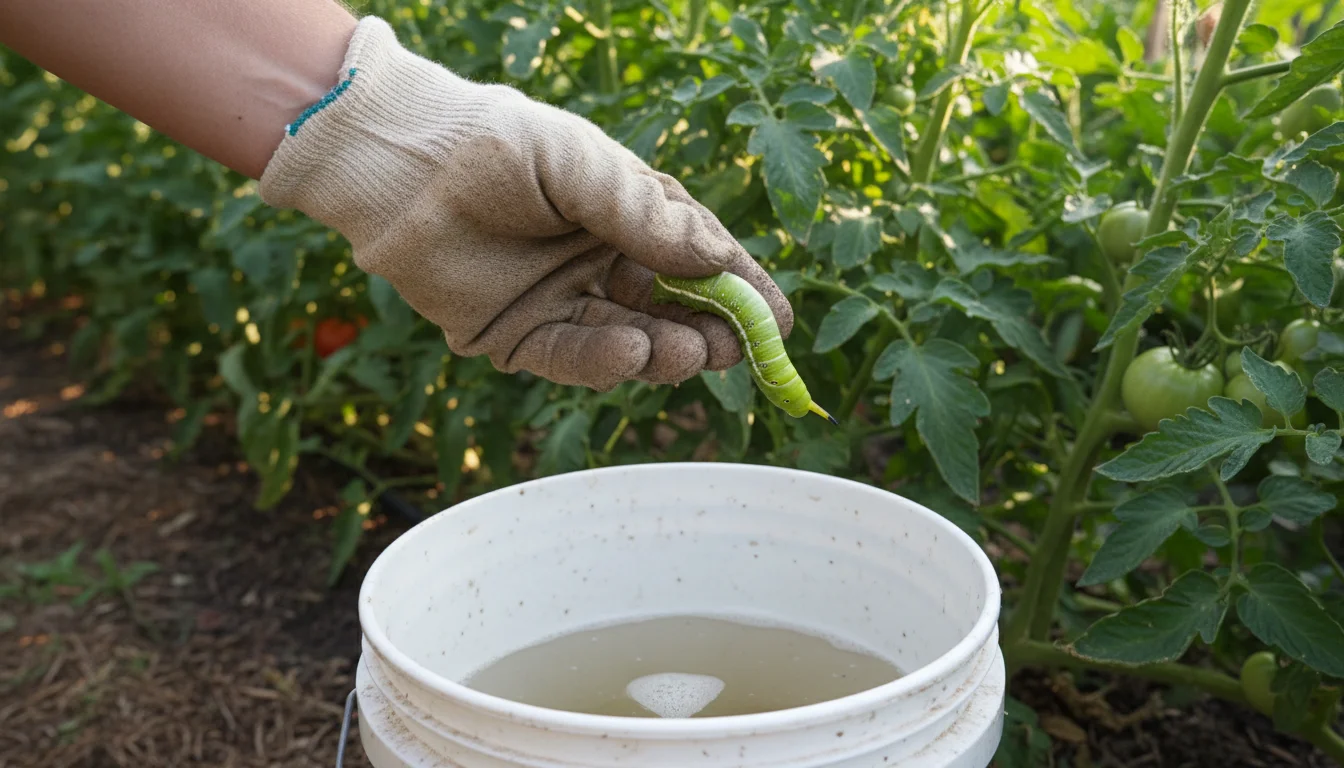
Go out in early morning – hornworms feed through the night and are still near the surface at dawn. Bring a bucket with a few inches of water and a few drops of dish soap added. When you find a hornworm, drop it in. Don’t just toss it on the ground or into the compost – these caterpillars are strong climbers and will make their way back to the plant.
Check under leaves, along main stems, and at the base of the plant near the soil. Follow the frass: find the pellets, look directly above, work up the stem. A 3-4 inch hornworm is large enough to see but the green-on-green camouflage is genuinely good. Running your hand along the underside of stems helps – you’ll feel it before you see it.
Repeat every two to three days during peak season. One round of picking won’t clear a problem. Moths lay eggs continuously through summer so new hornworms can appear even after you’ve removed an existing population.
For large infestations or if night inspections aren’t practical, a UV torch (blacklight) makes hornworms fluoresce bright green-white in the dark – they’re easy to spot in seconds compared to daytime searching.
How many are there? Seeing one usually means there are more. A single hawk moth can lay 200+ eggs over a season. Check the whole plant, including the lower sections near the soil – younger, smaller hornworms are often lower down while large ones have worked their way up to where the foliage is densest.
2. Bt Spray
Bacillus thuringiensis kurstaki (Bt-k) is a soil bacterium that kills caterpillars when they eat treated foliage. It’s organic, approved for food crops, and harmless to everything else – birds, earthworms, bees, pets, humans. Once ingested, the bacterial proteins destroy the hornworm’s gut lining. It stops feeding within hours and dies within 2-5 days.
The catch: timing matters more than product choice. Spray at dusk – Bt degrades in UV light and most daytime applications are half-wasted by the time hornworms start feeding at night. Reapply every 5-7 days and after rain. The spray needs to be on the foliage that hornworms are actively eating.
The other catch: Bt works best on young larvae. A 2-inch caterpillar that eats a treated leaf will die. A fully grown 4-inch hornworm eats relatively little (it’s close to pupating) and may not get a lethal dose before it drops off the plant. If you’re seeing large hornworms, hand-picking is more reliable. Use Bt early in the season when larvae are small or as a preventive once you know moths are laying eggs in your garden.
Monterey Bt is the standard brand at garden centers, typically $12-15 for a concentrate that makes several gallons. Dipel is another reliable option. Mix per label directions – usually 1-4 tablespoons per gallon (3.8 L) of water – and spray all plant surfaces including the undersides of leaves where hornworms rest during the day.
One limitation: Bt only works on caterpillars that eat treated foliage. It doesn’t persist in the soil, doesn’t affect pupae, and won’t kill hornworms that are already finished feeding and ready to drop off to pupate. For those, hand-picking is still faster. Use Bt as your routine spray and hand-pick anything large enough to grab.
3. Cayenne Pepper Spray
A deterrent rather than a killer. Worth using as a layer of protection around seedlings early in the season, or alongside hand-picking and Bt when pressure is high.
Mix 2 tablespoons of cayenne pepper powder with 1 quart (950 ml) of water and a few drops of liquid dish soap. Let it steep for 24 hours – this gives the capsaicin time to fully infuse. Strain it through a cloth or fine strainer (blocked spray nozzles are annoying), transfer to a spray bottle, and apply to the foliage and soil around your plants.
The capsaicin irritates hornworms’ sensory organs and makes treated surfaces unappealing to cross or eat. It won’t clear an existing infestation – a hornworm already feeding on your plant won’t move because of capsaicin nearby. What it does is make your plants less attractive to moths laying eggs and newly hatched larvae looking for a feeding site.
Reapply after every rain. It breaks down quickly and washes off entirely. Keep it away from eyes – it works on humans too.
4. Insecticidal Soap
Works by suffocating soft-bodied insects on direct contact. Unlike Bt, it has no delayed action – it either touches the pest or it doesn’t do anything.
Mix 1 tablespoon of pure liquid castile soap with 1 quart (1 L) of water. Don’t substitute dish soap with degreasers, antibacterial additives, or synthetic fragrances – they can damage plant tissue. Spray the solution directly onto the hornworm itself, coating its body. This is the key distinction from other sprays: you’re targeting the insect, not just the plant.
This is most effective on young larvae under about 2 inches. A large hornworm has a tougher outer coating and more body mass – insecticidal soap will distress but may not kill it with a single application. For large hornworms, hand-picking is faster and more reliable.
Apply in cool morning or evening conditions. Soap sprays in full sun or heat can scorch foliage. Reapply every 5-7 days if needed. Because soap leaves no residue once dry, beneficial insects visiting later aren’t harmed.
5. Companion Planting
A prevention strategy, not a cure. If you’ve got hornworms already, plant companions now and they’ll help next season. If you’re starting fresh, plant them at transplanting time.
Basil is the primary companion for tomatoes against hornworms – plant one basil plant per 2-3 tomato plants. The volatile oils basil releases deter the hawk moths that lay hornworm eggs. Dill and borage also deter hornworms and attract parasitic wasps (including braconid wasps) that prey on hornworm larvae. Marigolds planted around the bed perimeter deter a range of garden pests and don’t compete significantly with tomatoes for nutrients.
Don’t plant companions after hornworm damage has started expecting immediate results. The deterrence mechanism takes weeks to establish and has no effect on hornworms already present.
Prevention
Till in fall and early spring. Tomato hornworm pupae overwinter in the soil. Tilling beds 2-3 weeks before planting exposes them to cold, drying, and birds. It won’t eliminate all of them but it reduces the overwintering population before they can become your spring problem.
Use row covers on transplants. Fine mesh row covers over newly transplanted seedlings prevent hawk moths from reaching the plants to lay eggs. Remove when plants start flowering (pollinators need access) or once stems have toughened.
Inspect weekly. Early detection is the single most effective prevention. A two-minute frass check once a week during summer catches infestations when hornworms are still small and easy to deal with, before they’ve done serious damage.
Encourage predators. Ground beetles, paper wasps, and parasitic braconid wasps all attack hornworms. Leaving a patch of low flowering plants (dill, fennel, yarrow) near the vegetable bed gives these predators habitat and nectar sources. Avoiding broad-spectrum insecticide use matters here – pyrethroids and carbamates kill beneficial insects as readily as they kill hornworms, and spraying them sets back your natural predator population for the rest of the season.
FAQ
How do I keep hornworms off tomatoes?
Combination approach: row covers on young transplants, companion planting of basil and dill throughout the season, fall tilling to reduce the overwintering population, and weekly inspections starting in midsummer. No single method eliminates them – the goal is making your garden less attractive than your neighbor’s.
What causes tomato hornworms?
The five-spotted hawk moth (also called the hummingbird moth) lays eggs on plants in the nightshade family – tomatoes, peppers, eggplant, potatoes. If you grow nightshades and hawk moths are present in your area, you’ll get hornworms. It’s not a sign of poor gardening. It’s just what happens when host plants and hawk moths occupy the same territory in summer.
Where do tomato hornworms hide during the day?
Pressed against stems and under leaves, relying on camouflage. They blend almost perfectly against green tomato stems. Find them via frass: look for small dark pellets on leaves or at the base of the plant, then trace up the stem from that point. They’re usually within a few inches of the frass deposit.
Can tomato plants recover from hornworm damage?
Yes, if you catch it before the main stem is compromised. A plant stripped to bare stems but with its root system and main stem intact will push new growth within 1-2 weeks if you remove the hornworms, water well, and give it a light feed. Plants that lose their main stem or are stripped to below the graft line on grafted varieties are unlikely to recover. Don’t write off a heavily damaged plant immediately – give it a week after the hornworms are gone.
Should I kill a hornworm covered in white bumps?
No. Those are braconid wasp eggs. The wasp larvae feed on the hornworm from inside and will kill it naturally. Leave it on the plant. The adult wasps that emerge will parasitise other hornworms in your garden. Killing a parasitised hornworm destroys a beneficial predator.