Table of Contents
Whiteflies in a greenhouse are worse than outdoor infestations. Same pest, but the enclosed warm humid air means populations double in days rather than weeks, there’s no wind or rain to knock adults off plants, and beneficial insects don’t show up uninvited. The fix is two-stage: knock down what’s there now, then change the conditions so the next generation can’t establish at the same rate.
Most of the methods below are aggressive. Greenhouses give you control that outdoor gardens don’t – use it.
1. Yellow Sticky Traps
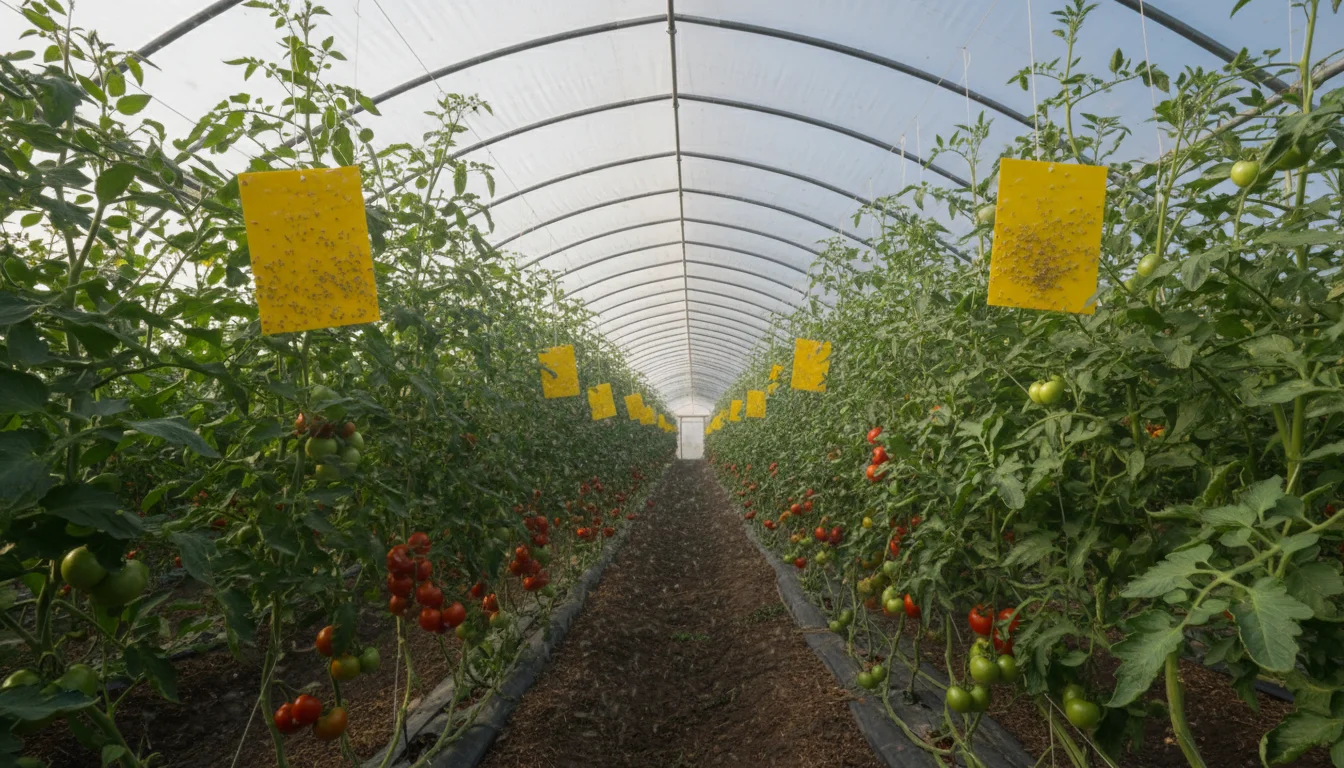
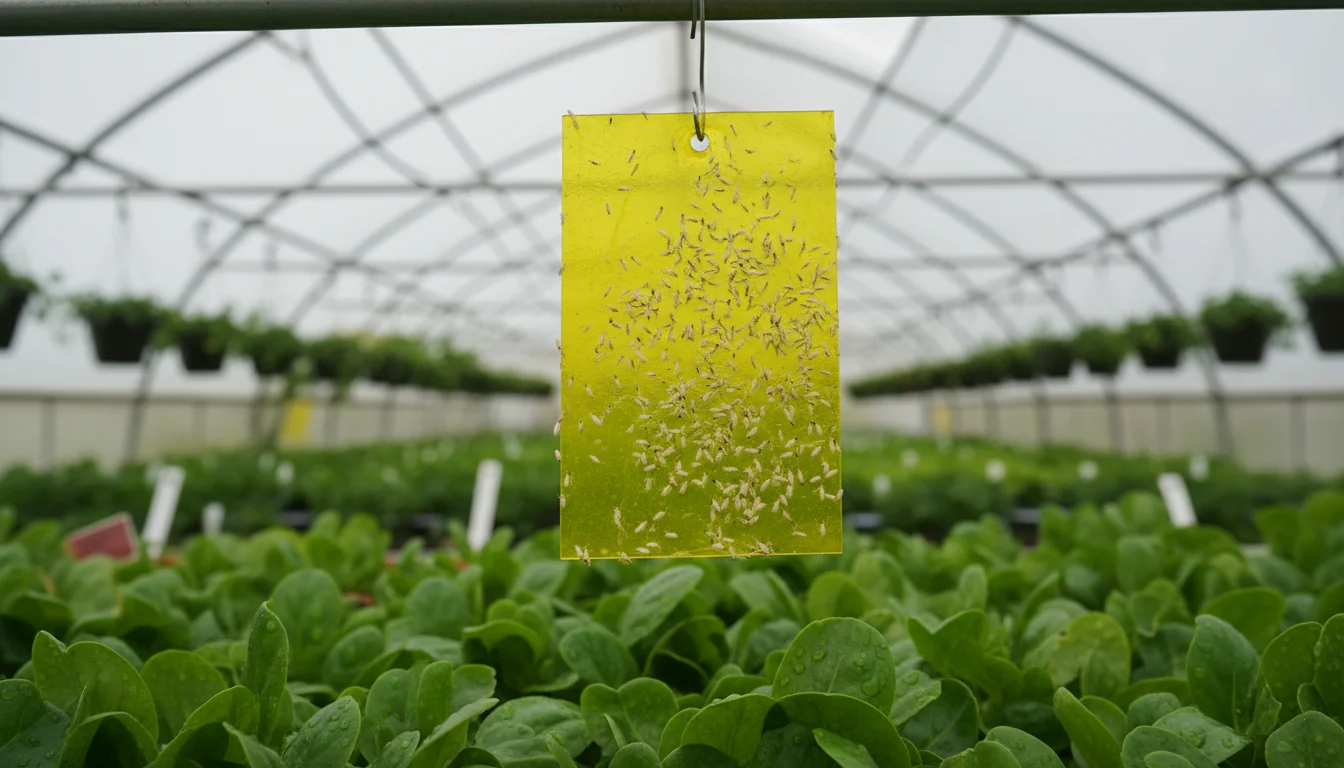
Start here. Hang yellow sticky traps just above foliage height throughout the greenhouse – one trap per 10 sq ft (0.9 sq m) of growing area is the density that gives you useful data rather than just token catches.
The traps serve two purposes. They catch adults before they can lay more eggs. And more usefully, they tell you where the population is concentrated and whether your other treatments are working. A week after starting treatment, the traps that are still filling fast are showing you where to focus spray applications. Traps going from covered to sparse means the population is declining.
Replace when full or when the stickiness degrades. In a warm humid greenhouse, that can be every 1-2 weeks.
2. Insecticidal Soap
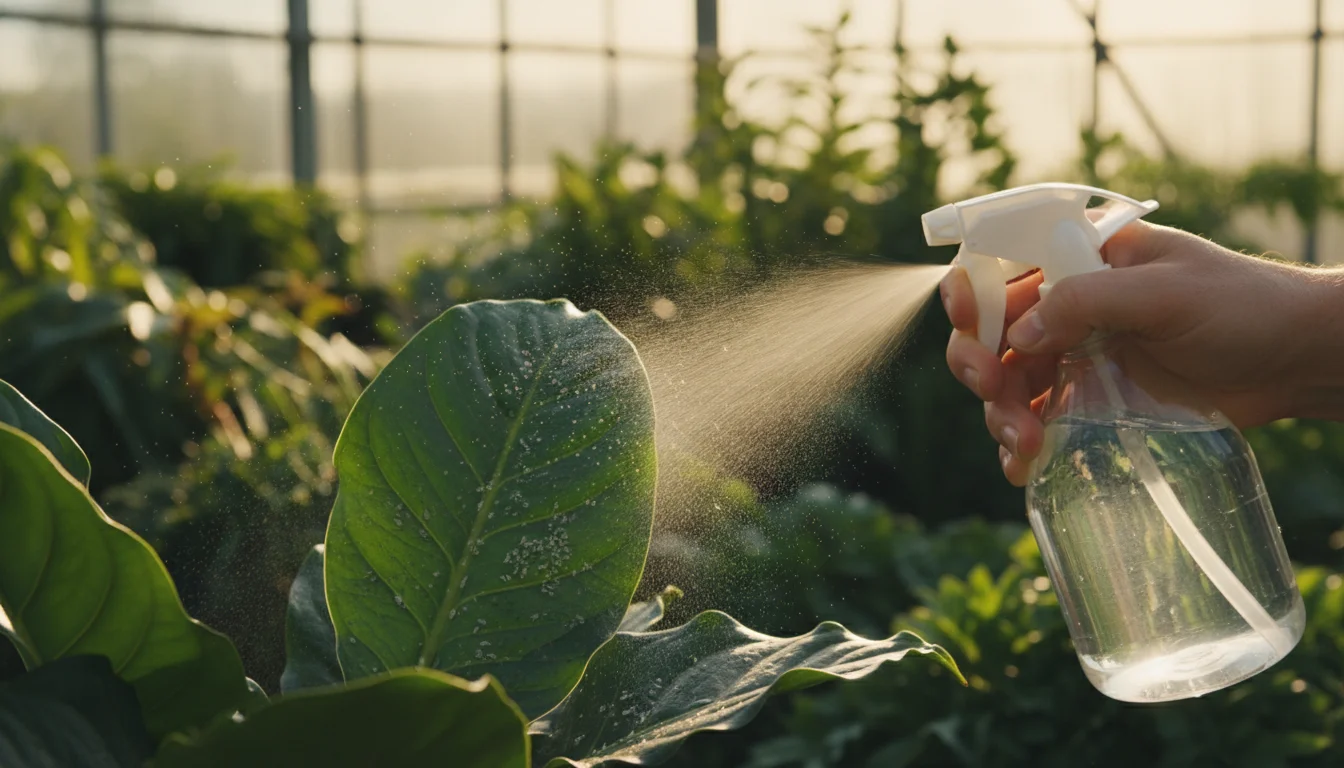
The fastest contact knockdown for the current population. Insecticidal soap works by disrupting the cell membranes of soft-bodied insects – it has to physically touch them to work, which means how you apply it matters as much as whether you apply it.
Mix 1 tablespoon of pure liquid castile soap with 1 quart (1 L) of water. Don’t use dish soap with degreasers or antibacterial additives – those can scorch plant tissue. Spray directly onto infested areas and focus especially on the undersides of leaves. That’s where whitefly nymphs cluster and feed. Spraying from above and missing the undersides is the most common reason this method fails.
Apply in cool conditions – early morning before the greenhouse heats up, or with vents open to keep temperatures down. Leaf burn from insecticidal soap happens in heat. Reapply every 5-7 days for at least three cycles.
One timing constraint if you’re planning to release beneficial insects: wait 48 hours after spraying before releasing. The soap doesn’t leave a residue once dry, but give it time to fully dry before your beneficials arrive.
3. Blast Them Off With Water
A strong water spray physically dislodges adults, nymphs, and loosens eggs from leaf surfaces. It won’t kill them – dislodged whiteflies on a greenhouse floor will try to crawl back up – but it dramatically reduces the feeding population and disrupts egg-laying.
Get under the leaves. Direct the spray upward at the leaf undersides with some force. For potted plants, move them to a dedicated washing area or outside to a hose. For in-ground beds, use a lance nozzle that lets you get the angle right.
Repeat every 3-4 days for two weeks. Whitefly eggs hatch in 6-10 days at greenhouse temperatures (faster than outdoors because of the warmth), so consistent repetition is what breaks the cycle rather than a single thorough blast. If you only do this once, the adults that escape will repopulate the plant within the same week.
4. Neem Oil
Neem works differently from soap – it’s not a contact killer but a growth disruptor. The active compound azadirachtin interferes with the whitefly life cycle: larvae fail to molt properly, adults have reduced fertility, eggs hatch less reliably. It won’t clear an infestation fast, but it degrades the population’s ability to replace itself.
Mix 1-2 tablespoons of neem oil per 1 gallon (3.8 L) of water with a few drops of dish soap as an emulsifier. Apply to all leaf surfaces, hitting undersides. Reapply every 7-10 days.
Because neem affects soft-bodied insects broadly, avoid applying it within 48 hours of releasing beneficial insects. Use it as a follow-up after contact treatments have knocked the population down, not as the first thing you reach for.
5. Remove Heavily Infested Leaves
Before you spray anything, pull off the worst-affected leaves. A leaf that’s completely coated in nymphs on the underside isn’t recoverable and isn’t contributing anything useful to the plant. Removing it cuts the population fast and makes spray applications more effective because you’re hitting actual leaf surface rather than a dense layer of insects.
Cut cleanly with scissors or pruners. Wipe the blades with rubbing alcohol between cuts – you don’t want to move nymphs from one part of the plant to another on your tool. Bag the leaves immediately and put them in the trash, not the compost. Whitefly eggs survive in compost at greenhouse temperatures.
Do this first. Then spray.
6. Release Beneficial Insects
This is the greenhouse-specific advantage that most gardeners don’t use. In an enclosed space, biocontrol agents stay in contact with the pest population. Outdoors, released beneficials disperse and disappear. In a greenhouse, they stay and work.
The gold standard is Encarsia formosa – a tiny parasitic wasp (about 0.6mm long, you won’t notice it) that parasitises whitefly nymphs. It lays eggs inside the nymphs; the larvae develop and kill the host. Infested nymphs turn black rather than the normal yellow or clear, which is how you can confirm the wasps are working. Encarsia is available from biocontrol suppliers online and is widely used in commercial greenhouse production. Release rates are typically 1-3 Encarsia per square meter per week depending on infestation level. They work best at temperatures above 64°F (18°C) with some natural light – this is why they’re more practical in a proper greenhouse than a cold shed.
For a simpler and more widely available option: lacewing larvae from garden centres. Lacewing larvae consume dozens of whitefly adults and nymphs daily. Ladybugs eat eggs and nymphs, breaking the reproductive cycle. Release both in the evening when temperatures are cooler. Water plants first – predatory insects need moisture to establish.
The patience requirement is real. Beneficial insect populations take 2-4 weeks to build up enough to make a visible dent. Don’t start a spray programme and then release beneficials the same week – you’ll just kill what you paid for. The right sequence is: contact treatments first to knock the population down, then once adults are sparse, introduce beneficials to hold the line.
Don’t spray insecticidal soap or neem oil within 48 hours of releasing either. Contact methods kill beneficials as readily as pests.
7. Vacuum Them Up
Useful for knocking down a high adult population quickly before running contact treatments. Cool the greenhouse slightly first (adults become less mobile in cooler air) then use a handheld vacuum to collect adults from leaf surfaces.
Hold the nozzle close to the leaf surface without touching it – you want suction to draw them in rather than disturbing them into flight. Work systematically across the most affected plants.
Empty the vacuum contents immediately into a sealed bag and dispose of it outside the greenhouse. If you leave them in the vacuum, adults will escape. This doesn’t affect nymphs or eggs, so follow up with a spray treatment the same day.
8. Manage Greenhouse Ventilation
This is the background condition that determines whether everything else works. Whiteflies thrive in warm, stagnant, humid air – still air at canopy level is where they feed, mate, and lay eggs undisturbed.
Open ridge vents and side vents together to create cross-ventilation. Ridge-only venting draws air upward but leaves the plant canopy layer stagnant, which is exactly where the problem lives. You want horizontal airflow through the foliage.
Add a small oscillating fan (a 6-inch (15 cm) or 12-inch (30 cm) clip-on model works for most home greenhouses) aimed at canopy level. Run it continuously during daylight hours. The moving air disrupts adults in flight, discourages egg-laying on leaf surfaces, and speeds transpiration so foliage dries faster.
Target 50-70% relative humidity. Below 40% and your plants stress; above 70% and you’re providing ideal conditions for rapid pest reproduction. A cheap digital hygrometer mounted at plant height (not near the roof – the reading up there is warmer and drier than where your plants are) gives you an accurate reading.
If your infestation keeps coming back between treatment cycles, this is usually why. The greenhouse microclimate is hospitable enough that populations rebuild as fast as you knock them down.
9. Avoid Over-Fertilizing
Excess nitrogen produces the soft, lush, fast-growing foliage that whiteflies prefer. If you’re applying high-nitrogen synthetic fertilizer regularly, you’re making your plants into better hosts.
Back off on nitrogen and switch to a balanced slow-release formula. Plants with steady but moderate nutrition are less attractive. They’re also more resilient when pest pressure does occur – stressed plants in either direction (over-fed or under-fed) handle infestations worse than plants in good steady condition.
This is also worth thinking about at the seasonal level. A burst of high-nitrogen feeding in late spring – common with tomatoes and cucumbers – coincides with the peak whitefly season. If you’re seeing bad outbreaks every summer in the same crop, the fertilizer timing might be part of why.
Frequently Asked Questions
How do I get rid of whiteflies in my greenhouse?
Two-stage approach: knock down the existing population with insecticidal soap (hit the undersides of leaves where nymphs feed) and remove heavily infested leaves before spraying. Then set up yellow sticky traps to monitor the decline and improve ventilation to prevent the population from rebuilding. For persistent infestations, release Encarsia formosa – a parasitic wasp available from biocontrol suppliers that provides ongoing control without chemicals.
What is the fastest way to get rid of whiteflies?
Insecticidal soap gives the fastest contact kill. Remove heavily infested leaves first, then spray thoroughly under every leaf. You’ll see a significant reduction within 24 hours. Follow up every 5-7 days for at least three cycles because eggs hatch continuously and you need to break the cycle.
What is the best natural killer of whiteflies in a greenhouse?
For immediate knockdown: insecticidal soap. For sustained long-term control: Encarsia formosa (the parasitic wasp). In a greenhouse, biocontrol works better than outdoors because the enclosed space keeps the beneficials in contact with the pest population rather than letting them disperse. One works fast; the other keeps working after you stop.
I have small flies near my soil – are those whiteflies?
Probably not. Whiteflies cluster on the undersides of plant leaves, not near soil. Small flies hovering around compost or soil are almost certainly fungus gnats – a completely different pest that needs different treatment (letting compost dry between waterings, sticky traps at soil level). Check the underside of your leaves: if you disturb a plant and see a cloud of small white flies, that’s whiteflies. If the flies are dark and coming from the soil, that’s fungus gnats.