Table of Contents
Physical methods for termites don’t rely on chemistry – they use biology, heat, light, and mechanical traps to kill or remove termites. Some of these are genuinely effective for specific situations. None of them handles a large structural infestation on its own. Know what you’re dealing with before you choose a method.
Beneficial Nematodes
Beneficial nematodes are microscopic roundworms that parasitize termites in soil. They hunt down larvae and pupae, enter the host, release symbiotic bacteria that kill it from within, and reproduce inside the dead insect. The new generation then disperses into the surrounding soil to repeat the cycle. Completely safe for humans, pets, and plants.
For termites, Steinernema carpocapsae is the most commonly recommended species for surface-active soil dwellers. Apply to moist soil around the foundation and in areas where you’ve seen subterranean termite activity or mud tubes – near wood-to-soil contact points is the primary target. Do this in early morning or evening when temperatures are below 85°F (29°C), as nematodes are sensitive to UV and heat. Water the treatment area before and after application to help nematodes move through soil and reach their target depth.
Nematodes work best against larvae and juveniles in the top layers of soil, not against worker termites already inside wood or deep underground. Think of this as a soil-perimeter suppression tool that reduces the termite population entering your structure from below, rather than a treatment for an active infestation. Give it several weeks to show results. Combine with moisture control and physical barriers for a layered approach.
Cardboard Bait Traps
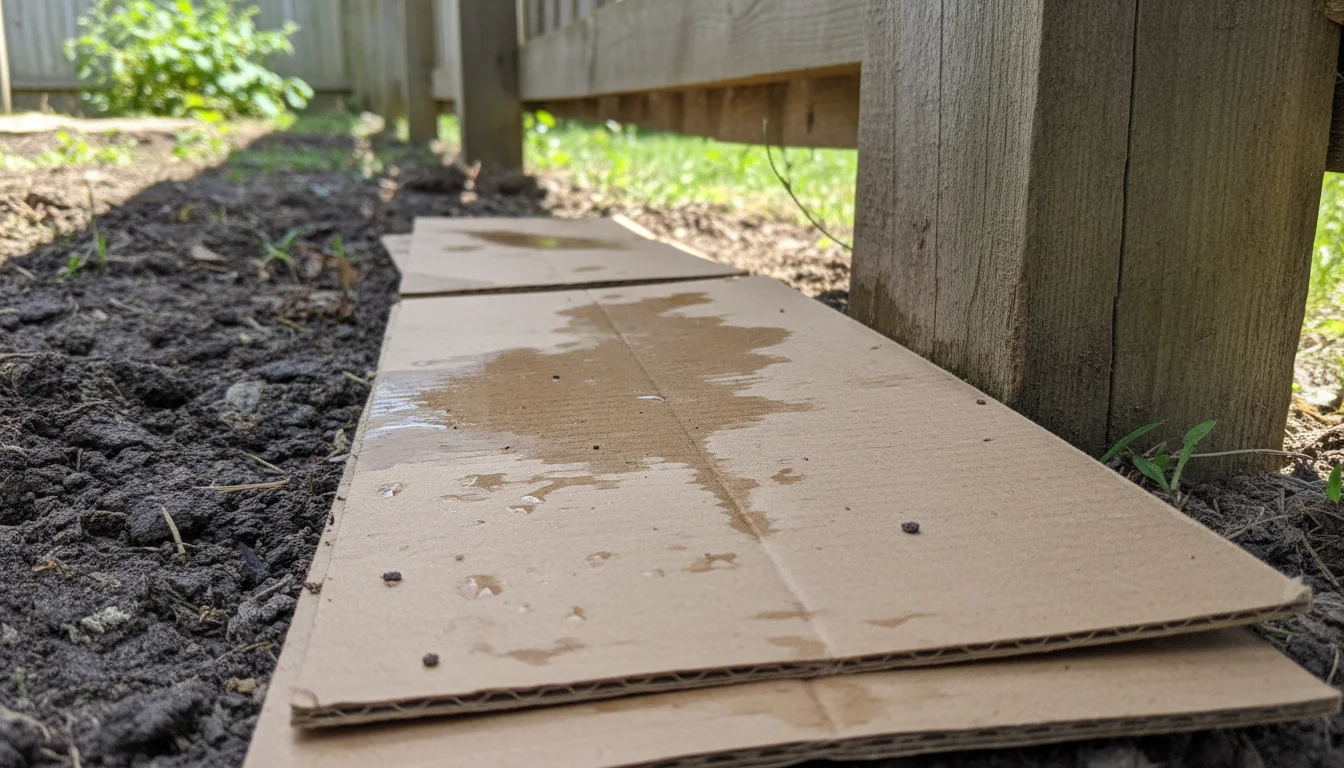
Termites are drawn to cellulose and moisture. Wet several sheets of corrugated cardboard and stack them near areas of confirmed termite activity – against the foundation, near wood-to-soil contact points, in crawl spaces. Within a few days you’ll have a cardboard stack loaded with feeding termites.
Take the entire stack outside and burn it. Repeat until you stop finding termites in fresh traps.
This won’t eliminate an established colony – the queen and the bulk of the colony aren’t coming to your cardboard trap. But it reduces active feeding numbers and gives you useful information: where the traps collect the most termites tells you where the main activity zones are. Use that information to guide where you apply other treatments. Simple, costs nothing, and takes about five minutes to set up.
Sunlight Exposure
Termites are photophobic and need moisture to survive. They build galleries inside wood precisely to avoid both light and dry air. Expose them to either and the infestation collapses.
For infested items you can move outdoors, this works surprisingly well. Drag infested furniture, boards, or wooden decorative items into direct sunlight for two to three days. UV radiation and heat kill termites while the drying conditions drive out any that don’t die outright. You’ll often find termites fleeing the wood on day one as conditions become hostile.
Only applicable to portable items – it won’t help with structural elements, walls, or floors. But for an infested piece of furniture or detached timber, it costs nothing and leaves no chemical residue. Before you dispose of an item you suspect might be infested, try two days in full sun first.
Heat Treatment
Heat kills termites at every life stage – eggs, larvae, nymphs, and adults – by denaturing their proteins and destroying cell structure. It’s a physical process that bypasses chemical resistance entirely and reaches termites inside wood where sprays can’t penetrate.
For structural infestations, professional heat treatment involves equipment that raises room temperature to 120-140°F (49-60°C) and holds it there for several hours, ensuring the heat penetrates into wall cavities and wooden members. Typically costs $1,000 or more for a single room, with whole-house treatments considerably higher. It’s thorough and you’re done in a day – no residue, no repeated applications.
For portable items – furniture, wooden decorative objects, small structural pieces – a heat chamber or a closed vehicle parked in direct sun on a hot day can reach effective temperatures. Household items like clothing or bedding contaminated with termite activity can be treated in a dryer on high heat for 30 minutes.
The practical limitation is reinfestation. Heat clears what’s present, but if the colony source isn’t addressed – typically subterranean termites entering through the foundation – the problem returns. Heat treatment works best as part of a complete treatment plan, not as the only intervention.