Table of Contents
High humidity in house is a fixable problem, but the target matters: 40-50% relative humidity. Below 30% and your sinuses dry out; skin cracks and woodwork shrinks. Above 60% and mold can establish itself on surfaces within 24-48 hours – that’s not a metaphor, that’s how fast it moves. If you don’t own a hygrometer, that’s the first $10 to spend. A digital one from any hardware store works fine. You need an actual number, not a guess about whether the air feels sticky. Everything below is aimed at getting that number down and keeping it there.
1. Fix Leaks Immediately
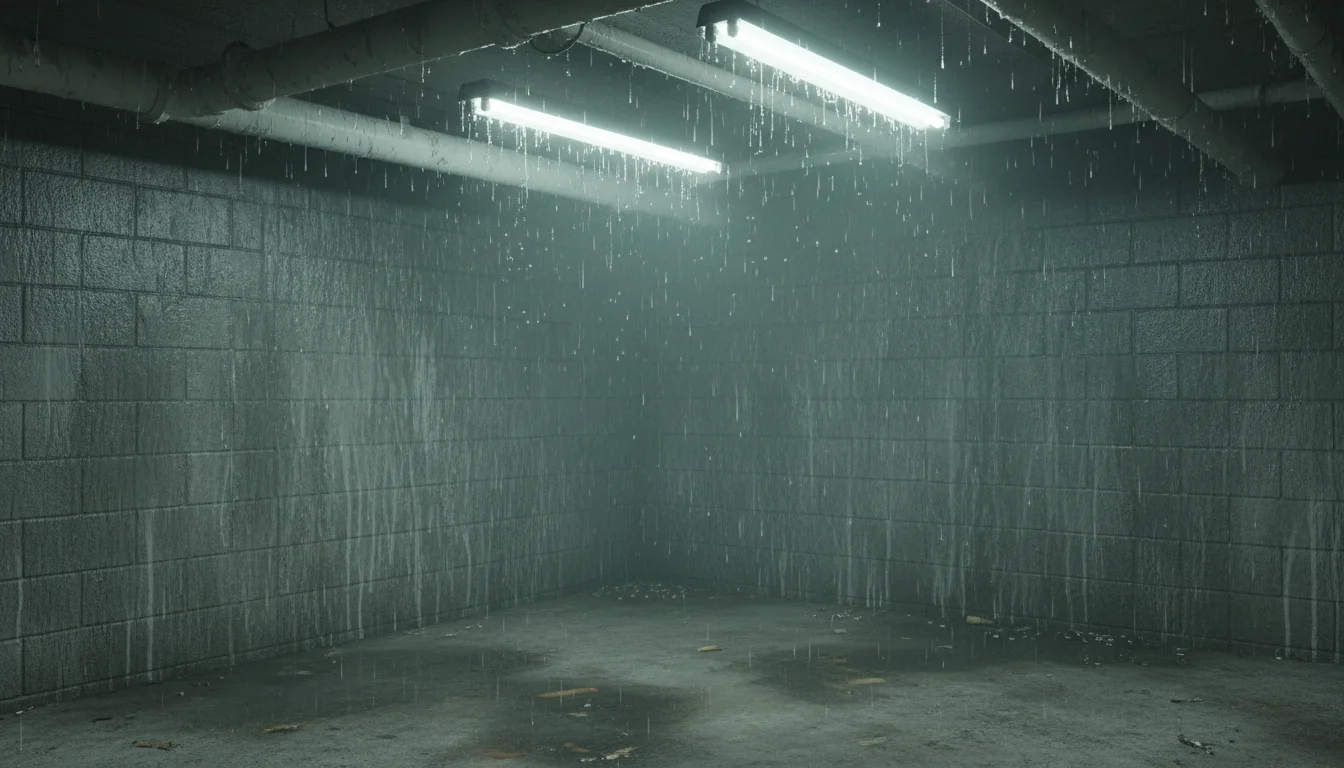
Before anything else. Leaky pipes, dripping faucets, and condensing supply lines add water vapor to the air continuously. Fix them and the moisture source disappears. Run a dehumidifier without fixing a leak and you’re just fighting a slow drip with a bucket.
Check under sinks, around the base of toilets, at washing machine hoses, and at water heater connections. Wrap cold supply pipes in foam insulation to stop condensation dripping – the cold surface chills the air around it to the dew point, and that moisture drips. Even a slow drip adds significant moisture over 24 hours.
2. Run a Dehumidifier Continuously
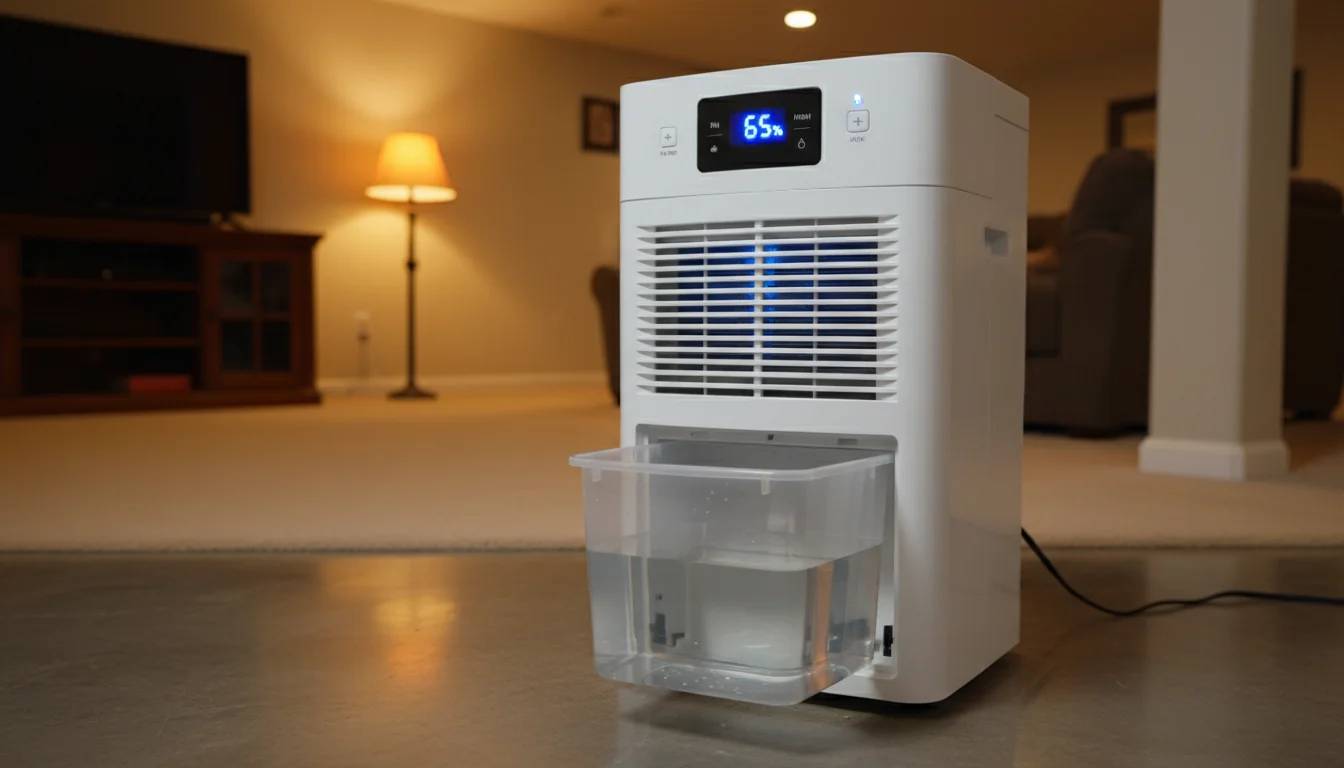
The most direct active fix once leaks are handled. Set it to 30-50% RH and leave it running. Empty the reservoir daily, or route a drain hose to a floor drain so you don’t have to think about it.
Size matters more than most people realize. A damp basement needs 30-50 pint capacity per 1,000 sq ft (93 sq m). An undersized unit runs constantly and barely keeps up. Run it year-round, but especially through summer when outdoor humidity is high – your AC does some dehumidification as a side effect of cooling, but it’s not enough on its own in humid climates. You’ll notice the smell improving within a few days once humidity drops below 60%.
3. Run Exhaust Fans in High-Moisture Areas
Kitchens and bathrooms generate more humidity per square foot than anywhere else in the house. Without proper exhaust, that moisture disperses through the whole home.
Turn on the range hood before you start cooking, not after you notice steam. Run it for 10-15 minutes after you’re done – that’s when residual evaporation peaks. Bathroom fans should run during showers and for at least 20 minutes afterward. Moisture continues evaporating from wet surfaces long after you step out. Most people turn the fan off when they leave the room, which leaves 80% of the work undone.
A timer switch for the bathroom fan is worth installing. Set it for 20 minutes and stop thinking about it. Some fans now have humidity sensors built in that turn on and off automatically – more expensive, but genuinely useful if you share the house with people who never remember to use the fan.
4. Install a Vapor Barrier in the Crawlspace
This one has the biggest impact for houses built on a crawlspace. Exposed soil continuously releases moisture into the air above – even in apparently dry conditions, the soil holds water from rain, irrigation, and the water table, and it evaporates upward constantly.
A vapor barrier – 6-mil polyethylene sheeting from any hardware store – laid directly on the soil stops this. Cover the entire soil area, overlapping seams by 12 in (30 cm) and taping them with foil tape. Run the sheeting 6 in (15 cm) up the foundation walls and secure it there. Pin it to the ground with landscape stakes or bricks at intervals to prevent it lifting.
The failure point on DIY installations is almost always the seams. An unsealed seam defeats the purpose – soil moisture finds the gap and evaporates through it. Budget an extra 30 minutes on seam work and you’ll be fine.
5. Seal Basement Walls and Floors
Bare concrete is porous. It absorbs moisture from the surrounding soil and slowly releases it into your basement air, which is why some basements smell musty even when there’s no obvious water source or visible condensation. Concrete isn’t solid – it has a network of microscopic channels that wick water from wet soil.
Clean the surfaces thoroughly first and fill any cracks, then apply a penetrating concrete sealer to floors and a waterproof masonry paint (DryLok is the common brand) to walls. Two coats on both. This cuts moisture transmission significantly. It also makes the surfaces easier to clean going forward, which matters if you’re using the basement for storage.
Don’t skip the crack filling step. Any crack that goes through the wall or floor is a direct path for soil moisture, and no surface coating will bridge an active crack.
6. Ventilation: Move Humid Air Out of the House
Opening windows on dry days helps. But here’s the mistake a lot of people make: they open windows on humid days to "air out" a humid house. If it’s humid outside, open windows make indoor humidity worse, not better. Only open windows when the outdoor humidity is lower than indoors – which means dry, breezy days, not sticky summer afternoons.
Basements without windows need a mechanical solution: an energy recovery ventilator (ERV) or a dedicated exhaust fan vented to the outside. A ceiling fan alone won’t do it – you need air exchange, not just air circulation. The ERV option is more expensive upfront but recovers heat and moisture from outgoing air, which matters in cold climates.
7. Use a Moisture Absorber
For smaller problem spots – a closet, a bathroom without ventilation, a corner where condensation always appears – passive moisture absorbers work well without electricity or noise. They’re also the right answer for rental situations where you can’t drill holes or run ducts.
DampRid or UniBond AERO 360 containers work for weeks before needing replacement crystals. Set them in corners, on windowsills, wherever condensation tends to show up. You can actually see them working: water collects visibly in the lower chamber. Replace when the crystals are mostly dissolved.
They won’t solve a whole-house humidity problem. A 500g container pulls maybe 500ml of moisture from the air before it’s saturated. A whole basement needs a dehumidifier. But for targeted spots – the wardrobe where jackets get musty, the bathroom that never dries out – they’re a no-fuss fix.
FAQ
How can I lower the humidity in my house fast?
Run a dehumidifier and close all windows and doors. If it’s humid outside, open windows make it worse. Turn on every exhaust fan you have. If the house has a crawlspace with exposed soil, covering it with polyethylene sheeting is the fastest structural fix – it can drop whole-home humidity noticeably within a few days.
What would cause high humidity in a house?
Usually a combination of moisture sources (cooking, showering, drying laundry indoors, leaking pipes) and inadequate exhaust. If you’re consistently above 65% RH, you probably have both a source problem and an exhaust problem. Check for exposed soil in a crawlspace, porous basement walls, or a slow leak you haven’t found yet.
How do I keep indoor humidity below 50%?
Fix any leaks, run exhaust fans for 20 minutes after every shower, never dry laundry indoors, and keep a dehumidifier running in problem areas. In summer, run AC – it dehumidifies as it cools. In winter, paradoxically, indoor humidity often rises because cold outdoor air is dry but indoor sources keep generating moisture with nowhere to go.
Why is my house at 70% humidity?
Likely poor ventilation combined with moisture generation from normal household activity (cooking, showering, breathing) with nowhere to go. If you’re consistently above 65%, check for a crawlspace with bare soil, a basement with porous walls, or a persistent slow leak. Houses at 70% RH consistently will develop mold. That’s not a "we’ll deal with it eventually" situation.