Table of Contents
Carp populations don’t shrink on their own. They’re prolific breeders – a single female can release over a million eggs in a season – and they have no meaningful natural predators once they’re over about 12 inches. Mechanical removal is the only approach that actually reduces the biomass in the water rather than just inconveniencing the fish. It requires permits, equipment, and usually professional contractors or commercial fishermen, but it’s the backbone of every serious carp management program.
Electrofishing During Spawning Season
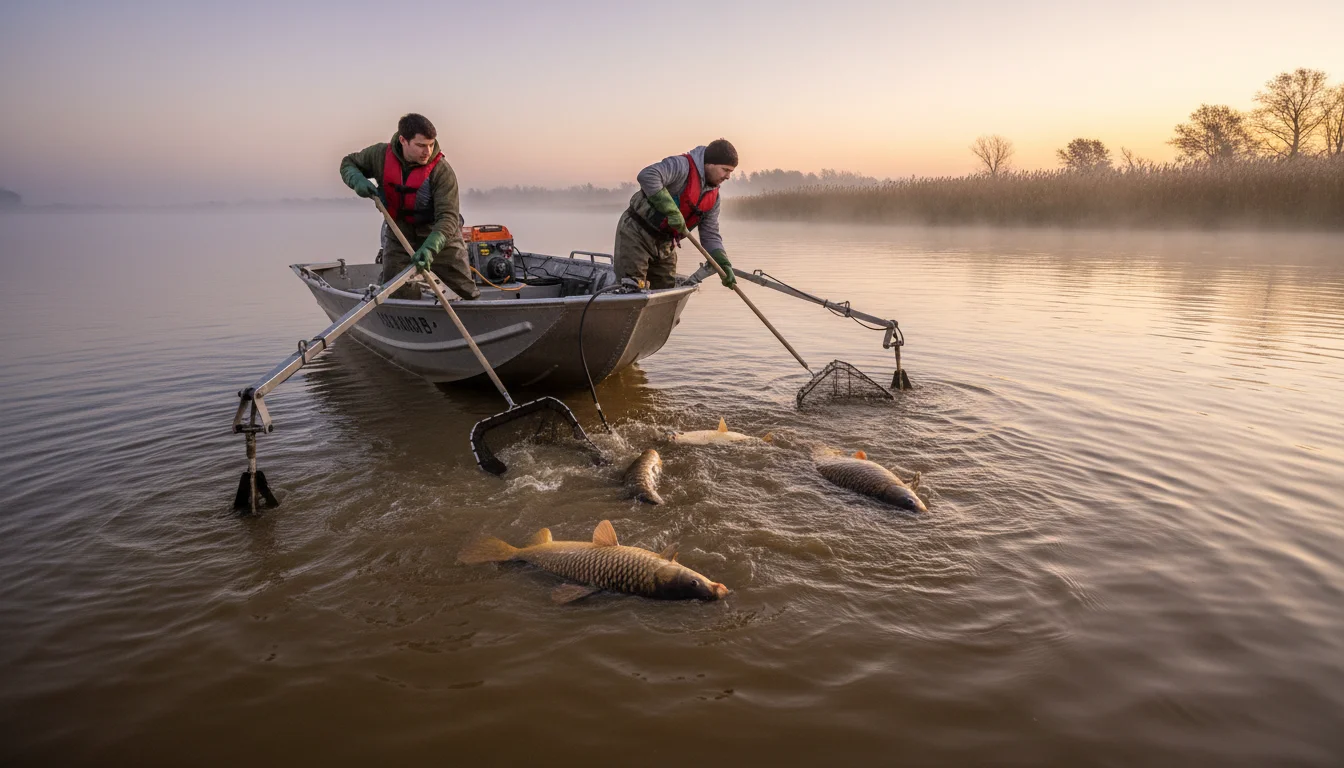
The best window for electrofishing is May through June, when carp concentrate in shallow vegetated areas to spawn. Boat-mounted equipment generates 3-6 amps of DC current that stuns fish, floating them to the surface where crew members net and remove them. A spawning aggregation that would be scattered across dozens of acres in September is compressed into a few coves and shallow flats during this period.
Focus effort on spawning areas with 1-3 ft (30-90 cm) depth. Multiple passes over a 3-4 week window can capture most of the breeding adults before they’ve deposited eggs for the season. The method is selective – carp behavior makes them disproportionately likely to be in the stun zone compared to most game fish species. Requires professional operators with licensed equipment.
Seine Netting in Open Water
A properly deployed seine net can capture large numbers of carp quickly. Optimal dimensions are 200-400 ft (60-120 m) long with 2 in (5 cm) mesh. Two boats pull the net in a wide arc, corralling fish against a shoreline or into a shallow bay where haul-in happens.
This method needs calm conditions and open water with minimal underwater structure to snag nets. Best results come from areas under 100 acres with consistent bottom contours. Plan multiple passes over the season – carp learn to avoid repeatedly seined areas, so rotate locations. Works well in combination with electrofishing: electrofish the spawning shallows in spring, seine the open water in summer.
Gill Netting with Large Mesh
Gill nets set with 3-4 in (7-10 cm) mesh catch carp by their head size while letting smaller fish pass through. Set nets perpendicular to shoreline in 8-15 ft (2.5-4.5 m) depth where carp travel, and check them every 12-24 hours. Non-target species caught incidentally need to be released quickly.
Ten to fifteen nets distributed around a lake provide ongoing removal rather than a single harvest event. Most effective during spring and fall when carp are actively moving between areas. Requires a commercial fishing license in most states. This is an attrition method – you’re removing adults across multiple seasons rather than trying to eradicate the population in one operation.
Annual Mechanical Harvest Program
For lake associations or municipalities serious about long-term carp management, an annual contracted harvest program maintains population at manageable levels year after year. Commercial fishermen rotate trap nets, gill nets, and seining through different lake zones across the season.
A realistic target is 5,000-10,000 lb (2,300-4,500 kg) of removal annually for a mid-sized lake. Primary harvest windows are April through June and September through October. Cost runs $2-5 per pound removed. This won’t eliminate carp from the lake, but it prevents the exponential population growth that eventually renders a water body unfishable. It’s a maintenance program, not a cure.
Bow Fishing Tournament Program
Organized bow fishing events are one of the cheaper ways to remove significant numbers of carp from shallow water. Schedule tournaments from May through July when carp are in 1-4 ft (30-120 cm) depth for spawning. Night events with lights are especially productive – carp are less wary, and the lights attract them.
A single tournament day typically removes 200-500 lb (90-225 kg). A series of annual events can pull 2,000-3,000 lb (900-1,360 kg) per year at minimal cost while building community engagement with the management program. Set a minimum size of 15 in (38 cm) to ensure participants are targeting carp rather than accidentally taking game fish juveniles. The sporting community becomes invested in population control, which is genuinely useful for long-term program continuity.
Commercial Harvesting and Processing Programs
The most cost-effective large-scale removal pairs with commercial operations that can move the fish into a market – fertilizer production, pet food manufacturing, or Asian food markets where carp is a desirable table fish. Payment ranges from $0.20-0.60 per pound depending on market conditions and fish size, which partially offsets program costs.
This approach works for lakes over 200 acres with established boat access for commercial equipment. Targets of 20,000+ lb (9,000+ kg) annually require year-round harvest contracts rather than seasonal events. Commercial operators handle transport in live-haul tanks. Permits and water body access agreements need to be in place before contracts are signed. Done well, this converts a serious ecological problem into a modest revenue stream.