Table of Contents
Mosquitoes are a breeding problem, not a presence problem. The ones biting you are adults that hatched from standing water somewhere within a few hundred feet of where you’re sitting. Spray as many as you want – the water is producing a new batch every week. The only way to actually reduce mosquito pressure is to remove the breeding sites, and there are almost always more of them than people expect.
That said, during peak season you can’t audit every breeding site on the block. So the answer is two-pronged: eliminate what you can control (standing water on your property, vegetation they rest in), then protect yourself and your outdoor space from what you can’t.
Standing Water Elimination
This is where mosquitoes come from. A female mosquito needs roughly a tablespoon of standing water to lay eggs, and larvae take 7 to 10 days to reach adulthood at typical summer temperatures. That means any water sitting still for a week is potentially producing mosquitoes.
Eliminate standing water with the Tip and Turn method – go around your property and tip out anything holding water, then turn it upside down or store it so it can’t collect water again. Bird baths, buckets, wheelbarrows, plant saucers, tarps, kids’ toys. This takes 20 minutes and it’s the highest-impact single thing you can do.
Empty and scrub water containers weekly. Mosquito eggs can survive drying out and hatch when water returns – just emptying containers isn’t always enough if you’re not also scrubbing the sides. A stiff brush and a quick rinse prevents the eggs already deposited from becoming larvae.
Maintain gutters and drainage. Clogged gutters holding standing water are one of the most productive mosquito breeding sites in suburban areas, and they’re completely out of sight, so people forget them. Clean gutters in spring and after heavy leaf fall. Check that downspouts drain fully and don’t create pooling at ground level.
Treat standing water you can’t eliminate with larvicide. Ponds, rain barrels, and decorative water features can be treated with Bacillus thuringiensis israelensis (Bti) – a naturally occurring bacterium that kills mosquito larvae without harming birds, fish, or other wildlife. Available as dunks (drop-in tablets) or granules. One dunk treats 100 sq ft (9 sq m) of water for up to 30 days.
Personal Protection
When you’re outside during mosquito hours (dusk and dawn primarily, but all day in some species), protection is about buying yourself comfort while the longer-term work proceeds.
Apply effective repellents. DEET at 20-30% concentration is the most studied and reliable option – it provides several hours of protection against most species. Picaridin (also called icaridin) at 20% is equally effective, odorless, and doesn’t degrade plastics the way DEET can. For those avoiding synthetics, oil of lemon eucalyptus (OLE) is the only plant-based option with CDC endorsement. Apply to exposed skin and reapply after sweating or water exposure.
Wear light and loose and long clothing during peak hours. Light colors are less attractive to mosquitoes than dark ones. Loose weaves give enough air flow that overheating isn’t a problem. This isn’t exciting advice, but it reduces bites without any chemistry.
Use mosquito nets for sleeping areas in high-pressure environments, especially during summer travel or for children’s beds near open windows. An untreated net reduces contact; a permethrin-treated net provides an additional kill barrier.
Yard and Vegetation Management
Mosquitoes rest in vegetation during the heat of the day. Dense shrubs, long grass, and leaf litter all provide daytime shelter. Reducing that shelter pushes them elsewhere.
Keep grass and vegetation trimmed, especially in the areas where you spend time outdoors. Mow regularly and cut back overgrown shrubs near seating areas. You won’t eliminate resting sites entirely, but you reduce the population density in the specific zones you care about.
Plant mosquito-repelling plants near seating areas and entry points. Citronella grass, lavender, basil, lemon balm, and catnip all contain compounds mosquitoes dislike. These aren’t force fields – don’t expect a circle of citronella pots to create a barrier. But as one element of an overall approach, near seating and near doors, they’re a useful passive measure.
Traps, Barriers and Deterrents
The remaining tools are about creating a less hospitable outdoor environment and catching adult mosquitoes.
Use outdoor mosquito traps that attract and capture adult mosquitoes using CO2, light, or heat. Propane-based CO2 traps (like Mosquito Magnet) are the most effective for reducing local population density in a yard-scale area. They work best deployed continuously and positioned between the breeding source and where you spend time. They’re an investment but they genuinely reduce pressure over a season.
Repair damaged screens on windows and doors. This is the simplest indoor protection measure, and torn screens are more common than people admit. Check yours in spring and patch or replace before mosquito season.
Use fans to create air barriers around outdoor seating. Mosquitoes are weak fliers – a sustained breeze of 2 mph (3 km/h) or more significantly reduces landing rates. An oscillating fan pointed at ground level (where mosquitoes approach low) around a patio seating area is one of the most underrated tools in this whole category.
Burn citronella candles or torches near outdoor seating. The effect is real but limited to a close radius – roughly 6 to 10 ft (2-3 m) from the flame. Use them as an atmospheric measure in combination with repellent on skin, not as a replacement for it.
Swap to yellow bug lights at outdoor fixtures. Standard white light attracts insects including mosquitoes. Yellow LED bug lights are less attractive to most insects. It won’t eliminate the problem but it reduces the draw to your entry points and outdoor areas.
When to Call a Professional
For persistent yard pressure that DIY approaches haven’t reduced, a pest control service offering barrier sprays – typically pyrethrin-based, applied to vegetation where mosquitoes rest – can knock down local populations significantly. Treatment holds for 3 to 4 weeks and is typically reapplied monthly during season. It’s not a permanent fix and it kills other insects too, so weigh that against the severity of the problem.
Mosquito control districts in many areas also handle large-scale standing water issues (drainage problems, neighborhood-level breeding sites) that individual homeowners can’t address. If your problem is originating from a ditch, a neighbor’s neglected pond, or municipal drainage, a call to the local vector control authority is the right move.
Where It Shows Up
Mosquitoes from standing water – the source-elimination approach. Covers the Tip and Turn method, scrubbing containers to remove eggs, gutter maintenance, and treating water features and rain barrels with Bti larvicide. If you want to reduce the population before it reaches you, start here.
How to get rid of mosquitoes from standing water
Mosquitoes with personal protection – when you can’t wait for source elimination to work or when you’re dealing with mosquitoes from beyond your property. DEET vs. picaridin vs. OLE, clothing choices, mosquito nets, fans as physical barriers, and screen repair.
How to get rid of mosquitoes with personal protection
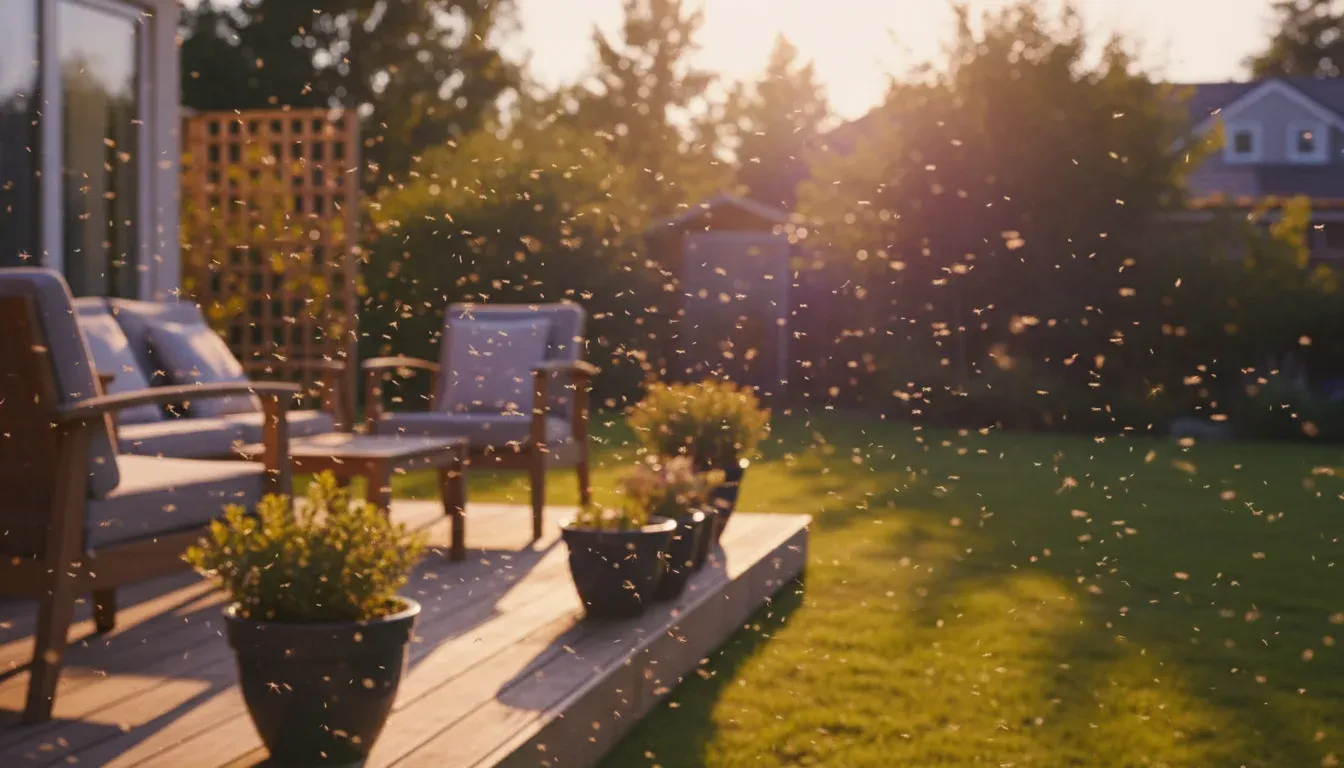
Mosquitoes in yard – the outdoor environment side. Grass trimming, repellent plants, outdoor traps, citronella, and swapping to yellow lights. Methods that make your yard less hospitable and give you more comfortable outdoor time.