Table of Contents
If you need to know how to get rid of scale insects, the first thing to understand is why spraying hasn’t worked. Adult scales secrete a hard waxy shell that most contact sprays can’t penetrate. You can drench the plant in insecticide and watch nothing happen, because the active ingredient never reaches the insect under the shell.
Sprays kill crawlers – the tiny mobile juveniles that haven’t yet formed their shell. Adults you have to physically remove or smother with oil. If you’ve been spraying and seeing no progress, you’re not doing it wrong, you’re just using the wrong approach for the life stage you’re dealing with.
The six methods below are ordered by what works best first, with the last-resort option at the end.
1. Scrape Them Off
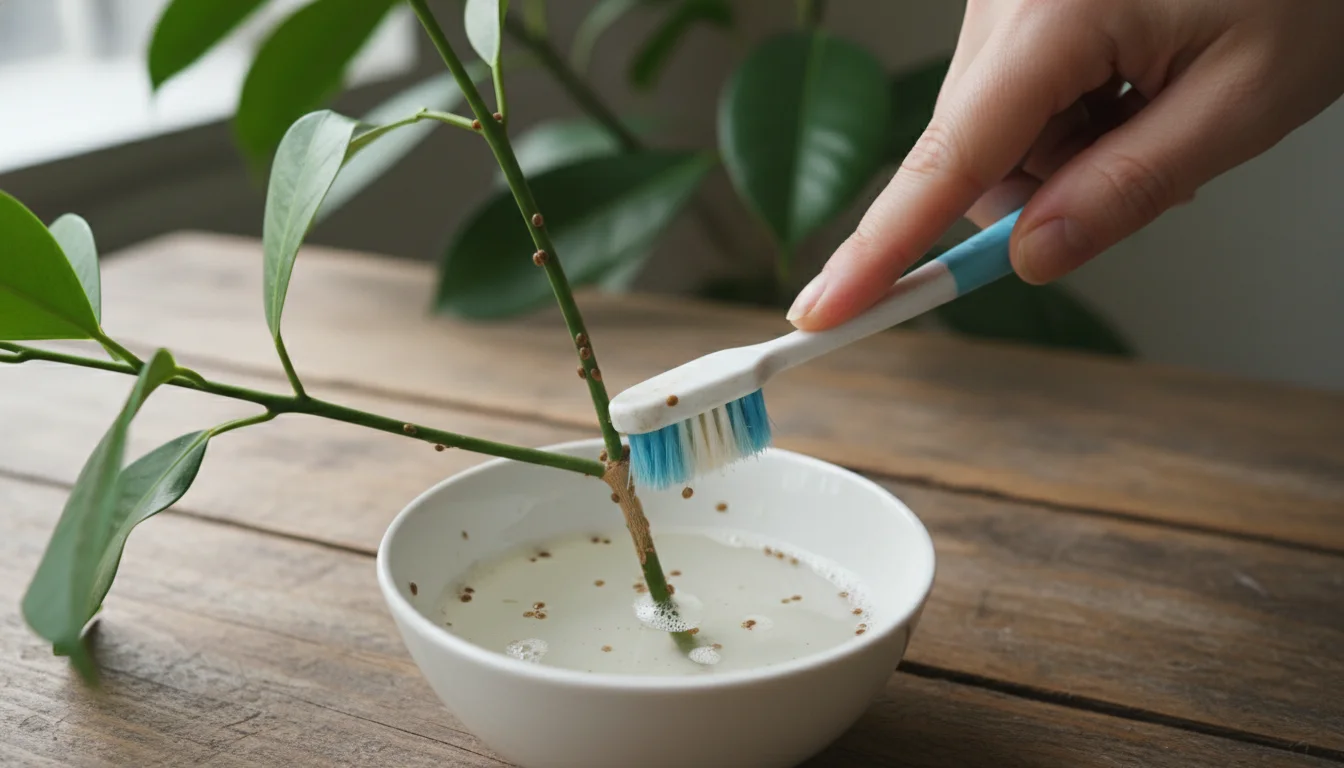
The most direct approach, and often the most effective on established infestations. A soft toothbrush, wooden skewer, old credit card, or your fingernail will do it. Work section by section over a container of soapy water and dislodge scales directly into it – they drown within minutes. The waxy armor that protects them from sprays does nothing against mechanical removal.
After the scraping pass, go over the plant with cotton swabs dipped in 70% isopropyl rubbing alcohol. The alcohol penetrates the waxy coating and kills adults you missed plus the tiny crawlers that are nearly invisible to the naked eye. Pay extra attention to stem joints, leaf nodes, and the undersides of leaves where scales concentrate – these are the spots that get missed in a quick inspection.
Rubbing alcohol is also useful for isolated infestations on houseplants. If you only have a few scales on one stem, a cotton swab with 70% isopropyl applied directly to each one is faster than mixing a spray. The scale dies on contact.
Recheck the plant every 3-5 days for a few weeks. Scraping doesn’t get eggs, and new crawlers hatch continuously during the growing season. Follow up with an oil spray (method 2) a few days after scraping to catch any survivors before they develop their armor. Scraping + oil is more effective than either approach alone.
This works well on houseplants and smaller ornamentals. For a large heavily infested outdoor shrub or tree, scraping alone isn’t practical – use horticultural oil as the primary treatment.
2. Apply Horticultural Oil
Horticultural oil is the best spray option for scale because it works differently from insecticides – it suffocates by physically clogging the pest’s breathing pores rather than delivering a toxin. This means even armored adults can be killed if the oil makes direct contact and holds long enough to do its work. Unlike most insecticides, there’s no resistance risk because it’s a purely mechanical kill.
Spray every surface until dripping wet – stems, undersides of leaves, branch joints, leaf axils. The oil must physically contact the pest to do anything, so coverage matters more than volume. Thin, even coverage of every surface beats heavy spray on visible areas only.
Timing makes a significant difference. For outdoor plants, dormant-season applications (late winter before new growth appears) are highly effective because the oil coats overwintering adults and eggs with no leaf interference. During the growing season, the optimal spray window is when crawlers are active – typically late spring to early summer for most species. Crawlers have no protective coating and die easily on contact with oil. The hard part is catching them before they armor up, which happens within a week or two of hatching.
For indoor houseplants, seasonal timing matters less since conditions are consistent year-round. Apply when you see active infestation and repeat every 7-10 days.
Don’t spray on heat-stressed or drought-stricken plants, and avoid temperatures above 85°F (29°C). Oil residue can accumulate on foliage and interfere with gas exchange. Wait at least two weeks between applications. Most infestations need 2-3 rounds to break the cycle – you’re trying to hit multiple hatching generations before each one can armor up. If you stop after one application and the population drops but doesn’t clear, you’ll be back at square one within weeks.
3. Prune Heavily Infested Branches
If a branch has dense scale coverage across most of its surface area, cut it off and bin it. Don’t compost it – scales can survive in the pile and spread via finished compost.
Pruning removes a large portion of the population in one move and leaves fewer targets for follow-up treatment. Prune back to a healthy bud or branch junction. Disinfect your pruners between cuts with a 70% alcohol wipe, particularly if working on multiple plants – you can mechanically spread crawlers on blades without realizing it.
Most plants handle targeted pruning without issue. A rose or ficus that looks bad after cutting usually rebounds faster than one kept intact while fighting a persistent infestation.
4. Quarantine the Plant
The moment you confirm scale, move the plant away from your others. Not to a different shelf – to a different room. Scale crawlers are tiny enough to travel on air currents, clothing, and tools. Neighboring plants are already at risk if they’ve been sitting close for more than a week.
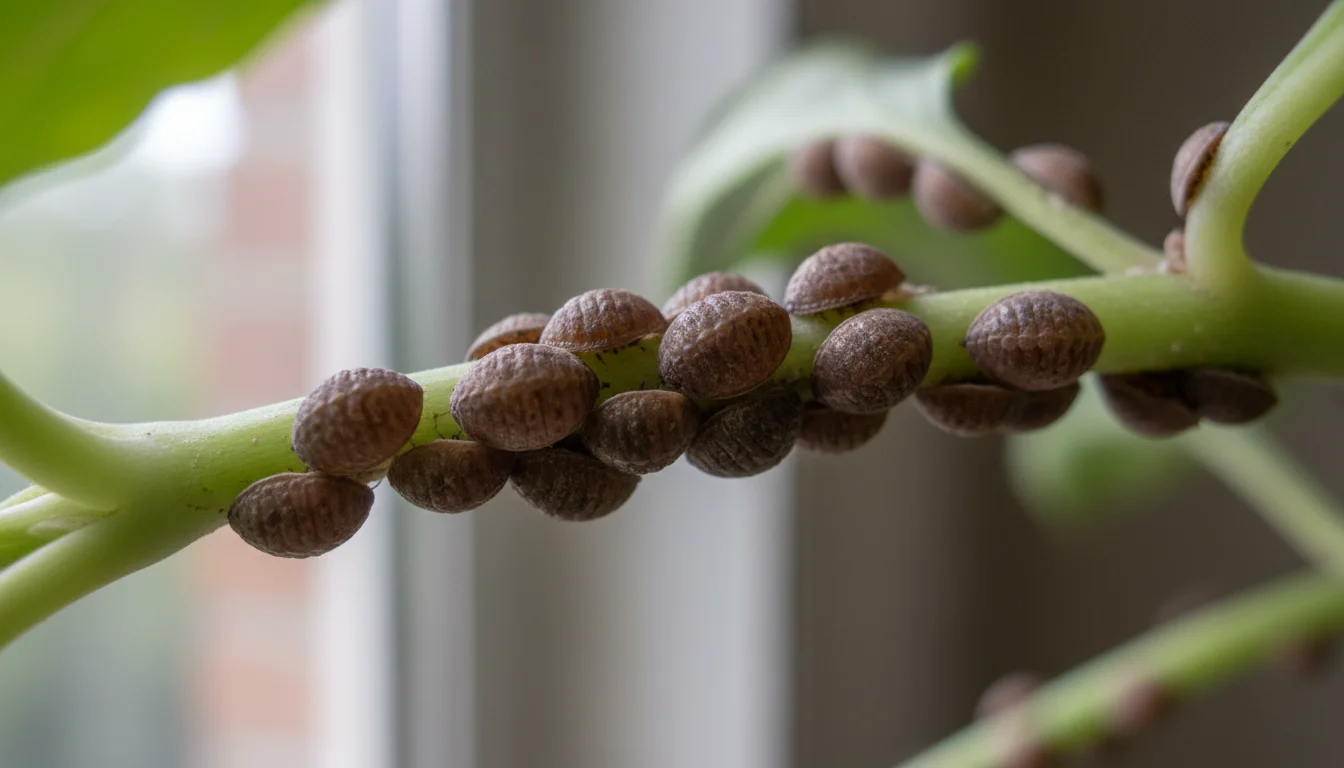
Check every plant near the infested one for sticky honeydew residue (a scale byproduct that coats surfaces below infested plants), sooty mold growing on that residue, or the scales themselves – brown or tan bumps that don’t wipe off, often along stems or the midrib of leaves.
Wipe down the surface where the infested plant was sitting with soapy water. Don’t return the plant to your collection until you’ve had two full weeks with no new damage and no live scales. Two weeks – not "when it looks better."
5. Inspect Incoming Plants Before They Join the Collection
Scale infestations usually arrive on new plants. Nurseries aren’t always clean, and online-shipped plants can carry crawlers that are nearly invisible at purchase.
Before bringing any new plant indoors, check the undersides of leaves, along stem joints, and at branch nodes. Look for small brown or tan bumps that don’t rub off, sticky residue, or sooty mold on leaves below. Quarantine new plants for two weeks before placing them near your existing collection regardless of whether you see anything. Spray with diluted dish soap (1 tablespoon per 1 quart / 1 L of water) as a precaution even on plants that look clean.
Stopping a pest at the door costs five minutes. Eliminating one that’s spread to six other plants costs weeks.
6. Discard the Plant
This isn’t giving up – it’s correct triage. When an infestation has colonized every stem and leaf junction, and you’ve treated twice without meaningful reduction, the plant has become a liability. Indoor environments lack the parasitic wasps and predatory beetles that control scale populations outdoors. A heavily infested houseplant can cycle indefinitely as a reservoir for reinfestation.
Bag the plant tightly in plastic before moving it. Crawlers can drift on air movement during transport and land on adjacent plants. Seal the bag in the room before you carry it out.
Don’t compost it. Discard in the general waste bin. Wipe down the shelf or windowsill with soapy water afterward and check neighboring plants closely for the next 2-3 weeks.
Prevention
The lifecycle is your leverage. Scales reproduce continuously in warm indoor environments with no seasonal die-off to reset the population. Crawlers – the tiny mobile juveniles before they develop their shell – are the only stage that contact treatments kill easily. Your goal is to intercept infestations at the door and catch any crawlers before they establish.
Inspect all incoming plants. Every one, every time. Check undersides of leaves, stem joints, and branch nodes for the small brown bumps that don’t rub off, sticky residue on surfaces below the plant, or sooty black mold growing on that residue. Two weeks of quarantine before joining your collection isn’t paranoid – it’s the only reliable way to prevent a new plant from seeding your entire collection.
For outdoor plants, apply horticultural oil during the dormant season before new growth starts. This is the single most effective timing and reduces the base population before the active season begins. Many gardeners who treat reactively (when they see damage) would get better results treating preventively in late winter instead.
Avoid broad-spectrum insecticides for general pest control. Pyrethroids and carbamates kill parasitic wasps that naturally predate scale crawlers outdoors. A well-functioning garden ecosystem controls scale passively – until one blanket spray for aphids or grubs wipes out the predator population and the scale explodes the following season.
Frequently Asked Questions
How do I permanently get rid of scale bugs?
Break the cycle over 4-6 weeks. Horticultural oil applied every 7-10 days hits newly hatched crawlers before they armor up. Pair with regular scraping for adults. Outdoors, dormant-season oil application reduces the base population before the season even starts. One treatment won’t do it – you need to outlast multiple generations.
Does Dawn dish soap kill scale on plants?
It kills crawlers on contact. Mix 1 tablespoon of plain dish soap (no degreasers or antibacterial additives) per 1 quart (1 L) of water and spray directly onto pests. Less effective on armored adults because the soap can’t penetrate the shell. Use it as a supplement to scraping, not a replacement.
Does vinegar kill scale bugs?
No reliable evidence it does, and diluted vinegar can burn plant tissue. Skip it.
What about Sevin (carbaryl) spray?
Sevin kills crawlers on contact but has no residual effect on armored adults. It also kills parasitic wasps that naturally control scale populations outdoors, which tends to make the long-term problem worse. Horticultural oil is a better choice for both indoor and outdoor plants.
Can scale insects spread to other plants?
Yes, during the crawler stage. Crawlers are tiny – barely visible – and mobile. They spread on air currents, on your clothing when you brush against an infested plant, and directly between plants that are touching or very close. An infested plant that sits next to your other houseplants for a week has almost certainly already spread crawlers. Quarantine immediately when you find scale, check every neighboring plant carefully, and don’t return the treated plant to the collection until it’s been clean for two full weeks.
What does scale look like?
Brown, tan, or white bumps along stems, branches, and the underside of leaves. They look like part of the plant until you try to rub them off – healthy tissue doesn’t come off in a small oval flake, but a scale insect will. Armored scales are flat and oval, about 1-3mm. Soft scales are rounder and often have a visible body under the coating. A reliable sign is sticky honeydew residue on leaves below the infestation, or sooty black mold growing on that residue.