Table of Contents
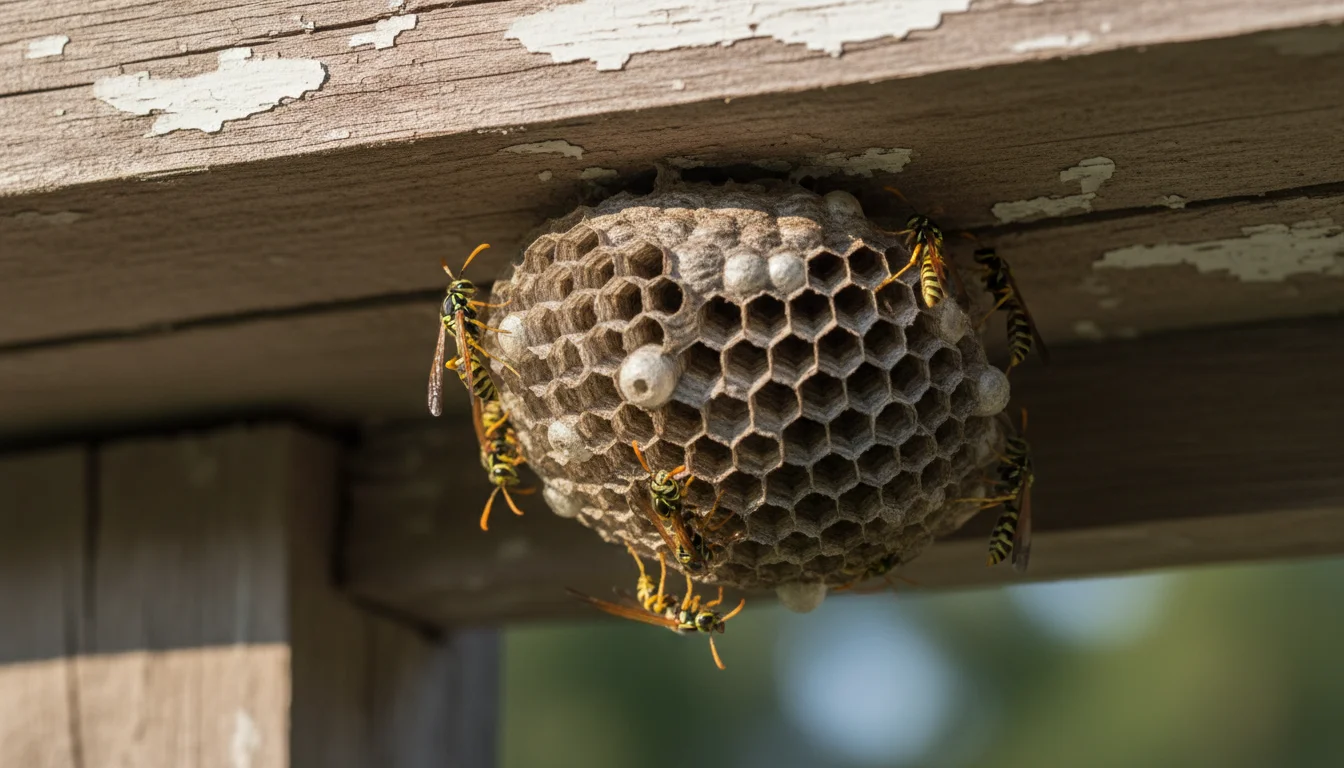
How to get rid of wasps depends almost entirely on where the nest is and what type you’re dealing with. An aerial nest under your eaves is a different problem from a colony tunnelled into your lawn, and both are different from wasps getting in through a gap in your siding. The right approach for one will do nothing for another.
Most people jump straight to buying a can of spray. That works for an exposed nest under the eaves, but it’s useless against a colony 8 inches (20 cm) underground, and it’s overkill for a couple of wasps buzzing around your deck. The method has to match the situation.
This page covers 24 methods across every wasp scenario you’ll run into. We’ve split the detail into two focused guides – one for removing visible nests and one for ground-nesting wasps – because the methods, timing, and risks are genuinely different. Below is the overview: what each approach category does, when it works, and which guide to read next.
Chemical Treatments
The fastest way to kill a colony. Commercial wasp sprays with 20+ foot (6 m) reach handle most aerial nests from a safe distance. For ground nests, aerosol spray aimed directly into the entrance hole works, but insecticide dust (applied with a squeeze-bulb duster) is often better because it coats the tunnels and keeps killing for days. Diatomaceous earth is the non-chemical alternative in this category – slower, but it works on ground nests and doesn’t introduce synthetic pesticides.
Specifics matter here. Aerosol sprays with a directional straw reach into wall cracks and brick gaps where a standard cone nozzle can’t. Dust applied with a squeeze-bulb duster works its way through tunnel networks over several days, killing wasps that contact it long after you’ve walked away. And diatomaceous earth (the food-grade kind) damages their exoskeleton on contact – slower than synthetic options, but it won’t contaminate soil around garden beds.
The shared rule across all chemical approaches: treat at dusk. Wasps are inside the nest and sluggish from the temperature drop. Daytime treatment is a good way to get swarmed.
Physical Removal
Boiling water poured into a ground nest entrance kills on contact. It’s free, it’s immediate, and it needs no special equipment – but it only works on nests you can pour directly into. For aerial nests, physical removal means cutting the nest down after the colony is dead (never while it’s active). Flooding works on shallow ground nests where you can saturate the whole cavity.
None of these have residual effect. If the queen survived, they’ll rebuild. Plan for two or three treatments on consecutive days with boiling water. With physical removal, wait until the colony is confirmed dead (24 hours minimum after chemical treatment) before you touch anything.
Traps and Contact Kills
Traps don’t eliminate colonies – they intercept foragers. A sweet bait solution (fruit juice, vinegar, sugar) in a commercial trap positioned 20 feet (6 m) from where people sit reduces the wasps you actually encounter. Dish soap in a spray bottle is the contact kill option: it coats their spiracles and suffocates them in minutes. Good for picking off individual wasps when you can’t find or reach the nest.
Both are supplementary. Use them alongside a primary method, not instead of one.
Deterrents and Prevention
Peppermint oil is the most documented wasp repellent. Spray it around potential nesting sites in early spring before colonies establish – eaves, fence posts, deck supports. Fake nest decoys exploit territorial behaviour (wasps avoid areas where another colony appears to be). Sealing entry points (gaps in eaves, fascia, soffits) and removing attractants (fallen fruit, open bins, lawn debris) reduce the odds they’ll set up in the first place.
Prevention works before nesting season. March through early May is the window, when queen wasps are scouting for nest sites. Once a colony is established (typically June onwards), deterrents alone won’t shift them – you need an active removal method first, then prevention to stop the next colony from moving in.
Timing and Technique
Three rules that apply to every other method on this page. Treat at evening when the colony is home and sluggish. Don’t shine a flashlight directly into the nest entrance (it agitates them – use a red-filtered light or memorise the location while it’s still light). And wait a full 24 hours after treatment before declaring victory – some methods take time to work through the colony, and premature removal gets you stung.
Professional Removal
Call someone when the nest is inside a wall void (requires drilling and injection), when you’re dealing with multiple entry points from a split colony, when the nest is in a high or awkward location, or when anyone nearby is allergic to stings. Yellow jackets in late summer are worth escalating – by August the colony is large, food-stressed, and aggressive. Cost is typically $150-400 (USD).
Where It Shows Up
Wasp nest removal covers 14 methods for accessible nests – under eaves, on branches, in sheds, in wall voids, on porches. Sprays, traps, decoys, physical removal, sealing entry points, and when to call a professional. This is the guide for most situations: you can see the nest (or you know roughly where it is), and you need it gone. It covers paper wasps, yellow jackets with aerial nests, and hornets.
Ground wasps covers 10 methods specific to nests built in the ground – yellow jackets and digger wasps that burrow into lawns, garden beds, stone walls, and root systems. The approach is different because you’re working with a hole in the ground rather than an exposed structure. Timing matters more (ground-nesters are aggressive when disturbed during the day), and application angles are trickier. Start here if the nest entrance is a hole in your lawn, near tree roots, or along a path edge.
FAQ
What will keep wasps away?
Peppermint oil around potential nesting sites in early spring, before colonies establish. Seal gaps in eaves, fascia boards, and exterior walls – wasps colonise existing cavities. Keep outdoor bins lidded and clear fallen fruit. Fake nest decoys deter scouting queens in spring. Traps reduce forager pressure through summer but won’t prevent nesting.
Why does WD-40 kill wasps?
It’s petroleum-based. Sprayed on wasps it coats their spiracles (breathing pores) and suffocates them – same mechanism as dish soap. It works, but it’s messy and leaves an oily residue. Dish soap in a spray bottle does the same thing, cheaper and cleaner.
Why shouldn’t you kill wasps?
They’re predators – they hunt caterpillars, flies, and other soft-bodied insects, which makes them useful around gardens. Paper wasp colonies die off naturally every autumn. If a colony is nesting somewhere low-traffic, leaving it alone is reasonable. The aggressive-wasp problem is usually yellow jackets specifically, in late summer when the colony is large and natural food sources thin out.
What smell do wasps hate?
Peppermint oil most consistently. Clove, lemongrass, and geranium also show documented repellent effects. The effect is on nesting site selection and territory avoidance, not on forager behaviour at close range – a dab of peppermint oil won’t stop a wasp that’s already after your sandwich.
When are wasps most aggressive?
Late summer, roughly August through September. The colony is at peak size, natural food sources (caterpillars, other insects) are declining, and workers shift to scavenging human food and sugary drinks. This is when most stings happen. Early in the season (May-June), wasps are focused on building and provisioning and largely ignore people unless you’re near the nest.
Do wasps come back to the same nest?
No. Wasp colonies die off every autumn – only newly mated queens survive the winter, and they start fresh nests in spring. But they often choose similar locations. If you had a nest under your eave last year, a new queen might pick the same spot. That’s why prevention (sealing gaps, applying repellent in early spring) matters even after you’ve successfully removed a nest.