Table of Contents
The biggest mistake with brick stains is reaching for the strongest cleaner first. Most people default to acid or a pressure washer when a stiff brush would’ve done it in five minutes. The second biggest mistake is using the wrong method for the stain type – vinegar won’t touch heavy efflorescence, and muriatic acid won’t do anything for algae. Figure out what you’re dealing with first. The method follows from that.
Types of Brick Stains (and Which Method Fixes Each)
You can narrow down the method by identifying the stain type. Most brick stains fall into one of five categories, and each responds to a different chemistry. Picking the wrong one wastes time and can sometimes make the stain worse (acid on rust, for example, darkens it).
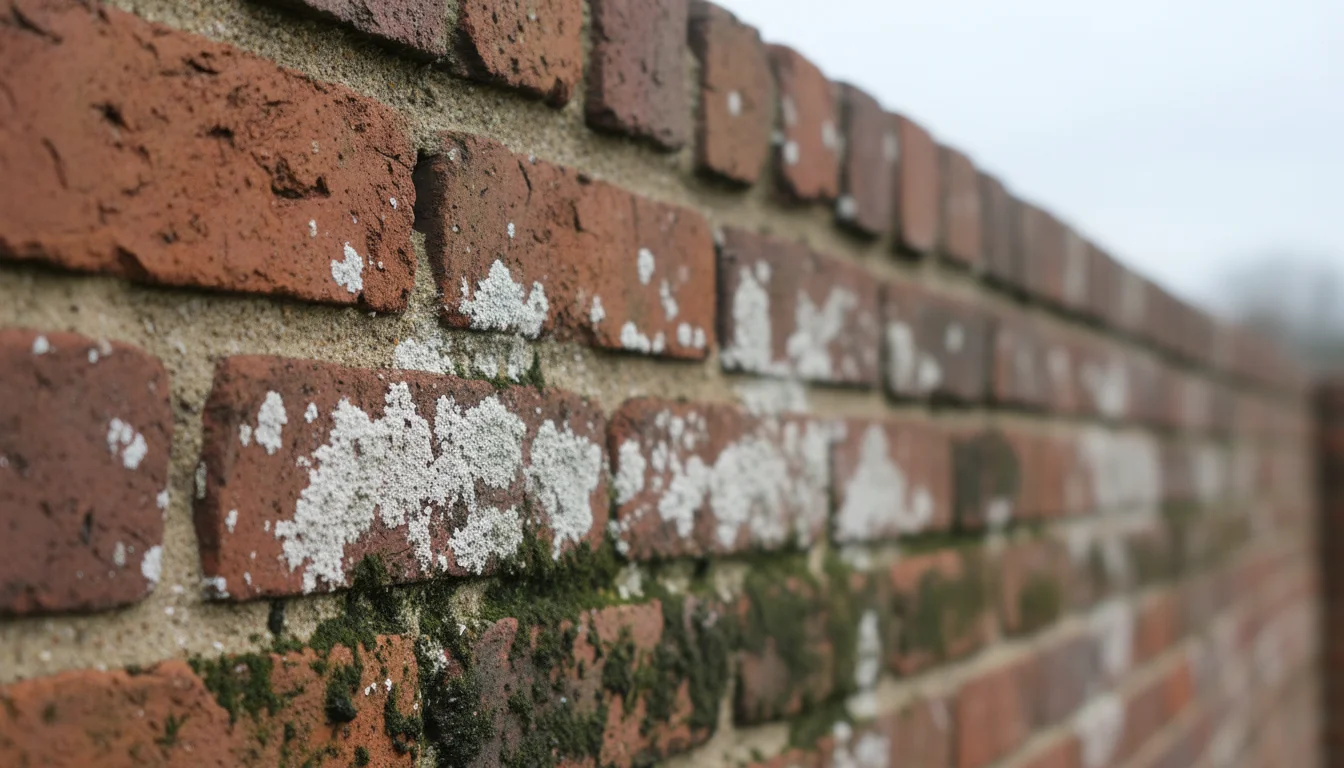
White or grey powdery deposits (efflorescence): salt crystals migrating through brick as moisture moves out. Needs an acid to dissolve. Vinegar for light deposits, muriatic acid or commercial masonry cleaner for heavy ones.
White haze or rough patches (mortar haze): residue from mortar or grouting work. Also acid-soluble. Commercial brick cleaner handles this cleanly.
Green or black growth (algae, moss, mold): organic staining. Responds to alkaline or bleach-based cleaners, or strong vinegar. Acid-based cleaners won’t do much here.
Grey-brown general grime (atmospheric soiling): traffic pollution, dust, general weathering. Pressure washing or a stiff brush handles this. No chemistry needed.
Orange-brown streaks (rust): from rebar corrosion or iron-rich water. Needs oxalic acid specifically – none of the standard methods below will shift it.
Now pick your method.
1. Stiff Brush Dry Scrub
Always start here, before anything wet or chemical touches the surface.
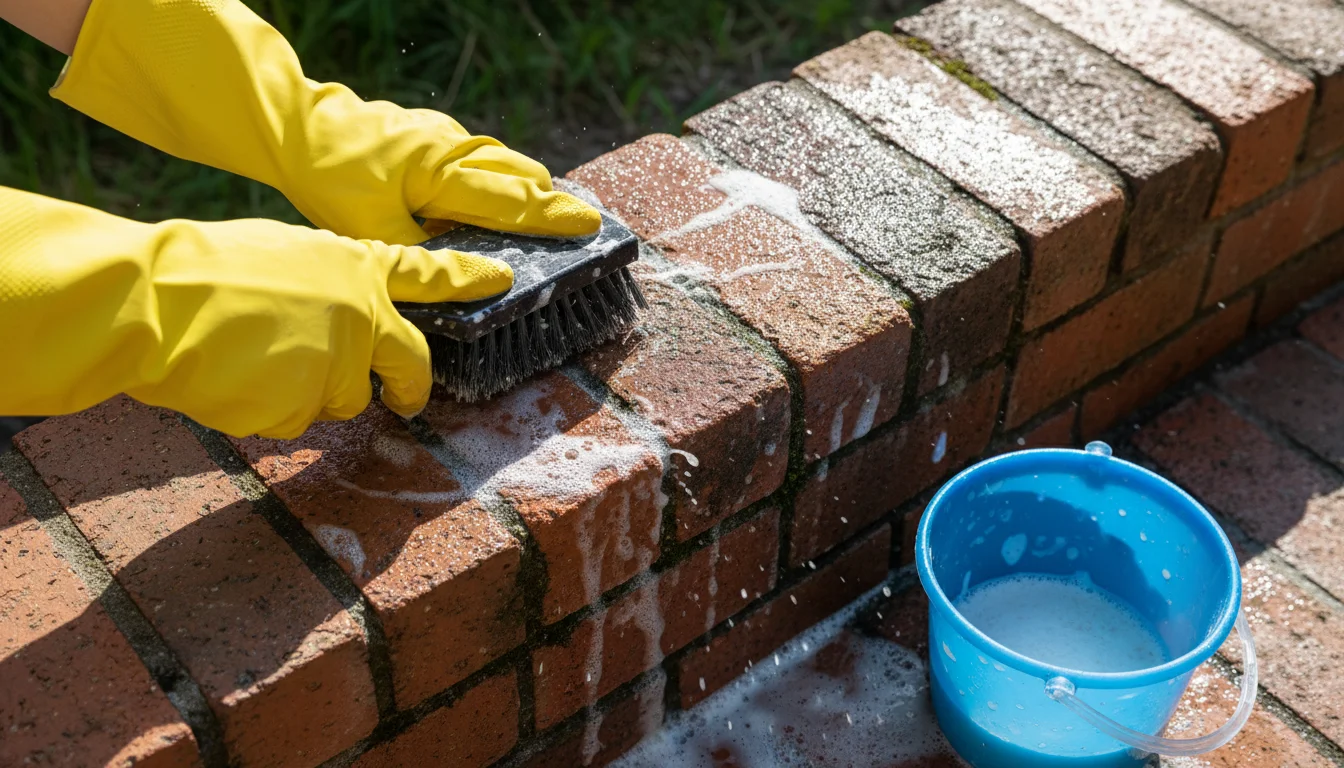
Use a stiff nylon or natural fiber brush. Not wire – wire bristles leave steel particles embedded in the brick face, which then rust and create new orange staining within weeks. Work across the stained area with firm pressure, then brush away the debris before it settles back into joints.
For dry, loose efflorescence, dry scrubbing removes most of it. The white powder comes straight off fresh deposits before they’ve bonded to the brick. For older crusted deposits you’ll need to escalate, but brushing first tells you how deep you’re dealing with and removes the loose surface layer so your chemical treatment works more efficiently.
This step also prevents a specific problem with acid methods: if you wet dusty brick with acid solution before brushing, you drive loose particles into the surface. Brush first, then treat.
2. Vinegar Cleaning Solution
White vinegar is 5% acetic acid – enough to tackle light mineral deposits, surface efflorescence, mold, and algae on brick without damaging the surface or mortar.
Mix 1 cup of white vinegar per 1 gallon (3.8 L) of water for light staining, or go 50/50 for stubborn organic growth. Pre-wet the brick with plain water first (this matters – dry brick absorbs the acid unevenly and you get patchy results). Apply the vinegar solution, let it sit for 10-15 minutes, scrub with a stiff nylon brush, and rinse thoroughly.
The honest limitation: vinegar won’t dissolve heavy efflorescence or mortar haze. The 5% acid concentration isn’t enough to break down thick mineral crusts. If light staining responds partially but doesn’t clear, that’s your signal to move to a commercial masonry cleaner or muriatic acid.
Don’t use this on natural stone borders or coping that sits next to brick – limestone, marble, and sandstone all etch with even mild acid.
3. Baking Soda Paste for Scrubbing
Good for soot staining on fireplace brick, light grime, and situations where you want abrasion without any acid. Particularly useful for interior brick where you don’t want acid fumes or runoff.
Mix 3 parts baking soda to 1 part water to form a thick paste. Apply to the stained area, let it sit for 15 minutes, then scrub hard with a nylon brush. Rinse completely.
For fireplace brick with heavy soot buildup, combine this with the vinegar method: apply the baking soda paste, then spray diluted vinegar over it. The fizzing reaction helps lift stubborn soot from the porous brick surface. Work in sections and rinse each one before moving on – baking soda residue left to dry can leave its own white marks.
This method won’t touch efflorescence or mortar staining. It’s an abrasive, not an acid, so it cleans by physical scrubbing rather than chemical dissolution. Use it for soot, grime, and anything where you want a gentle non-acid option.
4. Pressure Washing
Fast and effective for general grime, atmospheric soiling, algae, and moss – anything where you want physical force rather than chemistry. One pass over a stained wall or patio can clear years of surface buildup in under an hour.
The PSI matters for brick. Keep it at 1200-1500 PSI (8-10 MPa) for brick walls and paving. Higher pressure dislodges mortar from joints, especially on older brick or anything laid before the 1960s. If you’re unsure about the brick’s age or condition, start at 1000 PSI and test a small area.
Hold the nozzle 6-8 in (15-20 cm) from the surface and work in overlapping passes, moving the wand steadily. Don’t hold it in one spot. Use a 25 or 40-degree fan nozzle for brick surfaces – the narrow 0-degree pencil jet can cut into brick face on softer or older brick.
For large flat areas like paved patios, a surface cleaner attachment beats working with a wand. It gives even coverage, avoids the tiger-stripe pattern a wand leaves on flat concrete, and cuts the time on a big area by half.
Pressure washing removes grime and organic growth but won’t dissolve mineral deposits like efflorescence or mortar haze. If the staining persists after washing, it’s chemical rather than surface dirt and you’ll need an acid treatment next.
One follow-up step most people skip: after pressure washing brick paving, the joint sand gets displaced. Sweep polymeric sand into the joints while the surface is still clean and damp. If you skip this, weed seeds land in the bare joints within weeks and you’ll be back here sooner than you’d like.
5. Commercial Brick Cleaner
When you want predictable results without calculating acid dilutions, or when you’re treating a large area or expensive brick, a purpose-formulated masonry cleaner is the right tool.
These products come in two types and matching the type to the stain matters:
Acid-based (Sure Klean 600 Detergent, Prosoco Sure Klean 101 Lime Solvent): for efflorescence, mortar haze, lime deposits, and mineral staining. These work on the same principle as muriatic acid but at controlled concentrations designed for brick.
Alkaline or surfactant-based (products labeled "algae and mold cleaner" or "biological stain remover"): for organic staining – green algae, black mold, atmospheric soiling. Using an acid-based cleaner on organic stains won’t do much.
Pre-wet the brick thoroughly before applying any acid-based product – this is mandatory, not optional. Dry brick absorbs the acid unevenly and causes patchy etching. Apply at the recommended dilution, allow the contact time specified on the label (usually 3-10 minutes), scrub with a nylon brush, and rinse with plenty of water.
Sure Klean and Prosoco products are available at masonry supply stores. For smaller quantities, local hardware stores carry Prosoco and RadonSeal lines. Avoid generic "concrete cleaner" products not specifically labeled for brick – they’re often formulated for concrete and may be too aggressive for the mortar.
6. Muriatic Acid Wash
The most powerful option for heavy efflorescence, stubborn mortar haze, and thick mineral deposits. This is diluted hydrochloric acid – effective but unforgiving if used carelessly.
Safety first: wear acid-resistant gloves, eye protection, and work in good ventilation or outdoors. Never mix muriatic acid with bleach (produces chlorine gas). Have a baking soda solution ready as a neutralizer.
Dilute 1 part muriatic acid to 10 parts water in a plastic bucket. Always add acid to water – never pour water into acid. Pre-wet the brick wall or paving with plain water first. Apply the diluted solution with a stiff nylon brush, let it work for 1-3 minutes maximum (watch for active fizzing – that’s the acid dissolving deposits), then scrub and rinse with large amounts of water. Rinse a second time with a baking soda neutralizing solution (2 tbsp / 15g per gallon / 3.8L of water), then rinse again with plain water.
Don’t let the acid solution dry on the surface. Keep the brick wet during the process and work in sections of 3-4 sq ft (0.3-0.4 sq m) at a time. If the fizzing stops before you rinse, re-wet with plain water and keep going – you don’t want dried acid residue bonding to the surface.
After the final rinse, the brick may look slightly lighter or more textured than surrounding areas. That usually evens out as it weathers, but test on a small hidden patch first before treating a prominent wall.
This method is overkill for most domestic brick cleaning jobs. If Sure Klean or diluted vinegar haven’t shifted the staining, muriatic acid will. But start with commercial cleaner first – it gives similar results with less risk, especially if you haven’t used muriatic acid before.
FAQ
Can brick stains be removed?
Most brick stains can be removed with the right method matched to the stain type. White mineral deposits (efflorescence), mortar haze, and organic staining (algae, mold) all come off with different approaches. Deep rust stains from rebar corrosion or iron-rich water are harder and may need oxalic acid specifically. Paint and intentional brick stain products are a different category – those are designed to be permanent and won’t respond to cleaning methods.
Is brick staining permanent?
Natural staining from weathering, moisture, and organic growth is not permanent – it’s surface contamination that responds to cleaning. Intentional brick stain products (iron oxide pigments applied to change brick color) are engineered to be permanent. If you’re trying to remove a color treatment someone applied to change the brick’s appearance, that’s a restoration job, not a cleaning job.
Why spray Coca-Cola on bricks?
Phosphoric acid in cola can dissolve light mineral deposits on brick. It works on the same principle as dilute acid cleaners but at much lower concentration, so results are modest at best. It’s more novelty than method. If you’re going to use an acid on brick, vinegar (5% acetic acid) is more effective and predictable, and a commercial masonry cleaner is better still.
Does Dawn dish soap clean brick?
Dish soap helps with greasy soiling and atmospheric grime – the general dullness brick picks up from traffic pollution and weather. Mix a few drops with warm water, scrub, rinse. It won’t touch efflorescence or mortar haze because those need an acid to dissolve them, and soap is neutral pH. Use it as a first pass on general surface grime before escalating to acid treatments.